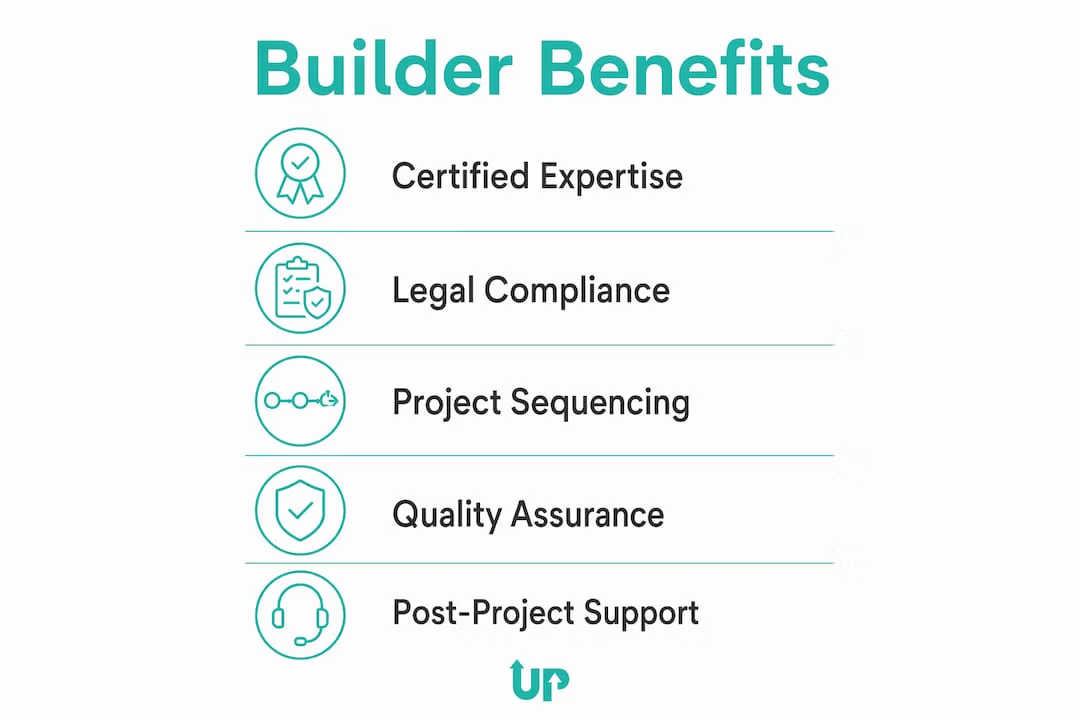
Hiring a professional builder protects your home, your budget and your legal position during a renovation, because certified builders carry the right qualifications, insurance and knowledge of UK building regulations. They also deliver workmanship that lasts long after the dust has settled.
Here is why the decision matters:
- Professional builders hold recognised qualifications, including NVQ in construction and Construction Skills Certification Scheme (CSCS) cards, verifying their competence on site.
- They manage project sequencing to prevent costly rework and trade clashes.
- They handle legal compliance under UK building regulations, planning permissions, and CDM 2015 duties, reducing your personal liability.
- They carry public liability insurance of at least £2 million, protecting you against third-party claims.
- Members of trade bodies like the Federation of Master Builders (FMB) are rigorously vetted, inspected, and continuously monitored for quality and reliability.
- They provide warranties, certificates, and snagging retention arrangements that protect your investment after completion.
- Choosing a professional builder avoids the delays, defects, and legal exposure that frequently follow unvetted or uninsured work.
How professional builders manage project sequencing
A renovation without proper sequencing is a renovation heading for trouble. Trades arriving in the wrong order, materials delivered too early or too late, and subcontractors working across each other are among the most common causes of cost overruns and delays on domestic projects. An experienced builder eliminates most of these problems before they start.
The key disciplines professional builders apply to sequencing include:
- Phased planning from the outset: Builders map the full project into logical stages, from groundworks and structural work through to first and second fix, plastering, and finishing trades, so each phase completes cleanly before the next begins.
- Subcontractor coordination: Rather than booking trades independently and hoping they align, a professional builder manages their own network of electricians, plumbers, and plasterers, scheduling them around confirmed site progress. Understanding the role of project managers in renovations makes clear how much this coordination reduces friction.
- Early identification of site-specific risks: Experienced builders spot potential complications, such as hidden services, structural anomalies, or access constraints, during the initial survey rather than mid-project.
- Milestone-based payment schedules: Payments tied to completed phases, rather than calendar dates, protect you financially. A typical structure runs 10 to 15% deposit, then 25% at foundations, 25% at roof-on, 25% on completion, and 5 to 10% of the contract sum retained for three to six months after completion to cover snagging and minor defects.
- Site supervision and quality checks: Regular inspection at each stage means defects are caught and corrected before they are buried behind plasterboard or floor finishes.
Good project scoping at the outset is what makes this sequencing possible. Without a clearly defined scope, even the most experienced builder cannot protect a project from scope creep and budget drift.
Legal and safety compliance builders handle in home renovations
This is where the difference between a professional builder and an unvetted tradesperson becomes most consequential. UK homeowners often underestimate how much legal responsibility sits with them when construction work takes place on their property.
Under the Construction (Design and Management) Regulations 2015, domestic clients are not exempt from duty. If you commission a project involving more than one contractor and fail to formally appoint a principal contractor and principal designer, those legal duties transfer automatically to whoever is in control of the work. A professional builder understands this framework and manages it on your behalf.
The compliance responsibilities a professional builder handles include:
- UK building regulations and planning permissions: Builders submit applications, liaise with local authority building control, and ensure all notifiable work is inspected and signed off correctly.
- CDM 2015 duties: On multi-contractor projects, professional builders take on the principal contractor role, managing health and safety across all trades on site and maintaining the required construction phase plan.
- Health and Safety Executive (HSE) standards: Site conditions, welfare facilities, and risk assessments must meet HSE requirements throughout the project. A professional builder maintains this compliance as a matter of course.
- Insurance documentation: Public liability insurance covers damage to your property and injuries to third parties. Employer’s liability insurance applies when the builder has staff working on site. These are distinct policies, and both matter. Confirming active certificates before work begins is essential.
- Warranties and completion certificates: Builders supply all relevant documentation at handover, including building control completion certificates, gas and electrical safety certificates, and any product warranties, all of which you will need for insurance purposes and future resale.
Pro Tip: Always request current insurance certificates before signing any contract. A builder who hesitates or promises to “sort it before they start” is a builder to walk away from.
What the 2026 NHBC and Future Homes Standard mean for your project
Two regulatory frameworks are shaping UK residential construction right now, and a professional builder’s familiarity with both directly affects the long-term value and compliance of your home.
The NHBC Buildmark warranty sets quality and structural benchmarks for new homes and major renovations. NHBC-registered builders are inspected at key construction stages, and the warranty provides cover for structural defects for up to ten years. For homeowners, this is a meaningful financial safeguard that unregistered builders simply cannot offer.
The Future Homes Standard, which came into force from 2025, mandates significantly higher energy efficiency and lower carbon emissions for new homes and substantial renovations. Professional builders stay current with these requirements through ongoing training and certification updates. Compliance is not optional: non-compliant work can result in enforcement action, costly remediation, and complications when selling or remortgaging.
The practical benefits for homeowners are clear:
- Homes built or renovated to Future Homes Standard specifications perform better on Energy Performance Certificates (EPCs), which increasingly influence mortgage rates and buyer demand.
- NHBC registration gives lenders confidence, which matters if you are financing the project or plan to sell within the warranty period.
- Professional builders’ awareness of evolving standards means your project will not need expensive retrofitting to meet regulations that were already in force when the work was done.
Upkeep UK maintains up-to-date knowledge of both frameworks, ensuring that residential projects across London and the wider UK are delivered to current standards from day one.
The ongoing benefits you gain after the project is finished
The relationship with a professional builder does not end at practical completion. The period immediately after handover is when the quality of your choice becomes most apparent, and it is where the advantages of hiring a vetted professional continue to pay off.
- Snagging retention: Withholding 5 to 10% of the contract sum for three to six months after completion gives the builder a clear financial incentive to return and rectify minor defects, stiff doors, cracked grout, or paint touch-ups, that only become visible once you are living with the work.
- Defect liability and accountability: Professional builders stand behind their work. If a structural or workmanship defect emerges within the agreed defects liability period, typically six to twelve months, a reputable builder will address it without dispute.
- Complete documentation at handover: All certificates, guarantees, and warranties are passed on at completion. This protects you in any future insurance claim and is expected by solicitors during property sales.
- Post-project communication: Good builders remain contactable after handover. A quick call about a minor issue should not require a new contract.
- Site tidiness and waste disposal: FMB members are required to leave the property clean and with waste properly disposed of. This is a standard that professional builders uphold as part of their code of conduct, not an afterthought.
Proper documentation and a retained snagging sum are the two most overlooked protections in residential building projects. Both are standard practice for professional builders and rarely offered by unvetted tradespeople.
How to choose the right professional builder in the UK
Selecting the right builder requires more than comparing three quotes. The process should be methodical, and the checks are straightforward once you know what to look for.
Verify credentials and trade body membership
FMB membership is one of the clearest trust signals available to UK homeowners. FMB members pass inspection of their workmanship, undergo credit and trading history checks, and are continuously monitored throughout their membership. The FMB logo is not a paid listing; it reflects a builder who has met independently verified standards. TrustMark and NHBC registration are similarly worth checking for larger projects.
Citizens Advice recommends asking for proof of qualifications such as an NVQ in construction or a CSCS card, which confirms the builder has the right technical competence for the work.
Check insurance certificates directly
Request current certificates for public liability insurance and employer’s liability insurance if the builder has staff on site. Do not accept verbal assurances. A legitimate builder will provide these without hesitation.
Get detailed written quotes and a proper contract
A quote should itemise labour, materials, specifications, start and completion dates, and how variations will be handled. A one-line figure is not a quote. For any project over £5,000, a JCT Homeowner contract is the industry-standard document for domestic work. It covers scope, price, timescales, variations, and dispute resolution, and it protects both parties. A written contract is a planning tool, not a sign of distrust.
Structure payments by milestone, not by date
Pay no more than 10 to 15% upfront as a deposit, and only once a signed contract is in place. Subsequent payments should follow completed construction phases: 25% at foundations, 25% at roof-on, and 25% on completion. Always retain 5 to 10% of the contract sum for three to six months after practical completion as snagging retention. Understanding home renovation permits before work begins also helps you budget accurately for building control fees and associated costs.
Ask the right questions before committing
- Who are the subcontractors, and how long have you worked with them?
- What warranties do you offer, and in what form?
- How do you handle variations to the agreed scope?
- Who is the named site supervisor, and how often will they be on site?
- Can you provide two or three references from recent comparable projects?
A builder who cannot answer these questions clearly, or who pressures you to commit quickly, is not the right builder for your project.
Upkeep UK: professional construction and property maintenance you can rely on
Knowing the benefits of hiring experienced contractors is one thing. Finding a team that actually delivers them is another matter entirely.

Upkeep UK provides professional construction and property maintenance services across London and the wider UK, working with residential homeowners, landlords, and commercial clients who need reliable, insured, and properly managed building work. Every project is handled by experienced tradespeople and supervised by dedicated project managers, with fixed pricing, transparent communication, and full insurance cover as standard. There are no vague estimates, no unexplained subcontractors, and no pressure to sign before you are ready.
Whether you are planning a full home renovation, a structural extension, or ongoing property maintenance as a landlord, Upkeep UK brings the same structured, accountable approach to every job. You can view completed construction projects to see the standard of work first-hand. To discuss your project and get a detailed written quote, contact Upkeep UK directly and take the first step toward a renovation done properly.
Key takeaways
Professional builders protect UK homeowners through certified expertise, legal compliance, structured project management, and post-completion accountability that unvetted tradespeople cannot match.
| Point | Details |
|---|---|
| Insurance is non-negotiable | Builders must carry at least £2 million public liability insurance; always request current certificates before work begins. |
| CDM 2015 affects you directly | Without formal appointments, legal duties under CDM 2015 transfer to whoever controls the work, including potentially the homeowner. |
| Milestone payments protect your money | Pay no more than 10 to 15% upfront; then 25% at foundations, 25% at roof-on, 25% on completion, and retain 5 to 10% for three to six months post-completion to cover snagging. |
| FMB membership signals verified quality | FMB members are inspected, credit-checked, and continuously monitored, not simply listed in a directory. |
| Upkeep UK delivers this standard | Upkeep UK offers fixed pricing, full insurance, and experienced project management for residential and landlord clients across the UK. |