
Which are the best facilities management companies in London?
The best facilities management company in London depends on the size of your estate. National contractors such as Mitie, ISS and Sodexo are built for large corporate sites, while landlords and managing agents with smaller London portfolios usually get faster, more personal service from a local provider. The table below compares the main options by services, contract model and best fit.
A note on this list: UpKeep UK publishes this guide and is one of the companies in it. The other providers are described by the services they are publicly known for, so check each company’s current services and accreditations on its own website before you shortlist.

| Provider | Services offered | Contract models | Best for |
|---|---|---|---|
| UpKeep UK | Reactive and planned maintenance, emergency repairs, building fabric, refurbishment | Flexible, one point of contact | London landlords, managing agents and smaller portfolios |
| Mitie Group PLC | Full hard and soft FM, compliance, security, cleaning | Total FM, bundled, standalone | Large commercial estates with complex FM needs |
| CBRE Group, Inc. | Property adviser and managing agent with an integrated FM arm | Managing agent, total FM | Owners wanting FM alongside wider property advice and management |
| Sodexo | Integrated FM, catering, workplace services, sustainability | Bundled, total FM | Organisations with ESG targets and combined FM delivery |
| ISS Facility Services | Hard and soft FM, technical services, cleaning | Flexible, bundled, standalone | Businesses needing customised contract structures |
| JLL (Jones Lang LaSalle) | Property adviser and managing agent; FM consultancy and asset management | Managing agent, total FM | Clients combining FM with property advisory |
| Equans (formerly Engie Services, Cofely and Bouygues Energies & Services in the UK) | Hard FM, M&E, FM integration | Total FM, bundled | Large estates needing technical FM |
| OCS Group (including the former EMCOR UK) | Cleaning, security, catering, soft FM and engineering-led hard FM | Soft and hard FM, bundled | Clients wanting soft and technical FM from one provider |
| Amey | Infrastructure FM, asset management, operations | Total FM, PFI contracts | Large public and private infrastructure estates |
| Serco Group | Public sector FM, estate management, compliance | Total FM, government contracts | Public sector and complex estate management |
| Vinci Facilities | Engineering FM, construction-linked maintenance | Total FM, bundled | Clients needing integrated construction and FM |
| Babcock International | Technical FM, defence and government estates | Government contracts | Government and security-sensitive FM contracts |
| Apleona UK | Hard and soft FM, international delivery | Total FM, bundled | Large corporate clients seeking integrated FM |
| NG Bailey | M&E engineering, hard FM, technical services | Hard FM specialist | Specialist engineering FM requirements |
| Morgan Sindall Property Services | Planned and reactive maintenance, building FM | Bundled, standalone | Medium to large estates needing planned maintenance |
| Kier Places (Kier Group) | Social infrastructure FM, public sector maintenance | Total FM, framework contracts | Public sector and government estates |
| Wates Group | Housing FM, public sector estates, planned maintenance | Total FM, framework | Local authorities and housing associations |
| Macro (formerly Mace Operate) | Facilities management and FM consultancy | FM services, consultancy | Clients wanting FM delivery with consultancy support |
| Aramark | Catering, cleaning, support services | Soft FM specialist | Facilities with significant hospitality and cleaning needs |
| Compass Group UK & Ireland | Catering, FM support services | Soft FM, bundled | Organisations wanting food services combined with FM |
| Savills Management | Property adviser and managing agent; estate management and FM consultancy | Managing agent | Clients seeking FM consultancy with estate management |

UpKeep UK is listed first because this guide is written for London landlords and managing agents with smaller portfolios, the market UpKeep serves. Its engineers are Gas Safe and NAPIT registered, it holds SafeContractor accreditation and every client has one point of contact. The national providers suit large corporate estates, where their contract minimums and account structures make sense.
Key standouts by specialism:
- Hard FM and M&E engineering: OCS (which bought EMCOR UK in 2025), Equans, NG Bailey and Vinci Facilities focus on mechanical and electrical services for large buildings.
- Energy and sustainability: NG Bailey and Vinci Facilities offer low carbon and decarbonisation services alongside FM.
- Soft FM and catering: Aramark, Compass Group UK & Ireland and OCS Group focus on cleaning, catering and support services.
- Public sector and government: Serco, Babcock International, Kier Places and Wates Group work mainly on public sector and government estates.
- Property advisers and managing agents: CBRE, JLL and Savills Management combine FM with wider real estate advice and estate management. As managing agents, they also appoint specialist contractors for repairs and maintenance on the buildings they look after.
- Smaller London portfolios: UpKeep UK covers reactive and planned maintenance, repairs and refurbishment, with one point of contact and a 1 to 3 hour emergency response in London.
How do you choose the right FM company in London?
The single biggest mistake landlords and managing agents make is selecting an FM provider on price alone, then discovering the contract excludes reactive callouts, or that the provider’s Gas Safe registration covers only part of the scope. Getting the selection right requires working through a structured set of criteria before you issue a tender or sign anything. Membership of the Institute of Workplace and Facilities Management (IWFM) is also a useful sign of professional standards.
Essential criteria for evaluating FM providers
- Certifications and compliance: Gas Safe registration is mandatory for any gas work. Electrical work should be done by competent electricians, ideally registered with a scheme such as NICEIC or NAPIT. SSIP member schemes, including CHAS and SafeContractor, are widely used to check contractor health and safety competence in the UK.
- Scope of services: Confirm whether the provider covers both hard FM (M&E, fabric, statutory compliance) and soft FM (cleaning, security, waste management), or whether you will need separate contracts for each.
- Contract model fit: Three models dominate the London market. A total FM contract places full responsibility with one provider. A managing agent model uses the FM company to coordinate specialist subcontractors on your behalf. In-house management retains control but requires internal resource and expertise.
- Response times and SLAs: Ask for written SLA commitments, not verbal assurances. Emergency response, planned maintenance scheduling, and escalation procedures should all carry defined timeframes.
- Pricing transparency: Fixed-price contracts reduce budget uncertainty. Variable or time-and-materials pricing can be appropriate for reactive work, but the rate card must be agreed upfront.
- Communication and reporting: A single named point of contact, regular performance reporting, and a clear escalation path are practical indicators of how a provider actually operates day to day.
Questions to ask potential FM providers
- What certifications do your engineers hold, and can you provide current registration numbers?
- How do you handle emergency callouts outside business hours, and what is your guaranteed response time?
- What does your SLA look like for planned preventive maintenance versus reactive repairs?
- How do you manage subcontractor compliance across your supply chain?
- Can you provide references from London commercial landlords or managing agents with portfolios similar to ours?
Red flags to watch for
Watch out for providers who cannot produce current Gas Safe or NAPIT registration numbers on request, who offer vague SLAs without defined response windows, or who price a contract suspiciously low without a clear explanation of what is excluded. Providers who resist transparent reporting or who cannot name a dedicated account manager for your portfolio are also worth approaching with caution.
Pro Tip: Always verify contractor accreditations directly against official registers, such as the Gas Safe Register and the SSIP portal, rather than relying solely on documents the contractor provides. Audit-ready compliance records are a legal and safety requirement, not a courtesy.
What is the difference between hard FM and soft FM in London?
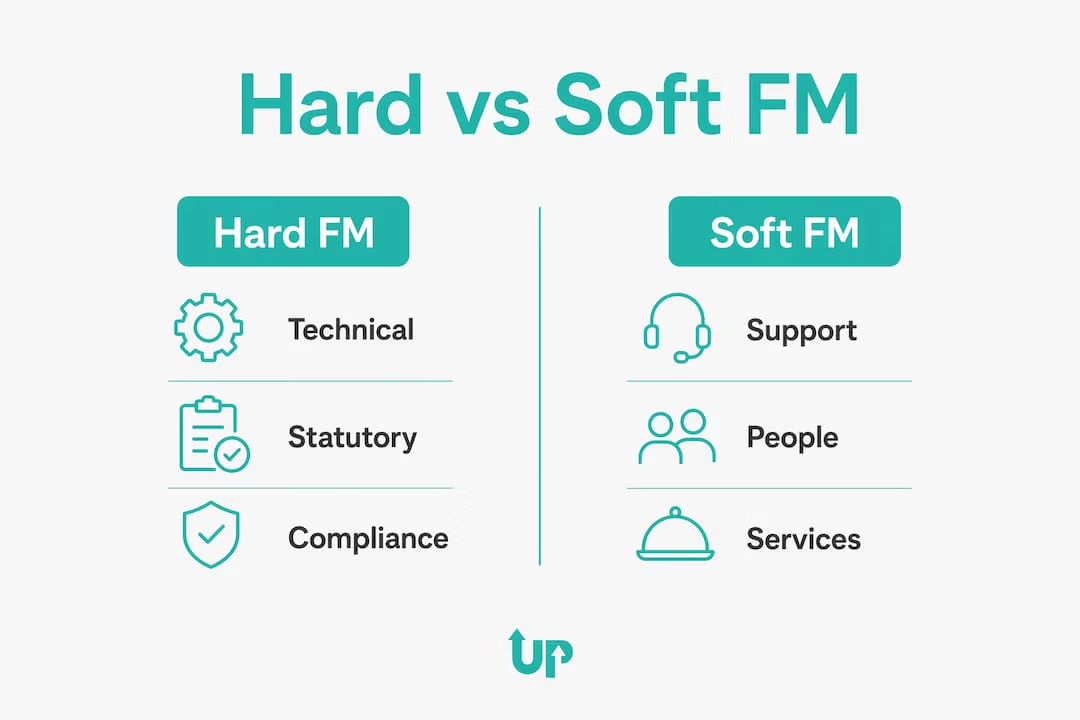
Understanding the distinction between hard and soft FM is the foundation of any sensible procurement decision. Get it wrong and you end up with gaps in your contract that only become visible when something goes wrong.
Hard FM: the technical and statutory core
Hard FM covers the physical building systems that have a legal or safety compliance dimension. This includes mechanical and electrical systems, heating, ventilation and air conditioning, lifts, fire detection and suppression, water hygiene (Legionella control), and building fabric maintenance such as roofing, glazing, and structural elements. CIBSE Guide M (2023) is CIBSE’s guide to maintenance engineering and management, covering maintenance strategy, risk, costs and life cycle.
The Indicative Economic Life Expectancy Tool, developed through collaboration between CIBSE, RICS, and BESA, aligns asset life expectancy data with SFG20 maintenance task codes. Incorporating this into a Computer-Aided Facilities Management (CAFM) system enables predictive maintenance planning and reduces total lifecycle costs across a portfolio.
Soft FM: people-centred support services
Soft FM covers the services that support the people using a building rather than the building’s physical systems. Cleaning, security, reception, catering, waste management, pest control, and landscaping all fall within this category. These services are often more visible to occupiers day to day, and their quality directly affects tenant satisfaction and retention.
The international standard definition, quoted by the IWFM, describes FM as the organisational function that integrates people, place and process within the built environment to improve people’s quality of life and the productivity of the core business. That framing applies equally to hard and soft services: both exist to protect the core business, not to run independently of it.
Bundled versus separate contracts
Bundling hard and soft FM into a single contract simplifies administration and creates clear accountability. One provider, one invoice, one point of escalation. For most London landlords managing portfolios of commercial units, that simplicity has real operational value. Separating contracts can make sense for large, complex estates where deep specialist expertise in a single discipline outweighs the administrative overhead of managing multiple providers.
Common FM services, compliance requirements, and typical contract arrangements:
| Service category | Examples | Key compliance requirement | Typical contract model |
|---|---|---|---|
| Mechanical and electrical | HVAC, lifts, electrical systems | Gas Safe, NICEIC/NAPIT | Hard FM or total FM |
| Fire safety | Detection, suppression, evacuation | Regulatory Reform (Fire Safety) Order 2005 | Hard FM or total FM |
| Water hygiene | Legionella risk assessment and control | HSE Approved Code of Practice L8 | Hard FM or total FM |
| Building fabric | Roofing, glazing, structural repairs | Building Regulations | Hard FM or total FM |
| Cleaning | Office, communal areas, specialist | COSHH compliance | Soft FM or total FM |
| Security | Manned guarding, CCTV, access control | SIA licensing | Soft FM or total FM |
| Waste management | Collection, recycling, disposal | Waste duty of care | Soft FM or total FM |
- Integrated FM under a single provider supports business continuity by reducing the risk of service gaps between contractors.
- Planned preventive maintenance, structured around CIBSE Guide M and SFG20 task schedules, extends asset life and reduces emergency repair costs.
- A total FM contract with a certified provider gives landlords a single compliance audit trail across all building systems.
- Soft FM quality directly affects occupier satisfaction, which in turn affects lease renewals and void periods.
Why do SMEs and growing London portfolios benefit from outsourcing FM?
Managing FM in-house sounds straightforward until the portfolio grows beyond a handful of properties. At that point, the compliance burden alone, covering Gas Safe certificates, EICR reports, fire risk assessments, Legionella logs, and asbestos registers, becomes a full-time administrative task before a single repair has been booked.
Planned maintenance reduces the likelihood of costly emergency failures. Treat maintenance as an investment that protects asset value and business continuity, not simply a cost to control. CIBSE Guide M sets out how to plan maintenance strategy, costs and life cycle.
Outsourcing to a qualified FM provider transfers that compliance burden to a team with the certifications, systems, and processes already in place. For an SME landlord or a managing agent with a growing portfolio, the practical benefits are concrete:
- Single point of contact: one account manager coordinates all planned and reactive work, removing the need to manage multiple trade contractors separately.
- Certified compliance: Gas Safe, NAPIT and SafeContractor accreditations are held by the provider, not sourced ad hoc for each job.
- Fast emergency response: a contracted FM provider with 24-hour reactive capability responds faster than a landlord calling individual tradespeople at short notice.
- Predictable costs: planned maintenance contracts convert unpredictable repair bills into a structured monthly or annual cost, which simplifies budgeting.
- Scalability: as your portfolio grows, the FM contract scales with it. Adding a new property to an existing agreement is administratively straightforward.
UpKeep UK’s model is built around exactly this need. For London landlords managing commercial units across multiple boroughs, having reactive maintenance and planned maintenance delivered by a single certified provider under one SLA removes the coordination overhead that typically consumes a disproportionate amount of a managing agent’s time.
Digital compliance platforms, which track accreditation expiry dates, store verification records, and generate audit-ready reports across multiple sites, further reduce administrative risk for growing portfolios. AI-powered accreditation tracking can flag renewal gaps before they become enforcement risks, a capability that matters more as portfolio size increases.
What do client reviews reveal about London FM companies?
When you read reviews of FM providers in London, look for answers to three questions: how quickly the provider responds, how clearly it communicates, and whether it delivers what the contract promises. The gap between the SLA on paper and what happens on site is where most complaints start.
Large national contractors tend to offer wide coverage and resources, while smaller London providers can often offer quicker attendance and a named contact who knows the buildings. Neither holds for every client, so treat review platforms as a starting signal only.
The most reliable check is to ask for references from clients whose portfolios match yours in size and property type, then speak to them directly.
What do successful FM projects in London look like?
London’s commercial property brings FM challenges you rarely meet elsewhere: dense occupation, mixed-use buildings, listed structures and frequent tenant turnover. Providers need urban experience as well as qualified engineers.
On large mixed-use and City office buildings, the national engineering FM providers coordinate complex M&E programmes across many occupiers. At the smaller end, UpKeep UK’s Barbican Building Restoration project turned a tired London workspace into a bright office, with a new layout, flooring, lighting and a welcoming lobby.
For managing agents overseeing block management maintenance across several London sites, the lesson is consistent: choose providers with qualified engineers, a structured maintenance programme and one accountable contact for each client.
Key takeaways
Selecting the right FM company in London requires evaluating certified compliance, contract model fit, and emergency responsiveness together, not any one factor in isolation.
| Point | Details |
|---|---|
| Certifications are non-negotiable | Gas Safe, NAPIT, CHAS, and SafeContractor accreditations must be verified against official registers, not contractor documents. |
| Contract model shapes accountability | Total FM contracts give one point of accountability; managing agent models suit complex estates needing specialist subcontractors. |
| Hard and soft FM together reduces risk | Bundling both under one provider closes the compliance gaps that separate contracts can leave. |
| Planned maintenance protects asset value | A planned programme, using guidance such as CIBSE Guide M and SFG20, protects asset value and business continuity. |
| UpKeep UK suits smaller London portfolios | For London landlords with commercial units, UpKeep UK combines hard FM, property maintenance and fast reactive response, with one point of contact. |
Why the FM market rewards the provider who actually picks up the phone
There is a persistent assumption in the London FM market that bigger automatically means better. The logic runs: a national contractor with thousands of engineers must be more reliable than a specialist provider. In practice, size does not guarantee better service, and for SME landlords and managing agents a smaller provider can be the better fit.
The FM providers who consistently deliver for smaller commercial portfolios share a specific set of characteristics. They hold the right certifications. They have a named account manager who knows your properties. They respond to emergencies within hours, not days. And they report against SLAs in writing, so you have a clear record of performance rather than a verbal assurance.
What the large contractors offer is genuine depth of resource for genuinely large estates. If you are managing a 500,000 square foot office campus with 24-hour occupancy and complex M&E systems, Mitie or OCS have the engineering bench and the account infrastructure to match that scale. But if your portfolio is a collection of commercial units across two or three London boroughs, that scale works against you. You become a small account in a large book, and your escalation path gets longer every time the account manager changes.
The providers worth serious consideration for SME and mid-market portfolios are those who treat the compliance audit trail as a core deliverable, not an afterthought. Gas Safe certificates filed correctly, EICR reports issued on time, Legionella logs maintained without chasing. That is the difference between a provider who protects your position as a landlord and one who creates liability.
UpKeep UK: FM for London landlords who need it done properly
If the providers compared above represent the full market, UpKeep UK represents a specific and well-defined alternative: a London-based FM and property maintenance company built for commercial landlords and managing agents who need hard FM and property maintenance under one roof, without the contract minimums and account management overhead of a large national contractor. We also provide hotel and hospitality maintenance for hotels, restaurants and serviced apartments across London.

UpKeep UK’s engineers are Gas Safe and NAPIT registered, and the company holds SafeContractor accreditation. Reactive callouts are handled by qualified engineers, planned maintenance runs to an agreed schedule, and every client has a single point of contact who knows their portfolio. For landlords managing commercial property maintenance across London, that combination of compliance and direct accountability is what smaller portfolios tend to need most.
The practical next step is straightforward. Contact UpKeep UK to discuss your portfolio, get a clear scope of services, and get a fixed quote after a site visit. You can start that conversation at upkeep.co.uk.