TL;DR:
- An Electrical Installation Condition Report confirms whether fixed electrical systems in a property are safe and compliant. Private landlords must obtain and renew an EICR every five years and complete any necessary remedial work within 28 days. An unsatisfactory report requires immediate action, detailed documentation, and compliance records to maintain legal property standards in the UK.
An Electrical Installation Condition Report (EICR) is a formal inspection and written report on whether a property’s fixed electrical installation is safe, carried out by a qualified electrician against BS 7671, the UK wiring regulations. Landlords in England need one at least every five years and must give a copy to tenants. It is different from an Electrical Installation Certificate (EIC) for new or altered work, and from PAT testing for portable appliances.
Who needs an EICR and when is it legally required?
Private landlords in England face a clear legal obligation. Under the Electrical Safety Standards in the Private Rented Sector Regulations, landlords must hold a valid EICR and renew it at least every five years. That requirement applies to all private residential tenancies, including assured shorthold tenancies and licences to occupy.
Houses in Multiple Occupation (HMOs) face stricter rules. Local authorities can require more frequent inspections, and HMO licences often carry their own electrical safety conditions. Commercial properties follow a different framework, with inspection intervals typically determined by the type of installation, its age, and the nature of the occupancy.
The legal obligations do not stop at the inspection itself. Once a report identifies remedial work, landlords must complete that work within 28 days. Written confirmation of the completed work must then be provided to tenants and the relevant local council within the same 28-day window. Failing to comply can result in enforcement action by the local authority, including civil penalties.
- Obtain the EICR from a qualified, registered electrician before or at the start of a tenancy.
- Review the report for any C1, C2, or FI codes requiring action.
- Commission remedial work and obtain written confirmation of completion.
- Provide the completed EICR and confirmation to all existing tenants within 28 days.
- Supply a copy to any new tenant before they move in, and to the local council within seven days of a request.
Pro Tip: Keep a dedicated compliance folder for each property containing the current EICR, any remedial work invoices, and written confirmation letters. This protects you immediately if a local authority requests evidence.
What happens during an EICR inspection?
An EICR inspection covers all fixed electrical components in a property. The electrician does not test portable appliances. The scope is the wiring, circuits, and fixed fittings that form the permanent installation.
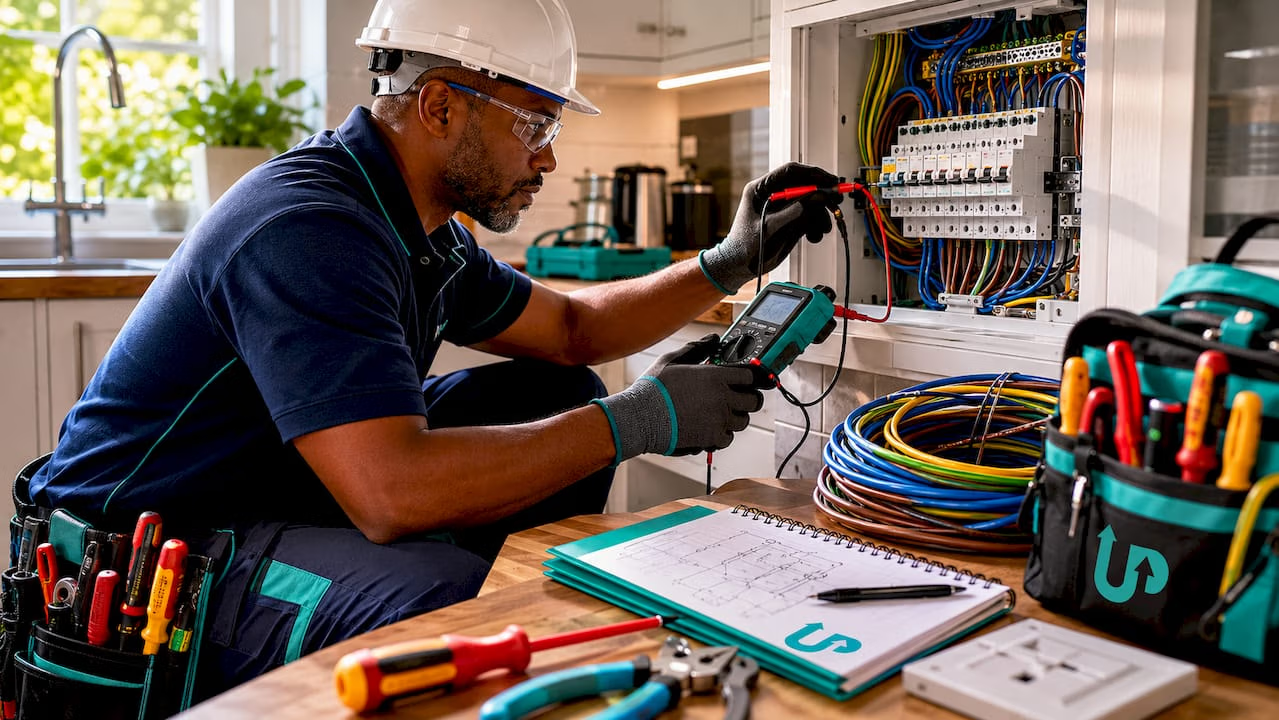
The inspection follows two distinct stages: a visual assessment and a series of electrical tests. During the visual stage, the electrician examines the consumer unit, circuit breakers, residual current devices (RCDs), wiring condition, socket outlets, light fittings, and earthing arrangements. The NICEIC confirms that EICRs identify hidden wear and deterioration in older installations that visual checks alone cannot detect.
The testing stage involves:
- Polarity testing: Confirms live, neutral, and earth conductors are correctly connected throughout.
- Insulation resistance testing: Measures the integrity of cable insulation to prevent current leakage.
- Earth continuity testing: Verifies that all metalwork is properly earthed to prevent electric shock.
- RCD testing: Confirms that residual current devices trip within the required time to protect against fault currents.
- Loop impedance testing: Checks that fault currents are high enough to operate protective devices quickly.
A standard residential inspection typically takes two to four hours, depending on the size of the property and the number of circuits. Larger or older properties with complex wiring can take longer.
Pro Tip: Before the electrician arrives, clear access to the consumer unit, loft hatch, and any underfloor access points. Restricted access can delay the inspection and may result in an FI code being issued for components the electrician could not test.
What do EICR codes C1, C2, C3, and FI mean?
Every observation recorded during an EICR is assigned a code. These codes communicate the severity of the finding and determine whether the overall report is rated satisfactory or unsatisfactory. Understanding them prevents costly misinterpretation.
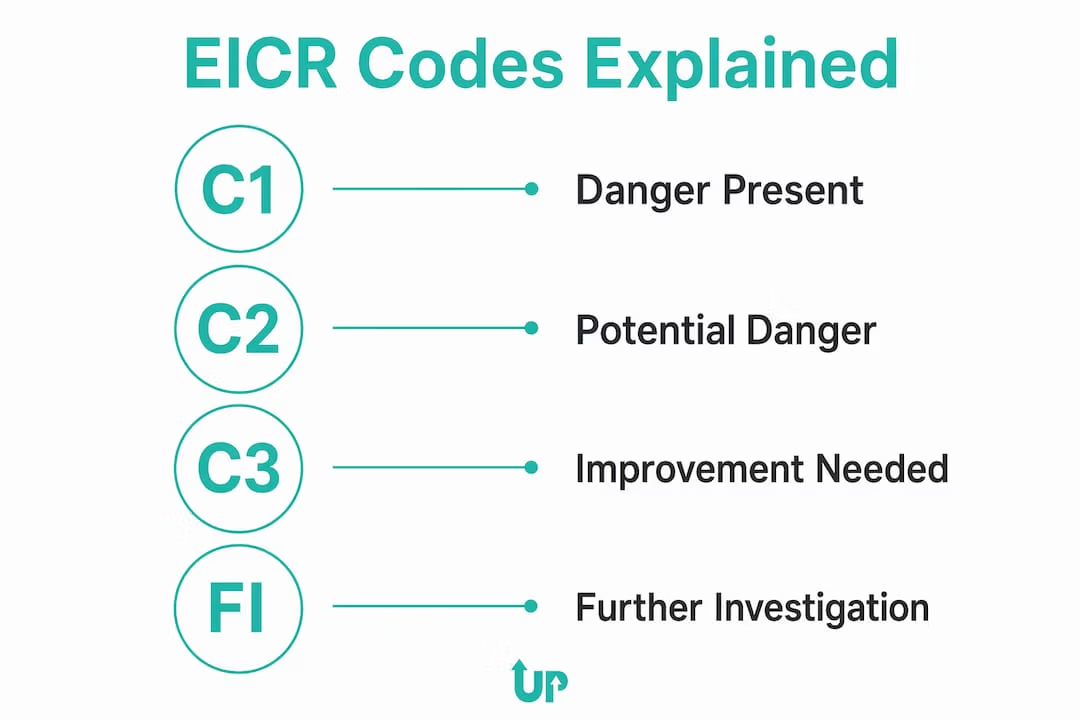
| Code | Meaning | Report outcome | Action required |
|---|---|---|---|
| C1 | Danger present, risk of injury | Unsatisfactory | Immediate remedial work |
| C2 | Potentially dangerous | Unsatisfactory | Urgent remedial work needed |
| C3 | Improvement recommended | Satisfactory | No legal obligation, but advisable |
| FI | Further investigation required | Unsatisfactory | Immediate follow-up investigation |
A C1 finding means the installation poses a direct risk of injury. The electrician may make the installation safe before leaving the property. A C2 finding indicates a potential danger that does not require immediate isolation but must be addressed urgently. An FI code is issued when the electrician could not fully access or test a component. As Total Skills UK explains, an FI code automatically renders the report unsatisfactory and demands immediate further investigation before the installation can be considered safe.
A C3 code does not make the report unsatisfactory. It records an improvement that would bring the installation closer to current BS 7671 standards, but it carries no legal obligation to act. Many landlords choose to address C3 findings anyway, as doing so reduces the likelihood of a C2 or C1 appearing at the next inspection.
One point that surprises many landlords: a satisfactory EICR rating does not mean the installation is fully compliant with every aspect of BS 7671. It means no immediate danger exists. Older installations can receive a satisfactory rating while still containing wiring that does not meet current standards, provided those deviations do not create a hazard.
Pro Tip: If your report contains a C2, do not wait until the 28-day deadline approaches. Commission the remedial work within the first week. Delays can affect your insurance position and, more critically, your tenants’ safety.
What to do after receiving an unsatisfactory EICR report
An unsatisfactory report requires a structured response. The 28-day deadline is firm, and the consequences of missing it are serious.
- Read the report in full. Identify every C1, C2, and FI code. Prioritise C1 findings, which require immediate action.
- Appoint a qualified electrician. Use a contractor registered with a competent person scheme such as NICEIC or NAPIT. This provides assurance that the remedial work meets BS 7671 requirements.
- Obtain written confirmation of completed work. The electrician must provide documentation confirming the remedial work is complete and the installation is now safe. This is a legal requirement, not optional paperwork.
- Provide copies to tenants and the local council. Both must receive the original EICR and the written confirmation within 28 days of the report date.
- Retain all records. Landlords must retain evidence of compliance and remedial work for future inspections. Failing to produce records when requested by a local authority can trigger enforcement action.
Avoiding common property maintenance mistakes at this stage matters. Landlords who delay remedial work or use unregistered contractors risk invalidating their compliance position entirely, even if the physical work is completed on time.
How much does an EICR cost in London?
EICR costs in London vary with the size and age of the property and the number of circuits, and UpKeep UK confirms a fixed price before booking.
The main factors that influence the final price include:
- Property size: A one-bedroom flat requires fewer circuit tests than a four-bedroom house. More circuits mean more time and a higher fee.
- Age of the installation: Older wiring, particularly pre-1970s installations with rubber-insulated cables, requires more careful testing and often takes longer.
- Number of consumer units: Properties with multiple distribution boards, common in converted flats or HMOs, attract higher fees.
- Access conditions: Poor access to the consumer unit, loft spaces, or underfloor voids adds time to the inspection.
- Remedial work: If the report identifies C1 or C2 findings, additional charges apply for the repair work itself. These costs are separate from the inspection fee.
Obtain at least three quotes before booking. Verify that each electrician is registered with NICEIC, NAPIT, or an equivalent competent person scheme. The cheapest quote is not always the best value, particularly if the electrician lacks the credentials to issue a legally valid report.
How does an EICR fit into your wider compliance programme?
An EICR sits within a broader framework of property safety obligations. Understanding where it fits helps landlords and homeowners build a coherent compliance programme rather than treating each certificate as an isolated task.
The three main electrical documents serve different purposes:
- EICR: Assesses the condition of existing fixed installations. Required every five years for private landlords.
- Electrical Installation Certificate (EIC): Issued for new installations or significant alterations. Confirms the new work meets BS 7671 at the time of completion.
- PAT testing: Covers portable appliances such as fridges, washing machines, and desk lamps. Separate from the EICR and not legally mandated for all property types, though widely recommended.
The NICEIC emphasises that EICRs serve as a preventative maintenance tool, identifying hidden deterioration in wiring that poses fire and electric shock risks. That preventative value is why embedding EICR scheduling into a landlord property maintenance plan makes practical sense. A missed inspection does not just create a legal liability. It leaves a potential fire risk undetected.
Regular EICR inspections also support insurance compliance. Many insurers require evidence of a valid EICR as a condition of buildings or landlord insurance. A lapsed report can affect a claim outcome. Scheduling the next inspection before the current certificate expires removes that risk entirely.
Key takeaways
An EICR is a legally required, five-yearly safety inspection for private landlords in England, and a satisfactory result does not mean a perfect installation, only that no immediate danger exists.
| Point | Details |
|---|---|
| Legal frequency | Private landlords must renew their EICR at least every five years under current regulations. |
| 28-day remedial deadline | Any C1 or C2 findings must be resolved and confirmed in writing within 28 days of the report. |
| Code meanings | C1 is immediate danger, C2 is potentially dangerous, C3 is advisory, and FI requires urgent further investigation. |
| Satisfactory does not mean perfect | A satisfactory rating confirms no immediate hazard, not full compliance with every BS 7671 requirement. |
| Record retention | Landlords must keep all EICR documents and remedial work confirmation for future inspections and enforcement requests. |
The EICR detail most landlords overlook
The terminology confusion around EICRs is more consequential than it appears. Many landlords ask for an “Electrical Safety Certificate” without realising that phrase has no formal meaning in UK law. What they actually need is an EICR, a specific diagnostic document under BS 7671. Receiving the wrong certificate, or a document that does not meet the legal standard, leaves a landlord non-compliant even if they paid for an inspection in good faith.
The second misconception I encounter regularly is the assumption that a satisfactory EICR means the electrics are modern and fully up to standard. It does not. An installation wired in the 1980s can receive a satisfactory rating if it presents no immediate danger. That is reassuring, but it is not a reason to defer maintenance indefinitely. The gap between “satisfactory” and “safe for another decade” is wider than many property owners appreciate.
The practical lesson is this: treat the EICR as the start of a conversation about your electrical installation, not the end of one. A C3 code today can become a C2 at the next inspection if nothing is done. Proactive landlords who address C3 findings between inspection cycles consistently report fewer costly surprises at renewal. That approach also demonstrates a duty of care that matters if a tenant ever raises a complaint or a claim.
Staying informed about evolving regulations is equally important. The electrical safety standards for the private rented sector have been updated in recent years, and further changes to social housing requirements are in progress. Working with a qualified electrician who keeps current with BS 7671 amendments is the most reliable way to stay ahead of those changes.
Drahim Hasula, Founder & CEO, UpKeep UK
Upkeep UK’s EICR and property compliance services in London
Upkeep UK carries out EICR inspections for residential and commercial properties across London, working with qualified, registered electricians who issue legally valid reports.

Whether you manage a single buy-to-let flat or a portfolio of HMOs, Upkeep UK coordinates the full process: inspection booking, report delivery, and remedial work where required. All remedial work comes with written confirmation documentation, keeping you compliant with the 28-day requirement without the administrative burden. For landlords who want a single point of contact for landlord property maintenance across electrical, structural, and general upkeep, Upkeep UK offers a practical, fixed-price service built around your compliance calendar. Contact Upkeep UK today to book your EICR or request a quote.
FAQ
How much does an EICR cost in London?
The price of an EICR in London depends on property size, age, number of circuits and access, with any remedial work quoted separately. UpKeep UK confirms a fixed price before booking.
What is a C2 on an EICR?
A C2 code means the electrician has identified a potentially dangerous condition in the fixed electrical installation. It makes the overall report unsatisfactory and requires urgent remedial work, which must be completed and confirmed in writing within 28 days.
Do I need an EICR before letting a property?
Private landlords in England must hold a valid EICR before a new tenancy begins and must provide a copy to the tenant before they move in. A new EICR is required at least every five years, or sooner if the existing certificate has expired.
What does EICR stand for?
EICR stands for Electrical Installation Condition Report. It is a formal inspection and written assessment of the fixed electrical installations in a property, carried out against the requirements of BS 7671.
Is an EICR the same as an Electrical Safety Certificate?
No. “Electrical Safety Certificate” has no formal legal definition in the UK. An EICR is the specific document required by law for private landlords, and only a report that meets the BS 7671 inspection standard qualifies as a valid EICR for compliance purposes.