
TL;DR:
- A London-based property maintenance company handles planned upkeep, emergency repairs, and compliance requirements across all boroughs. They provide rapid response times, borough-specific knowledge, and integrated management for residential and commercial properties. Their services extend to the Home Counties and nationwide portfolios, ensuring consistency and legal compliance.
A property maintenance company in London handles planned upkeep, emergency repairs and compliance checks so residential and commercial buildings stay safe, legal and in good condition. UpKeep UK is a London-based provider covering every borough, with a 1 to 3 hour emergency response and planned maintenance programmes for landlords, agents and commercial owners.
What does a property maintenance company in London actually do?
A property maintenance company manages the physical condition of buildings through planned upkeep, reactive repairs, and statutory compliance work. In London, this covers everything from a burst pipe in a Hackney flat at 11PM to a full electrical inspection programme across a commercial portfolio in Westminster. The scope is broader than most property owners expect.
Planned maintenance covers scheduled tasks: decorating cycles, boiler servicing, gutter clearing, and roof inspections. Reactive maintenance addresses faults as they arise, from broken locks to failed heating systems. Compliance maintenance handles legally mandated work, including gas safety certificates, electrical reports, and damp remediation. A capable provider handles all three without the property owner needing to coordinate separate contractors.
Upkeep UK positions itself as a single point of contact for all three categories. Their team includes builders, electricians, roofers, and project managers, which means complex jobs do not require handoffs between firms. For property managers running large portfolios, that accountability matters more than any individual trade skill.
What property maintenance services are available across London’s zones and boroughs?
London’s 33 boroughs divide naturally into five operational zones, and the best building maintenance services in London are structured around that geography. Borough-level knowledge matters because access restrictions, parking regulations, and local authority requirements vary significantly between, say, Kensington and Chelsea and Tower Hamlets.
Central London (Westminster, City of London, Kensington and Chelsea) presents the highest concentration of commercial properties, listed buildings, and mixed-use developments. Maintenance work here often requires prior consent for external alterations and careful coordination with conservation officers.
North London (Camden, Islington, Haringey, Barnet, Enfield) combines dense Victorian terraces with newer residential developments. Islington and Camden in particular have active selective licensing schemes, which means landlords face additional compliance obligations on top of standard repair duties.
South London (Southwark, Lambeth, Wandsworth, Lewisham, Croydon) covers a wide range of property types, from period conversions in Clapham to purpose-built blocks in Croydon. Wandsworth and Lambeth both have active enforcement teams monitoring property standards.
East London (Hackney, Tower Hamlets, Newham, Waltham Forest) has seen rapid development over the past decade. Tower Hamlets operates one of London’s most active selective licensing programmes, and landlords there face close scrutiny of property condition.
West London (Hammersmith and Fulham, Ealing, Hounslow, Brent) includes a high proportion of HMOs and multi-let properties, where maintenance demands are higher and response times more critical.
- Emergency repairs: 2 to 4 hour response across all London boroughs
- Routine upkeep: decorating, plumbing, carpentry, and groundworks
- Electrical and gas: EICR inspections, CP12 certificates, and fault repairs
- Roofing: flat roof repairs, pitched roof maintenance, and gutter work
- Compliance programmes: planned inspection cycles aligned to legal deadlines
Pro Tip: Choose a provider with direct contacts in the specific borough where your property sits. A contractor who regularly works in Hackney will know which local authority forms to submit and which access restrictions apply, saving you time and avoiding delays.
For a detailed breakdown of borough-level coverage across London, Upkeep UK publishes its full service area online.
How do statutory compliance requirements affect property maintenance in London?
Compliance is the area where property maintenance crosses into legal obligation, and the penalties for failure are significant. Section 11 of the Landlord and Tenant Act 1985 requires landlords to keep the structure, exterior, heating, plumbing, electrical, and gas installations in proper working order. These obligations cannot be transferred to tenants, regardless of what a tenancy agreement states.
The 2026 compliance framework adds further weight to these duties. Civil penalties reach up to £40,000 per offence for landlords who fail to meet their repair obligations. That figure applies to failures around damp, mould, and Category 1 hazards under the Housing Health and Safety Rating System (HHSRS), all of which fall within a maintenance company’s scope of work.
Awaab’s Law sets specific timeframes for emergency repairs. Emergency repairs must begin within 24 hours and complete within 7 days in social housing, with courts and councils treating these as benchmarks for reasonable response in the private rented sector from 2026. A maintenance provider who cannot meet those timelines creates direct legal exposure for the property owner.
The Renters’ Rights Act 2025 abolished Section 21 notices and introduced Periodic Assured Tenancies from may 2026. This shift makes tenant relations more critical than ever, and a poorly maintained property now carries greater risk of formal dispute.
| Compliance requirement | Frequency | Penalty for non-compliance |
|---|---|---|
| Gas safety certificate (CP12) | Annual | Up to £40,000 per offence |
| Electrical Installation Condition Report (EICR) | Every 5 years | Up to £40,000 per offence |
| HHSRS Category 1 hazard remediation | As identified | Enforcement action and penalties |
| Awaab’s Law emergency repairs | Within 24 hours to begin | Court action and compensation claims |
| Selective licensing compliance | Ongoing (15+ boroughs) | Licence revocation and fines |
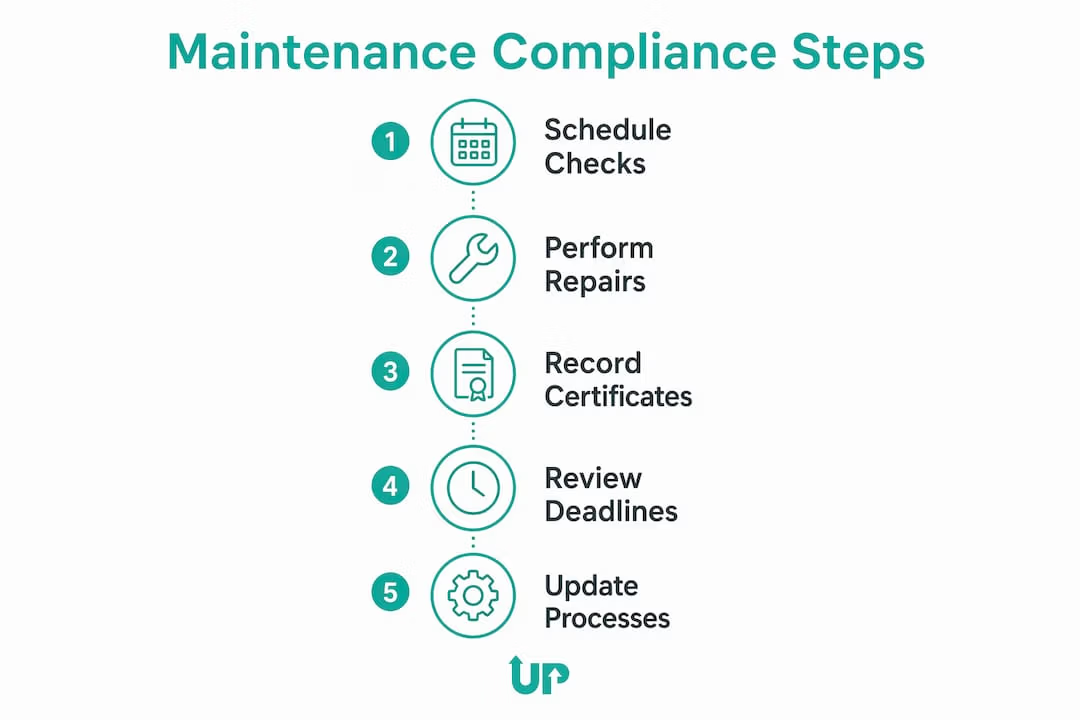
Integrating compliance deadlines into a planned maintenance programme is the most reliable way to avoid penalties. Upkeep UK builds compliance calendars for landlords, tracking CP12 and EICR renewal dates alongside routine maintenance schedules. For further reading on avoiding compliance failures, Upkeep UK’s blog covers the most common pitfalls in detail.
What property maintenance options exist for the Home Counties surrounding London?
The Home Counties, Surrey, Kent, Essex, and Hertfordshire, represent a natural extension of London’s property market. Many London-based landlords and portfolio managers hold properties in these areas, and they expect the same standard of service they receive in the capital.
Service availability in the Home Counties is generally strong for planned maintenance and compliance work. Response times for emergencies are longer than in London, typically 4 to 8 hours rather than 2 to 4 hours, reflecting travel distances and contractor availability outside the M25. Property owners managing mixed portfolios across London and the Home Counties benefit from working with a single provider who understands both environments.
Key considerations for Home Counties property maintenance include:
- Surrey and Hertfordshire: High proportion of detached and semi-detached residential properties, with strong demand for roofing, driveway, and garden maintenance alongside standard repairs
- Kent: Significant HMO and rental stock in towns like Maidstone and Medway, with compliance requirements mirroring London’s framework
- Essex: Rapid residential development around Chelmsford and Brentwood creates demand for new-build snagging and ongoing maintenance contracts
Outdoor maintenance and renovation work in the Home Counties often requires careful planning. Working with a provider experienced in both London and the Home Counties removes the coordination burden of managing separate regional contractors.
How do property maintenance services support UK-wide portfolio clients?
London is the operational heartland for Upkeep UK, but the demand for consistent property care services does not stop at the M25. Clients managing national portfolios across Manchester, Birmingham, Leeds, and Bristol need the same compliance standards and repair quality they expect in London, delivered through a single accountable partner.
UK-wide property maintenance for multi-site portfolios typically operates on a planned basis. Compliance programmes, including EICR cycles, gas safety renewals, and HHSRS inspections, are scheduled in advance and managed centrally. Reactive maintenance outside London carries longer response windows, but planned work can be coordinated efficiently with the right systems in place.
The advantage of a London-based provider with national reach is the combination of local agility and central oversight. A company that handles reactive maintenance in London daily has the operational discipline to manage planned programmes nationally. That discipline shows up in reporting, compliance tracking, and contractor accountability across regions.
Strategies for managing national portfolios effectively include:
- Centralising compliance calendars so no certificate renewal is missed across any site
- Using a single Service Level Agreement (SLA) that defines response times by region and urgency category
- Scheduling planned maintenance visits in clusters by geography to reduce mobilisation costs
- Appointing a named account manager who coordinates across all sites and regions
Pro Tip: When selecting a provider for a national portfolio, ask specifically how they manage contractor quality outside their core region. The best providers maintain vetted subcontractor networks in major cities and apply the same SLA standards regardless of location.
For property owners considering best maintenance services in 2026, Upkeep UK’s guide covers how to evaluate providers across both London and national coverage.
Key takeaways
A reliable property maintenance company in London must combine rapid emergency response, borough-level knowledge, and integrated compliance management to protect both property condition and legal standing.
| Point | Details |
|---|---|
| Compliance is non-negotiable | Section 11 obligations and penalties up to £40,000 apply to every residential landlord in London. |
| Borough knowledge matters | Selective licensing and local authority requirements vary significantly across London’s 33 boroughs. |
| Emergency response benchmarks | Awaab’s Law sets 24-hour start and 7-day completion targets that courts treat as private sector standards. |
| Home Counties need a single provider | Managing London and Home Counties properties through one company removes coordination risk and gaps in coverage. |
| National portfolios need central oversight | A single SLA with regional response tiers keeps compliance and quality consistent across multi-site portfolios. |
What I have learned from London’s property maintenance market
By Drahim Hasula
The thing that surprises most property owners when they first engage a maintenance company is how much of the work is invisible. The repairs that get done on time, the certificates renewed before the deadline, the tenant call handled at 7AM on a Saturday. None of that appears in a report. You only notice it when it stops happening.
London’s compliance environment in 2026 is genuinely demanding. The combination of Awaab’s Law benchmarks, selective licensing in 15+ boroughs, and the Renters’ Rights Act changes means that a landlord who treats maintenance as an afterthought is carrying real financial risk. I have seen landlords face enforcement action not because they were negligent, but because they did not have a system. A good maintenance partner is that system.
The other thing I would say is that location knowledge is underrated. A contractor who works regularly in Tower Hamlets knows the selective licensing requirements there. One who works in Westminster knows the conservation area restrictions. That local knowledge saves time and prevents costly mistakes. When you are evaluating providers, ask them to name the boroughs they work in most frequently and what makes each one different. The answer tells you everything about whether they genuinely know London or just claim to cover it.
Drahim Hasula, Founder & CEO, UpKeep UK
Upkeep UK’s property maintenance services across London and the UK
Upkeep UK covers all 33 London boroughs with emergency response times of 2 to 4 hours, making it one of the most responsive property maintenance providers in the capital. The team includes directly employed builders, electricians, roofers, and project managers, so complex jobs are handled without subcontracting delays.

For landlords managing residential portfolios, Upkeep UK’s landlord property upkeep services cover planned maintenance, reactive repairs, and full compliance management including CP12 and EICR programmes. For property owners with properties in the Home Counties or national portfolios, Upkeep UK extends planned maintenance and compliance programmes beyond London with the same standards and accountability. Contact Upkeep UK to discuss your portfolio and receive a tailored maintenance plan.
FAQ
What does a property maintenance company in London do?
A property maintenance company manages planned upkeep, reactive repairs, and statutory compliance work for residential and commercial properties. In London, this includes emergency callouts, gas and electrical inspections, structural repairs, and compliance with selective licensing requirements.
How quickly should a London maintenance company respond to emergencies?
The industry benchmark, set by Awaab’s Law, requires emergency repairs to begin within 24 hours. Upkeep UK targets a 2 to 4 hour response across all London boroughs for urgent callouts.
What compliance certificates do London landlords need?
London landlords must hold an annual gas safety certificate (CP12) and an Electrical Installation Condition Report (EICR) every 5 years. Properties in selective licensing areas require a valid licence, with fines of up to £40,000 for non-compliance.
Can a London-based maintenance company cover Home Counties properties?
Yes. Providers with London operations typically extend planned maintenance and compliance programmes to Surrey, Kent, Essex, and Hertfordshire. Emergency response times outside the M25 are longer, typically 4 to 8 hours, but planned work is managed centrally.
What is the difference between planned and reactive maintenance?
Planned maintenance covers scheduled tasks such as boiler servicing, decorating, and compliance inspections. Reactive maintenance addresses faults as they occur, such as a failed boiler or a leak. A good provider manages both under a single Service Level Agreement.