A project manager is the person accountable for delivering your construction or refurbishment project on time, on budget and to the agreed standard. They balance scope, schedule, finance, risk, quality and resources, the framework the Association for Project Management uses to define the role, and in practice they plan the programme, coordinate the trades, control changes and costs, and hand over a finished, compliant building.
For landlords, facilities managers and business owners, the real questions are what a project manager does day to day, how they are paid and whether your project needs one. At UpKeep UK, every refurbishment and fit-out has a dedicated project manager as your single point of contact, so the advice below comes from running live London projects.
Success on a typical property project looks like this:
- The work finishes on the agreed date, without last-minute slippage.
- Costs land within the approved budget, with every variation tracked and signed off.
- The finished job meets the specification and delivers what you paid for, from a warmer building to a compliant fire system.
Table of Contents
- What is the role of project managers across the project lifecycle?
- What skills do project managers need most?
- What does a project manager do week to week on your project?
- How much does a project manager cost?
- How is project management different from operations management?
- Which tools and methods do project managers use?
- Project manager, main contractor or architect: who does what?
- How do project managers work on real property projects?
- What’s often missed about the role of project managers?
- Do you need a dedicated project manager for a renovation?
- Frequently asked questions
- Sources
What is the role of project managers across the project lifecycle?
Every project moves through five stages, and a project manager’s responsibilities shift at each one.
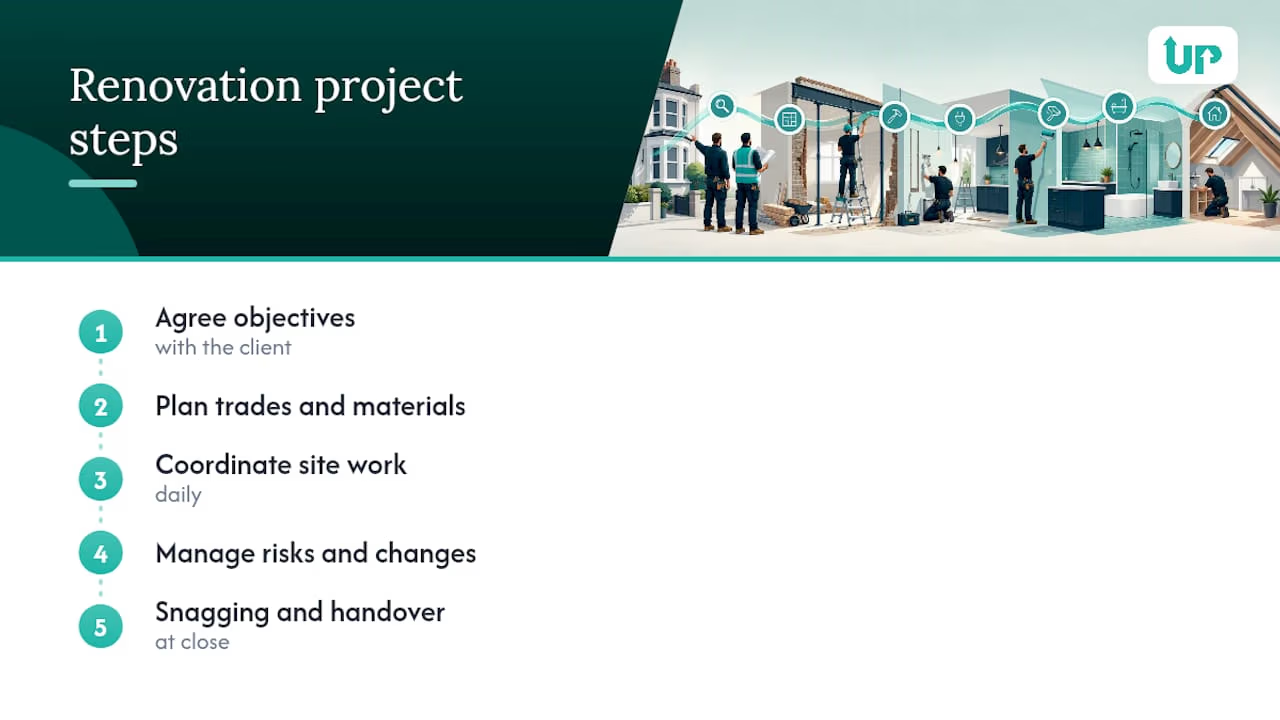
Initiation means agreeing objectives with the client, confirming scope, and setting a realistic budget before anyone picks up a tool. Planning produces an integrated programme covering trades, deliveries, permits and inspections, with cost estimates attached to each work package. Execution is where the PM runs day to day site coordination, briefs contractors, and keeps materials moving to schedule. Monitoring and control covers change management, tracking spend against budget, and managing risks as they surface, whether that’s a delayed delivery or an unexpected structural issue. Close involves snagging, handover documentation, and a lessons learned review that feeds into the next job.
- Initiation: agree scope and budget with the client, confirm the six core aspects are understood.
- Planning: build the integrated plan, procure specialists, set the risk register.
- Execution: coordinate trades on site, manage day to day decisions.
- Monitoring and control: run change control, report progress, resolve emerging risks.
- Close: snag the works, hand over documentation, capture lessons learned.
Prospects confirms this same pattern nationally: agreeing objectives, planning resources, managing risk, overseeing budgets, and reporting to stakeholders sit at the core of the job, whatever the sector.
Pro Tip: Tie every task on your programme to one of the six core aspects. If a task doesn’t map to scope, schedule, finance, risk, quality or resources, question why it’s on the plan at all.
What skills do project managers need most?
Some skills matter more than others, and the ranking below reflects what actually determines whether a property project runs smoothly or turns into a firefight.
- Leadership. A PM sets direction for trades and subcontractors who don’t report to them directly, and holds the team to a shared standard even under pressure.
- Stakeholder management. APM’s guidance on difficult stakeholders treats this as one of the hardest parts of the job, and on a landlord project it’s often the landlord, the letting agent and the tenant all pulling in different directions at once.
- Planning and scheduling. Sequencing trades correctly (first fix before plastering, plastering before decorating) prevents costly rework.
- Commercial acumen. A PM who understands contracts can spot an inflated variation claim from a subcontractor before it eats the contingency budget.
- Risk and quality management. Spotting a compliance gap on a fire door before sign off saves a much larger problem later.
- Communication. Clear, regular updates keep clients calm even when a project hits a snag.
- Emotional intelligence. Reading when a trade is under pressure, or a client is anxious about cost, lets a PM head off conflict early.
When you interview a project manager, test for leadership, stakeholder management, planning, commercial awareness and risk management first. Those five carry the most weight on property projects, according to APM’s role profile for project managers.
What does a project manager do week to week on your project?
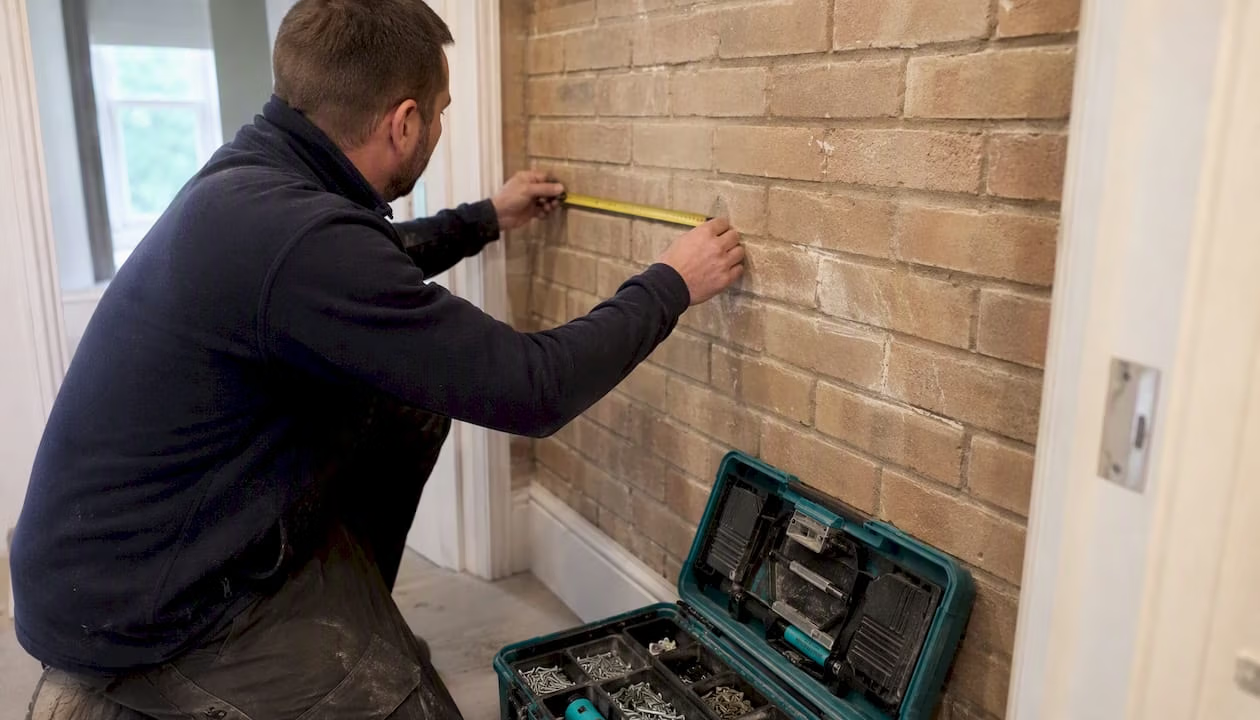
On a live refurbishment, a good project manager is visible. Expect them to be on site regularly, chasing anything that blocks the next day’s work, and reporting to you in a predictable rhythm rather than only when something goes wrong. In a typical week that includes:
- At least one site inspection to check progress and quality against the specification
- Procurement checks on materials and lead times, so deliveries land before trades need them
- A programme review to re-sequence trades if anything has slipped
- A progress update or meeting with you or your managing agent
- Updating the risk register and the log of variations awaiting your approval
Behind the scenes there is a heavy administrative load: contracts, compliance paperwork, building control inspections and health and safety records under CDM 2015. Handling that paperwork is a large part of what you are paying for.
How much does a project manager cost?
Independent project managers on domestic and small commercial refurbishments usually charge either a percentage of the build cost or a day rate for shorter, advisory work, and larger schemes tend to sit at a lower percentage because the build cost is higher. UpKeep UK gives a fixed quote after a site visit, with a dedicated project manager on every refurbishment.
The other common route is to use a contractor that provides project management as part of the package. On a managed refurbishment or design and build project, the project manager’s time is built into the contract price, and you get one party accountable for both the management and the work itself. Whichever route you choose, ask exactly what the fee covers: site visits, cost reporting, CDM duties, building control liaison and snagging should all be spelled out in writing.
How is project management different from operations management?
Projects are temporary and change focused; operations are ongoing and built around stability. A comparison from ACE puts it plainly: one role delivers something new, the other keeps something running.
- Project: fixed end date, defined scope, one off deliverable.
- Operations: continuous service, recurring tasks, no fixed finish.
- Example: installing a new heating system is a project; running the annual maintenance rota for that system is operations.
Many senior property leaders combine both skill sets, and that overlap matters most at handover, when a completed project needs to settle smoothly into day to day running without dropping standards.
Which tools and methods do project managers use?
Waterfall suits property projects with a fixed sequence of trades and a clear end date, which describes most renovations. Agile principles occasionally help on projects with evolving specs, such as a phased commercial fit-out. PRINCE2 and PMI’s PMBOK both provide structured frameworks, and many UK project managers hold PRINCE2 or APM qualifications.
- Waterfall: sequential planning, best for renovations with a fixed trade order.
- PRINCE2: UK-recognised methodology built around defined stages and governance.
- PMBOK: PMI’s broader standard, useful for terminology and process consistency.
- Tools: Atlassian’s Jira and Confluence for task tracking and documentation, Wrike for collaborative scheduling on larger teams.
Match the tool to project size. A small refurbishment might run fine on a shared spreadsheet; a multi-site commercial fit-out benefits from Jira or Wrike with a single source of truth everyone works from, avoiding the confusion of three versions of the same programme circulating by email.
Project manager, main contractor or architect: who does what?
These roles overlap, which is where confusion about who is responsible usually starts.
- Architect or designer: designs the scheme, produces drawings and specifications, and handles planning applications. On some projects they also administer the building contract.
- Main contractor: employs or subcontracts the trades and builds the works to the agreed price and programme.
- Project manager: represents your interests across the whole project, coordinating designers and contractors, controlling cost and change, and making sure the finished building is handed over properly.
On smaller jobs one party often covers more than one role. A contractor with in-house project managers can run the programme and the build together, which is often the simplest option for landlords and businesses without their own property team. On larger or more complex schemes, an independent project manager acting purely for you adds a valuable layer of oversight.
How do project managers work on real property projects?
On a typical renovation project, a PM coordinates trades, schedules compliance checks (fire, water hygiene, gas, electrics) and manages the handover so nothing gets missed between finishing works and occupation.
- Fewer defects, since a PM catches issues at inspection rather than after sign off.
- Predictable budgets, because variations get tracked and approved rather than surfacing at completion.
- Clearer communication for landlords and facilities managers, who get regular, structured updates instead of silence between milestones.
Pro Tip: Ask any prospective project manager how they handle change control before work starts, not after. Their answer tells you more than their CV does.
What’s often missed about the role of project managers?
The instinct is to treat project management as a scheduling exercise. It isn’t. The hardest part of most property projects is holding together a landlord, a letting agent, several subcontractors and sometimes a tenant, all with different priorities and different tolerance for disruption. Get that wrong and even a perfectly sequenced programme collapses.
Our practical advice: in the first week of any new project, map who needs to sign off on what, and confirm it in writing before the first delivery arrives on site. If you are planning a refurbishment, get a scoped site visit and an integrated plan before committing to a start date. Book a scoped site visit with UpKeep UK and we will map the programme, the approvals and the budget with you.
Do you need a dedicated project manager for a renovation?
Property outcomes depend more on stakeholder coordination and disciplined change control than on any single technical skill a project manager brings.
| Point | Details |
|---|---|
| Six core aspects | Every project balances scope, schedule, finance, risk, quality and resources, per APM. |
| Lifecycle mapping | Responsibilities shift across initiation, planning, execution, monitoring and close. |
| Stakeholder skill | Managing landlords, agents and trades is often harder than the technical scheduling. |
| Qualifications vs track record | PRINCE2 or APM qualifications show a structured approach, but experience on similar projects matters more. |
| Site presence | Frequent inspections catch defects early and reduce costly rework. |
You probably need a dedicated project manager if your project involves more than two or three trades, structural work, building control sign-off, an occupied building or a fixed deadline such as a new tenancy or reopening date. For a simple like-for-like repair, a reliable contractor is usually enough. UpKeep UK delivers property refurbishments and commercial fit-outs across London with a dedicated project manager on every job and fixed-price quotes agreed upfront. Call 020 3148 8884 to talk through your project.
Frequently asked questions
What is the main role of project managers?
The main role of project managers is to deliver a temporary initiative to agreed scope, cost, quality and timescale, balancing the six core aspects APM defines: scope, schedule, finance, risk, quality and resources.
What do project managers do on a typical renovation?
They agree objectives with the client, plan trades and materials, coordinate site work daily, manage risks and changes, then handle snagging and handover at close.
What skills matter most for project manager duties?
Leadership, stakeholder management, planning, commercial acumen and risk management matter most, particularly for anyone moving into property project work early in their career.
How much does a project manager cost for a renovation? Independent project managers typically charge 5% to 15% of the build cost on domestic and small commercial refurbishments, or a day rate for shorter engagements. When a contractor provides project management as part of a managed refurbishment, it is usually included in the contract price.
PRINCE2 is the most commonly requested certification on UK property and construction roles, while APM membership suits those aiming for Chartered status over time.
Is a project manager the same as an operations manager?
Do I need a project manager if I already have a builder? Not always. For a small, single-trade job a good builder can manage the work. Once you have several trades, structural changes, building control sign-off or an occupied building, a project manager pays for themselves by preventing delays, rework and disputes over variations.
No. A project manager delivers a fixed, temporary piece of work, while an operations manager runs an ongoing service with no fixed end date.
Sources
- What does a project manager do? | Association for Project Management
- Project manager | Prospects
- PMBOK | PMI