


Emergency repairs protect guest safety, limit revenue loss and preserve a hotel’s reputation, making them one of the few maintenance functions with a direct line to your bottom line. The moment a pipe bursts above a suite or a chiller fails in July, you’re not managing a fault, you’re managing guest trust in real time.
The fastest actions matter more than the perfect ones; for detailed practical steps, see the Essential guide to emergency pipe repairs for Reading homeowners. Secure the affected area, move guests away from any hazard, and get word to your duty manager and on-call engineer within minutes, not shifts. Gov makes clear that testing, maintenance and record-keeping for life-safety systems are legal duties, not optional extras, and the same discipline applies to any fault that threatens guest safety. A specialist partner such as Upkeep UK exists precisely for this window: the first hour after a call, when isolating risk and getting a competent tradesperson on site decides whether the incident stays a footnote or becomes a one-star review.
Three priorities dictate what happens next:
- Isolate the risk — cut power, water or gas supply to the affected zone before anything else.
- Communicate early — tell the guest what’s happening and roughly how long it will take, even if the honest answer is “we’re still finding out.”
- Escalate correctly — route the fault to an on-call engineer or contracted specialist rather than waiting for the next shift change.
Key Takeaways
Emergency repairs succeed when hotels combine fast, well-defined triage with protected preventive maintenance and consistent documentation across every incident.
| Point | Details |
|---|---|
| Safety comes first | Isolate the hazard and move guests clear before diagnosing the fault. |
| Protect the PM schedule | An 80/20 preventive-to-reactive split correlates with fewer emergencies and higher satisfaction. |
| Track the right KPIs | Monitor response time, MTTR, reactive share and repeat-fault rate every month. |
| Document everything | Time-stamped photos speed up contractor billing and insurance claims. |
| Consider retained cover | Upkeep UK offers 24/7 callout, fixed-price windows and audit-ready reporting for hotels needing scale or traceability. |
Table of Contents
- What is the role of emergency repairs in hospitality maintenance?
- What are the most common emergency scenarios in hotels?
- How should a hotel triage and respond to an emergency repair?
- How do you build 24/7 emergency response without overspending?
- Which tools help reduce emergency repairs and speed them up?
- What KPIs prove your emergency response is working?
- How should hotels communicate with guests during repairs?
- Should you keep emergency repairs in-house or outsource them?
- What does the evidence say about preventive maintenance and guest satisfaction?
- What do hotel maintenance teams get wrong about emergency repairs?
- How can a specialist partner support your emergency repair strategy?
- Sources
What is the role of emergency repairs in hospitality maintenance?
Emergency repairs sit at the sharp end of hotel maintenance, dealing with faults that threaten safety, guest comfort or the ability to trade right now. Everything else in your maintenance programme, from scheduled boiler servicing to five-year lift inspections, exists partly to reduce how often you land in this category.
The distinction matters because each maintenance type carries a different response clock and a different cost profile. Preventive maintenance is scheduled work carried out on a fixed interval regardless of current condition, such as quarterly HVAC filter changes or annual fire alarm testing. Predictive maintenance uses condition data, vibration readings on a chiller compressor or temperature drift in a walk-in fridge, to intervene before a component actually fails. Reactive (or corrective) maintenance covers non-critical faults that can wait for the next scheduled visit: a sticking door handle, a flickering corridor light, cosmetic wear that annoys nobody urgently.
An emergency repair breaks that queue entirely. It’s any fault causing immediate risk to guest or staff safety, an unavoidable loss of essential comfort, or a stoppage in a critical operational system. A guest trapped in a lift is not the same category as a lift running slightly rougher than usual, and treating them the same way is how small faults become headline incidents.
Where the boundary actually sits
Most disputes inside maintenance teams happen at the boundary, not in the obvious cases. A dripping tap is reactive. Water pooling near an exposed socket is an emergency, because the risk profile changed the instant electrics and water met. The rule of thumb worth training into every member of staff: ask whether delay increases the risk, not just the inconvenience.
| Maintenance type | Trigger | Typical response window | Hotel example |
|---|---|---|---|
| Emergency repair | Immediate safety or operational risk | Under 1 hour | Water ingress near electrics, lift entrapment, fire alarm fault |
| Reactive maintenance | Non-critical fault reported by guest or staff | Same day to a few days | Squeaky door, cosmetic damage, minor leak with no exposure risk |
| Preventive maintenance | Scheduled interval, condition-independent | Planned, weeks in advance | Boiler service, fire extinguisher check, HVAC filter change |
| Predictive maintenance | Condition data trend or sensor alert | Days to weeks before failure | Chiller vibration alert, refrigeration temperature drift |
A useful boundary checklist for front-line staff:
- Is anyone in immediate physical danger? Treat as emergency, always.
- Is a life-safety system involved (fire, gas, lift, structural)? Treat as emergency.
- Could the fault worsen significantly in the next hour if untouched? Treat as emergency.
- Is it confined to comfort or appearance with no safety dimension? Log as reactive.
What are the most common emergency scenarios in hotels?
Water, heat and power dominate the emergency call list, and each carries a distinct pattern of guest disruption and cost.
Leaks and flooding top most engineering teams’ incident logs. A burst pipe above a room forces an immediate move-out, often with associated damage to soft furnishings, flooring and neighbouring rooms below. Guest impact is severe and instant: you lose the room, sometimes several rooms, on the night itself. HVAC and chiller failures hit differently depending on season, but a chiller down in August or a boiler out in January produces the same outcome, comfort complaints escalating within hours and refund requests by evening. Refrigeration failure in the kitchen is arguably the most financially dangerous scenario of all: stock write-offs, potential service shutdown, and food safety exposure that touches HSE’s catering and hospitality guidance directly.
Other high-frequency scenarios include:
- Lift entrapment or failure — safety-critical, requires immediate isolation and specialist callout, often with statutory reporting obligations.
- Power outages — cascading effect across lighting, key card systems, kitchen equipment and life-safety systems simultaneously.
- Fire alarm faults or false triggers — evacuation risk and guest disruption even when no actual fire exists.
- Gas leaks — immediate evacuation of the affected zone and mandatory use of a Gas Safe registered engineer.
- Loss of hot water — comfort-impacting rather than safety-critical, but drives complaint volume disproportionately during peak occupancy.
Cost and timeline reality: out-of-hours emergency callouts routinely carry a premium over standard daytime rates, and every hour a room sits out of service represents lost room revenue on top of the repair bill itself. Industry analysis from HotelSpeak links delayed maintenance directly to eroded guest trust and higher downstream costs, arguing that proactive monitoring catches many of these failures before they reach emergency status at all.
How should a hotel triage and respond to an emergency repair?
A five-step triage sequence keeps every member of staff acting the same way regardless of who picks up the call: assess safety, protect guests and staff, contain or isolate, restore or escalate, then document and follow up.
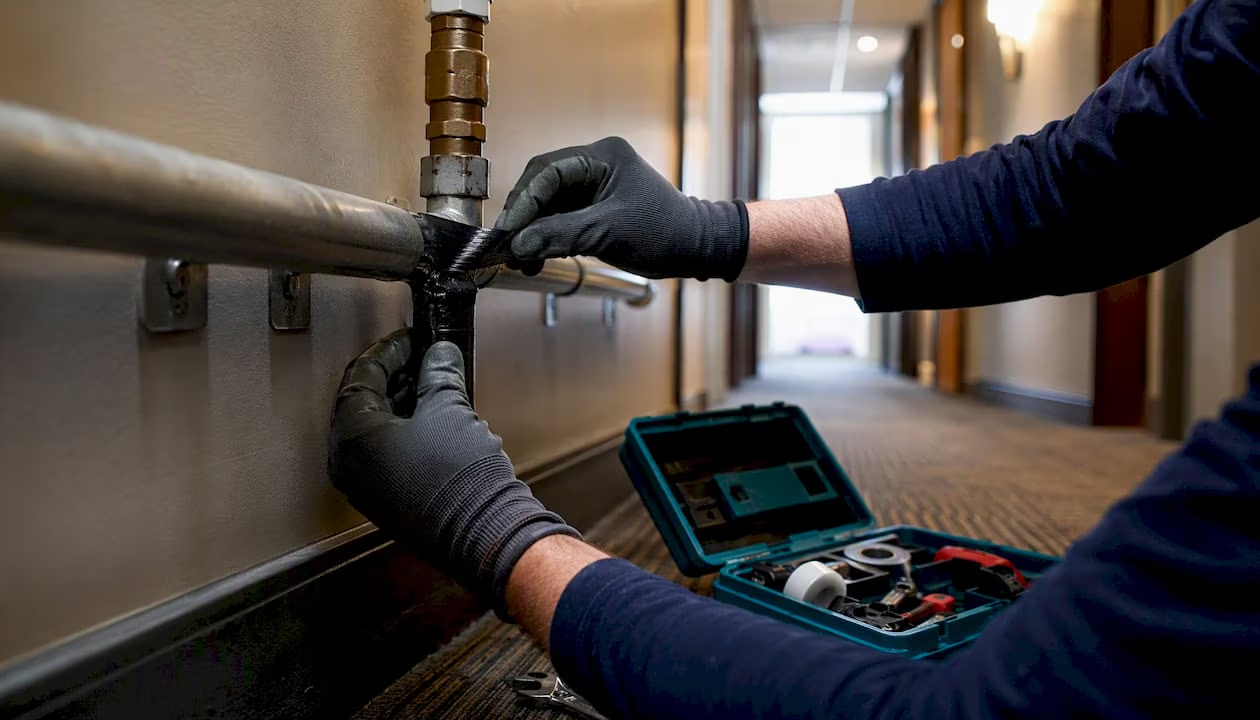
That sequence sounds obvious written down. It rarely happens cleanly under pressure unless it’s rehearsed. The value of a fixed framework is that it removes decision-making from the moment of maximum stress, when a duty manager is fielding a distressed guest, a housekeeping supervisor and an engineer’s voicemail all within the same three minutes.
The first 10 minutes, first hour, first 24 hours
First 10 minutes: confirm the nature and location of the fault, isolate the immediate hazard (power, water or gas as appropriate), move any guests away from risk, and log the exact time the report came in.
First hour: notify the on-call engineer or contracted specialist, brief the front desk on what guests should be told, assess whether rooms need to be taken out of service, and begin photographing the affected area with timestamps.
Next 24 hours: confirm repair progress or parts sourcing, update affected guests with a revised timeline, complete incident documentation, and schedule a follow-up inspection once the repair is signed off.
| Role | Immediate action | Within the hour | Follow-up |
|---|---|---|---|
| Front desk | Take the report, alert duty manager | Brief guests, manage room moves | Log guest communication outcomes |
| Housekeeping | Vacate and secure the area | Support room reallocation | Deep-clean or reset once cleared |
| Engineering | Isolate the hazard | Diagnose and begin repair | Complete work order, close ticket |
| Security | Cordon off the zone if needed | Monitor access | Confirm area is safe for re-entry |
| On-call contractor | Confirm ETA | Attend and assess | Submit report and invoice with evidence |
| Senior manager | Approve escalation | Authorise spend if needed | Review incident, brief ownership |
Teams that treat maintenance as part of guest service rather than a back-of-house function tend to handle this moment better: the repair either stays invisible to the guest, or the team delivers a service-recovery experience good enough that the guest remembers the response, not the failure.
Pro Tip: Photograph the asset ID, the fault, and a visible timestamp before you touch anything. That single habit does more to speed up contractor invoicing and insurance claims than any amount of paperwork after the fact, because it ties the repair to a specific asset and moment rather than relying on memory later.
How do you build 24/7 emergency response without overspending?
Three coverage models exist, and most hotels end up somewhere between the second and third: an in-house rota, a retained contractor arrangement, or a hybrid that mixes both depending on trade and severity.
An in-house rota gives you the fastest possible response and the most control, since your own engineer already knows the building, the assets and the quirks of every plant room. It’s expensive to sustain around the clock unless you have enough scale to justify shift patterns, and single-site boutique properties rarely do. A retained contractor or emergency call-out panel spreads that cost across multiple clients, trading a little response speed for a fixed, predictable retainer. A hybrid model, in-house cover for common trades with a contracted specialist for gas, lifts or refrigeration, tends to suit mid-sized independent hotels best.
Pro Tip: Ask any prospective contractor for their average response time by severity band, not just their advertised “24/7” claim. A vague promise of availability is not the same as a guaranteed arrival window.
Whichever model you choose, your SLA should specify:
- Response time by severity (immediate safety versus comfort-impacting versus minor).
- How parts are sourced out of hours, and who absorbs the cost of expedited sourcing.
- A clear escalation path if the first attending engineer can’t resolve the fault.
- Guaranteed callout windows tied to price zones, so out-of-hours rates are agreed in advance, not negotiated mid-crisis.
Pro Tip: Fixed-price callout windows protect you from surprise invoices more than any other single contract clause. Ask for them explicitly rather than assuming they’re standard.
Contract clauses worth insisting on include capped callout fees, proof of trade competency and insurance (including Gas Safe registration for gas work, as required by the Gas Safe Register), and audit access so you can review response performance over time rather than taking a provider’s word for it.
- Consolidate vendors where possible, fewer relationships mean simpler escalation and better negotiating leverage on retainer pricing.
- Build zonal rosters if you manage a portfolio, so one on-call engineer can reasonably cover several nearby sites.
- Use shift overlap at handover points to avoid gaps where nobody is technically on call.
Pro Tip: A retainer makes financial sense once your emergency call volume becomes predictable enough to forecast. Below that threshold, a well-vetted call-out panel usually beats paying for standing capacity you don’t use.
For London properties in particular, response geography matters as much as contract terms. Practical guidance on emergency property repair in dense urban settings shows how traffic and access restrictions can turn a nominally fast SLA into a much slower real-world response if the contractor isn’t genuinely local.
Which tools help reduce emergency repairs and speed them up?
A CMMS (computerised maintenance management system) is the single biggest lever most hotels underuse, routing work orders automatically, maintaining full asset history, and scheduling preventive tasks before they become emergencies.
Mobile workflows matter as much as the software itself. An engineer who can log a fault, attach a photo and close a work order from a phone on the plant room floor generates a far more useful audit trail than one filling in a paper log at the end of a shift. ServiceChannel’s analysis of reactive versus preventive maintenance recommends exactly this: standardising tasks through a CMMS and benchmarking your reactive-to-preventive ratio over time rather than guessing at it.
IoT sensors extend that same logic into prediction. A vibration sensor on a chiller compressor, a temperature logger in a walk-in fridge, or a leak detector under a plant room floor can flag drift long before a guest notices anything wrong. That’s the practical difference between reactive and predictive maintenance: one waits for failure, the other watches for the early signs of it.
Implementation works best in stages:
- Start with your highest-criticality assets, kitchen refrigeration, lifts, boilers, rather than trying to sensor everything at once.
- Run new digital logging in parallel with existing paper processes for a few weeks before switching over completely.
- Train front-line staff, not just engineers, to capture photos and timestamps the moment they spot a fault.
- Review sensor alerts weekly to catch false positives before they erode trust in the system.
Pro Tip: Time-stamped photo documentation isn’t just good practice, it directly speeds up contractor billing, insurer claims and owner reporting. Matterport’s research on digital documentation in hospitality maintenance shows that tying a repair to a specific asset and location through visual evidence reduces disputes and accelerates every downstream process that depends on proving what happened and when.
- Photograph the fault and asset ID before repair begins.
- Photograph the completed repair for verification.
- Attach both images and a timestamp to the work order in your CMMS.
- Use that same evidence trail for insurance claims and owner reporting without re-creating documentation later.
What KPIs prove your emergency response is working?
Seven metrics tell you almost everything you need to know about how well your maintenance operation is performing: response time by severity, mean time to repair (MTTR), percentage reactive versus preventive work, PM completion rate, cost per occupied room, repeat-fault rate, and work-order backlog.
Response time and MTTR measure speed. The reactive-versus-preventive split and PM completion rate measure discipline, whether you’re actually running the programme you designed or letting it slip under pressure. Cost per occupied room ties maintenance spend to your actual business metric rather than treating it as an isolated departmental cost. Repeat-fault rate catches the pattern most teams miss: the same asset failing three times in a quarter isn’t three unrelated emergencies, it’s one unresolved root cause.
| KPI | Target range | Why it matters |
|---|---|---|
| PM completion rate | Above 85% | Confirms scheduled work is actually happening, not just planned |
| Reactive work share | Below 20% of total work orders | Siteminder’s guidance suggests an 80/20 preventive-to-reactive split as a practical goal |
| MTTR (critical severity) | Under 2–4 hours | Minimises guest-facing disruption for safety-critical faults |
| Repeat-fault rate | Trending downward quarter on quarter | Flags root causes rather than symptom-chasing |
A regression study covering five hotels found preventive maintenance predicted customer satisfaction with a correlation of r = 0.71 (p < 0.01), meaning preventive work explained over half the variance in guest satisfaction scores across the sampled properties. That’s a striking number for a maintenance function that guests rarely notice when it’s working properly.
Report these figures to ownership in trend form, not single snapshots. A single month’s MTTR tells you almost nothing; six months of MTTR trending downward alongside a rising PM completion rate tells a story ownership can act on, and it’s the kind of evidence that justifies further investment in preventive systems rather than treating maintenance as a pure cost centre.
How should hotels communicate with guests during repairs?
The right script depends entirely on severity, and using the wrong tone for the wrong situation is where most service recovery goes wrong.
For an immediate safety issue (a fire alarm activation, a gas smell, an evacuation), front desk staff need calm, direct language: “For your safety, we need you to move to reception while our team checks something in your area. We’ll have you back in your room as soon as it’s confirmed safe.” No apology tone here, just clarity and calm authority.
For a comfort-impacting fault (no hot water, air conditioning down), the script shifts toward reassurance and a timeline: “We’re aware of the issue and have an engineer working on it now. We expect it resolved by [time], and in the meantime we’d like to offer you [amenity or room move].” For minor disruption (a noisy repair nearby, brief corridor access restriction), a simple heads-up suffices: “We wanted to let you know we’ll have some brief maintenance work happening on this floor between 10 and 11am.”
Discreet working protects the guest experience as much as the repair itself:
- Schedule non-urgent repair elements outside peak occupancy hours where possible.
- Have contractors wear identifiable, presentable uniforms rather than arriving in unbranded work clothes.
- Offer temporary amenities (a different bathroom, a loaner kettle) rather than leaving a guest without a basic comfort.
- Move guests to an equivalent or upgraded room when a fault can’t be resolved same-day.
Safety compliance sits underneath all of this. HSE’s Legionella guidance requires dutyholders to assess and manage water-system risks with proper monitoring records, and audit-ready documentation, the same time-stamped evidence trail discussed earlier, is what protects you if a compliance body or insurer ever asks to see your process rather than just your outcomes.
Pro Tip: Reserve compensation for genuine safety or comfort failures where the guest lost something material. For minor disruption, a sincere update and a small gesture, a complimentary coffee, an early checkout, usually rebuilds trust faster than a discount that implies something went badly wrong.
Guest review data consistently links maintenance responsiveness to satisfaction scores, and HotelSpeak’s analysis found that well-executed preventive maintenance correlates with fewer negative reviews overall, reinforcing that how you handle the rare emergency matters, but preventing it in the first place matters more.
Should you keep emergency repairs in-house or outsource them?
The decision comes down to five factors: scale, asset criticality, internal skillset, cost volatility and procurement overhead, and most hotels land on a mixed answer rather than an all-or-nothing one.
A large multi-site group with in-house engineers already on shift can often handle common trades, electrical, minor plumbing, general fabric, internally, while outsourcing specialist plant like lifts, commercial kitchen equipment and gas systems to certified contractors regardless of scale. A single-site boutique hotel rarely has the volume to justify a full in-house team and typically does better with a retained contractor relationship that guarantees response times without carrying full-time payroll cost.
Outsourcing reduces latency when your internal team lacks the specific competency, gas work legally requires a Gas Safe registered engineer, and there’s no shortcut around that requirement. It adds cost and reduces control when you’re outsourcing routine work that an in-house team could handle faster and more cheaply simply because they already know the building.
Watch for these red flags that point toward bringing in a specialist partner:
- Repeated emergency calls on the same asset or system within a short period.
- Specialist plant failures your internal team can’t diagnose confidently.
- Recruitment or retention difficulty keeping a stable in-house engineering team.
- Rising out-of-hours spend with no visibility into why.
- Vet any contractor’s competency documentation and insurance before signing anything.
- Confirm response-time guarantees are written into the contract, not just quoted verbally.
- Check whether the contractor can integrate with your CMMS for shared visibility on work orders and history.
Pro Tip: Ask a prospective contractor how they document completed work. A contractor who photographs and timestamps every job as standard practice will save you far more admin time over a year than one who simply invoices and moves on.
MRI Software’s analysis of facilities management in hospitality makes the broader case well: structured FM discipline, whether delivered in-house or through a partner, protects asset value and keeps you audit-ready for life-safety compliance, which matters as much to your insurer as it does to your guests.
What does the evidence say about preventive maintenance and guest satisfaction?
The clearest piece of evidence available is a regression study of five hotels showing preventive maintenance predicted customer satisfaction at r = 0.71 (p < 0.01), meaning the relationship is both strong and statistically unlikely to be chance, with preventive work explaining more than half the observed variance in satisfaction scores.
That single figure reframes how maintenance spend should be judged. It’s not simply a cost line that shrinks when nothing breaks; it’s an input that measurably moves the metric ownership actually cares about.
| Maintenance approach | Typical cost pattern | Guest experience impact |
|---|---|---|
| Preventive-led (80/20 target) | Predictable, budgeted spend | Fewer visible disruptions, higher satisfaction correlation |
| Reactive-heavy | Volatile, premium out-of-hours rates | Higher complaint frequency, greater revenue risk |
Siteminder’s industry guidance recommends targeting roughly an 80% preventive to 20% reactive split as a practical benchmark, arguing that hotels closer to this ratio see fewer emergency incidents and more stable operational costs. Moving toward that ratio isn’t an overnight shift, it usually takes a full budget cycle of protected PM funding before the reactive share visibly drops.
Documentation discipline reinforces every part of this case. Time-stamped photos and asset history don’t just speed up individual repairs, they build a record that demonstrates competence and diligence over time, the kind of evidence an insurer, an auditor, or a prospective buyer of the property will eventually want to see.
- Preventive maintenance correlates strongly with guest satisfaction (r = 0.71, p < 0.01).
- An 80/20 preventive-to-reactive split is a realistic, evidence-backed target rather than an arbitrary number.
- Documentation isn’t paperwork for its own sake, it’s the trail that proves your maintenance discipline when it matters most.
What do hotel maintenance teams get wrong about emergency repairs?
Most operational failures I’ve seen in hospitality maintenance trace back to one habit: treating the preventive maintenance schedule as the first thing to sacrifice when a property gets busy. It’s an understandable instinct, PM feels deferrable because nothing is visibly broken yet, but it’s exactly backwards. The properties with the calmest emergency logs are the ones that protect PM funding hardest during peak season, not the ones that relax it.
The second mistake is treating documentation as an afterthought rather than part of the repair itself. Teams that photograph and log everything as they go, rather than reconstructing what happened after the fact, consistently resolve insurance claims faster and face fewer disputes over invoicing. It’s a small behavioural change with outsized returns, and it costs nothing beyond the discipline to do it every time rather than only when it seems worth the effort.
The third gap is training. Front-line staff, not just engineers, need to know the difference between a reactive fault and an emergency, because they’re usually the first person to spot it. A housekeeper who knows to flag water pooling near a socket as urgent rather than routine can prevent a genuinely dangerous situation from sitting unreported for hours.
None of this requires exotic technology or huge budgets. It requires protecting the boring, scheduled work, documenting consistently, and training people who aren’t engineers to recognise risk early. Where scale or traceability becomes a genuine constraint, and a small in-house team simply can’t cover 24/7 response across multiple properties, a retained partner with structured reporting fills that gap without requiring a hotel to build out a full engineering department it doesn’t otherwise need.
How can a specialist partner support your emergency repair strategy?
Upkeep UK is built around exactly the gap most hotels feel hardest: getting a genuinely fast, insured response at 2am without carrying the overhead of a full in-house engineering rota. The offering combines 24/7 callout cover, fixed-price windows so you’re never negotiating rates mid-crisis, fully insured tradespeople across every trade a hotel needs, and planned preventive maintenance programmes that keep your reactive share trending down rather than up.
Multi-site hotel groups benefit from consolidated reporting across properties and consistent response standards regardless of location. Single-site boutique hotels get contracted cover without the cost of standing engineering capacity they’d rarely fully use. Properties with specialist plant, pools, commercial kitchens, plant-heavy HVAC systems, benefit particularly from a partner who already understands that equipment rather than learning it during an emergency.
Every job comes with audit-ready records: time-stamped photos, asset history and completion evidence that speeds up insurer reviews and owner reporting without extra admin on your side. If you’re weighing whether to formalise your emergency response with a retained partner, Upkeep UK’s hospitality maintenance service is a practical place to start, and if a fault is live right now, get a quote for emergency repairs to get a response underway today.
Sources
- Gov
- Preventive maintenance and customer satisfaction study (zenodo DOI)
- The silent revenue killer: how maintenance delays are sabotaging guest experience (HotelSpeak)
For deeper, company-provided guidance, Upkeep UK’s own resources cover related ground in more detail:
































