


Hire a property maintenance consultant when the job ahead is bigger than day-to-day upkeep, specifically when you need a multi-year planned preventative maintenance (PPM) programme, a capital needs assessment, or a compliance audit that your in-house team doesn’t have the time or the specialism to produce. If that’s where you are, Upkeep UK offers exactly this: property consultancy maintenance that moves from survey to a costed, prioritised works programme without months of back-and-forth.
Three things should come out of a well-run consultancy engagement:
- A prioritised capital plan that ranks work by risk and cost, not by who shouts loudest
- A measurable drop in reactive, emergency spend within the first year
- Documented compliance assurance across fire, water hygiene, gas and electrical systems
If you’re managing a single let and firefighting the odd boiler breakdown, you don’t need this. If you’re sitting on a portfolio with unclear lifecycle costs or a looming compliance gap, you do.
Key Takeaways
Property consultancy maintenance works when a costed, prioritised PPM programme is paired with clear governance and SLAs tracked through a CMMS.
| Point | Details |
|---|---|
| Match service to need | Commission PPM and CNA for strategic planning; keep operational repairs with day-to-day management. |
| Set KPIs from day one | Track response time, cost-per-job, deferred maintenance backlog and satisfaction scores from month one. |
| Vet credentials before scope | Confirm RICS familiarity, PI insurance and sector experience before reviewing any fee proposal. |
| Budget beyond the survey fee | Plan for subconsultant costs, procurement management and a 10 to 15% contingency line. |
| Choose a delivery-ready provider | Upkeep UK combines survey-led planning with fixed-price, insured delivery across London and the UK. |
Table of Contents
- What does property consultancy maintenance cover?
- How does a consultant’s role differ from day-to-day management?
- What ROI and KPIs should you expect from consultancy maintenance?
- How do you choose the right maintenance consultant?
- What does the consultancy process actually involve?
- What do consultancy fees typically cover?
- Why trust Upkeep UK on consultancy-style maintenance work?
- What outcomes have similar consultancy engagements delivered?
- What’s the realistic timeline for a consultancy maintenance project?
- What does consultancy maintenance really cost over time?
- What the industry gets wrong about consultancy maintenance
- Get a property maintenance survey without the agency overhead
- Frequently asked questions
- Sources
What does property consultancy maintenance cover?
Property consultancy maintenance isn’t one service. It’s a bundle of related disciplines that a good consultant will unbundle for you at the briefing stage, because paying for the wrong one wastes money and delays the work you actually need.
Planned preventative maintenance (PPM) sits at the core. RICS describes PPM as a structured survey process that produces a condition assessment and a costed replacement schedule, typically covering five to ten years, sometimes stretching to thirty for major structural elements. A condition survey is the diagnostic snapshot; a capital needs assessment (CNA) turns that snapshot into a funding plan, usually phased across financial years.
Beyond PPM, the main service categories are:
- Asset management advisory — lifecycle costing, replacement forecasting, and portfolio-level prioritisation
- Compliance advisory — auditing fire, water hygiene, gas and electrical systems against statutory obligations
- Development and project consultancy — feasibility and specification work for refurbishments, extensions and fit-outs
Outputs typically arrive as a schedule of works, a costed programme broken down by year, and a procurement pack ready to send to contractors. Landlords tend to commission PPM and compliance work directly; managing agents and asset managers more often commission the fuller CNA and development consultancy packages, particularly on mixed-use or block portfolios.
How does a consultant’s role differ from day-to-day management?
A consultant thinks in years; a property manager thinks in weeks. That distinction causes more scope confusion than any other part of the brief, so it’s worth setting out clearly before you sign anything.
- Strategic tasks belong to the consultant: condition surveys, lifecycle modelling, capital planning, and compliance gap analysis. Operational tasks stay with your managing agent or in-house team: responding to a leaking tap, chasing a contractor invoice, logging a tenant complaint.
- Sample deliverables you should expect include a costed PPM programme, a lifecycle replacement model for major plant and fabric, and a contractor performance review benchmarking your incumbent suppliers against market rates and response times.
- Consultants operate in two modes: advisor only, where they hand you the programme and you procure the work yourselves, or delivery management, where they also manage tendering and contractor oversight. Clarify which one you’re buying before the fee is agreed.
- Where you already run a CMMS, expect the consultant to align their PPM programme with your existing asset registers and reporting fields rather than build a parallel system you’ll have to reconcile later.
Skipping this distinction is the single most common cause of disputes over what a consultancy fee was actually meant to cover.
What ROI and KPIs should you expect from consultancy maintenance?
Preventative planning reduces lifecycle costs because you’re replacing components on a schedule, not in a panic. A roof that’s re-covered on a planned regular cycle costs significantly less than an emergency repair after water ingress has damaged underlying structures, the ceiling below that, and the tenant’s goodwill along with it.
Better Buildings Partnership guidance notes that condition-based and predictive maintenance strategies usually demand higher upfront investment in monitoring but reduce total lifecycle cost and downtime over the medium to long term.
Track these KPIs from month one so you can prove impact rather than just feel it:
- Emergency response time against your agreed SLA
- Cost-per-job trend, split between planned and reactive spend
- Deferred maintenance backlog, tracked as a rolling total rather than a snapshot
- Tenant or occupier satisfaction scores, particularly for repair turnaround
Savings tend to surface first in procurement, where bundled, planned works attract better contractor pricing than one-off emergency call-outs, and in reduced rework, where a properly specified job doesn’t need revisiting within eighteen months. For the first 12 to 24 months, set a realistic target: a measurable reduction in reactive spend as a proportion of total maintenance budget, not a dramatic overnight transformation. Hybrid delivery models combining a small in-house team with outsourced specialists coordinated through a CMMS tend to outperform both fully outsourced and fully in-house setups on cost and response time.
How do you choose the right maintenance consultant?
Getting this decision wrong is expensive twice over: once on the fee, and again on the rework when the programme they hand you doesn’t survive contact with your actual building.
Start with credentials. Look for genuine familiarity with RICS standards, particularly the PPM guidance, appropriate professional indemnity insurance, and demonstrable experience in your property sector, since a consultant who’s only ever surveyed retail units will misjudge the specialist plant in a hotel or a listed residential block. RICS is explicit that PPM surveys should never exceed the surveyor’s own competence; specialist areas like M&E, fire engineering, cladding and asbestos usually need named subconsultants, and a proposal that doesn’t mention them is worth questioning.
Before appointing anyone, ask to see:
- A sample PPM report or condition survey from a comparable property
- Their survey methodology, including how they grade condition and prioritise risk
- CVs for the actual surveyors who’ll be on site, not just the partner who signs the proposal
Red flags worth walking away from: vague scope documents, no named subconsultants for specialist systems, proposed SLAs with no measurable response times attached, and any reluctance to confirm how their reporting will integrate with your CMMS.
Pro Tip: Ask for a de-scoped version of a past PPM report with client details redacted. How they structure priorities on paper tells you more about their thinking than any pitch deck will.
If you’re weighing this decision against ongoing operational risk, our piece on property maintenance mistakes landlords must avoid covers the failure patterns that tend to surface when this stage is rushed.
What does the consultancy process actually involve?
A property consultancy maintenance engagement runs through five predictable stages, and knowing them in advance means you can prepare the right inputs rather than scrambling for records mid-survey.
- Briefing. You provide historical maintenance records, current leases, access arrangements, and any existing asset registers. The clearer this pack, the sharper the resulting programme.
- Site inspection. The surveyor walks the building, assessing structure, plant, fabric and statutory compliance items against the brief, usually cross-referencing against any CMMS data you’ve already supplied.
- Survey and CNA production. Findings are converted into a condition-graded schedule and, where commissioned, a capital needs assessment that phases spend across financial years by urgency and budget cycle.
- Programme presentation. You receive a prioritised, costed works programme, typically with options for phasing if the full spend isn’t affordable in year one.
- Procurement and governance. Work packages go out to tender, contracts are set with short, testable SLAs for emergency response and completion times, and reporting is linked back into your CMMS so contractor payment can be tied to SLA compliance.
RICS guidance stresses that this whole chain depends on clear written contracts and defined managerial responsibilities at every handover point. Skipping the governance stage, treating procurement as an afterthought, is where good surveys turn into programmes nobody actually delivers.
What do consultancy fees typically cover?
Fee structures vary more than most property owners expect, so it’s worth understanding the model before comparing quotes side by side.
- Fixed-fee surveys suit a defined scope, such as a single condition survey or compliance audit on one building
- Day rates apply where the scope is uncertain at the outset or spans multiple specialisms
- Retainers cover ongoing advisory work, such as quarterly programme reviews or compliance monitoring
- Hybrid models combine a fixed survey fee with a percentage-based charge for delivery management if the consultant also runs procurement
Price is driven by scope size, building complexity, the state of existing records, and how many specialist trades need subconsultant input. A well-maintained building with good historical records costs less to survey than one with no records at all, because the surveyor is starting from zero.
Whatever model you agree, the contract needs to nail down deliverable formats, explicit exclusions, liability and insurance limits, and who owns the survey data and IP once the engagement ends. Ambiguity here, especially around service charge transparency on multi-let buildings, is a recurring source of dispute later.
Why trust Upkeep UK on consultancy-style maintenance work?
Upkeep UK has built its reputation on the parts of this process that tend to break down elsewhere: fast response, fixed pricing, and fully insured tradespeople who actually show up when scheduled. That matters just as much in consultancy-adjacent work as it does in reactive repairs.
- Fixed-price quoting on survey-led works, so a capital plan doesn’t get derailed by scope creep
- Insured, vetted tradespeople across roofing, electrical, plumbing and building trades
- Quick turnaround from survey findings to an actionable, costed programme
- Experience across residential, commercial, hospitality and public sector portfolios in London and beyond
The gap between a report that sits on a shelf and a programme that actually gets delivered is almost always governance: who owns each action, by when, and against what SLA. That’s the part we focus on once the survey is done.
This article’s editorial perspective is provided by Drahim Hasula, drawing on Upkeep UK’s own delivery experience across planned maintenance and refurbishment projects. If you want to see how a survey turns into delivered work, our landlord maintenance services and block management pages set out how we run that handover in practice.
What outcomes have similar consultancy engagements delivered?
Two short examples illustrate how a consultancy input translates into a measurable result, rather than just a report.
- A residential block with a growing backlog of deferred roofing and communal electrical work commissioned a condition survey and CNA. The resulting phased programme prioritised roof works in year one, reducing emergency call-outs related to water ingress within two survey cycles. Success was tracked against reactive spend as a proportion of total maintenance budget, reviewed quarterly with the managing agent.
- A commercial property facing a fire compliance gap commissioned an audit and remedial works programme. Compliance was achieved against a fixed deadline, with contractor payment linked to SLA completion dates logged in the client’s CMMS. Follow-on works included a rolling PPM schedule to prevent recurrence.
Typical duration for this scale of project runs from initial survey to first remedial works in eight to twelve weeks, with the CNA phasing the remaining spend over subsequent budget years.
What’s the realistic timeline for a consultancy maintenance project?
Most owners underestimate how long the early stages take and overestimate how long delivery takes, which is the opposite of what actually happens.
The briefing and records-gathering phase typically runs one to two weeks, longer if leases and historical maintenance data are scattered across multiple agents. Site inspection and survey work, depending on building size and complexity, takes anywhere from a few days for a single property to several weeks for a multi-block portfolio. Producing the costed programme and CNA usually adds another two to four weeks, since this is where lifecycle costing and prioritisation logic get built and checked.

Once you have a programme, procurement for the first tranche of works, tendering, contractor selection, contract signing, generally runs four to six weeks for straightforward jobs and considerably longer for specialist trades like cladding remediation or major M&E replacement. First works on site typically start within two to three months of the initial brief for a well-organised engagement.
From there, the project shifts into an ongoing maintenance phase: quarterly or annual programme reviews, rolling procurement for subsequent works tranches, and continuous compliance monitoring. A five-year PPM programme isn’t a single project with an end date. It’s a live document, revisited and reprioritised as conditions, budgets and regulations change. Owners who treat the CNA as fixed rather than iterative tend to find it stale within eighteen months.
What does consultancy maintenance really cost over time?
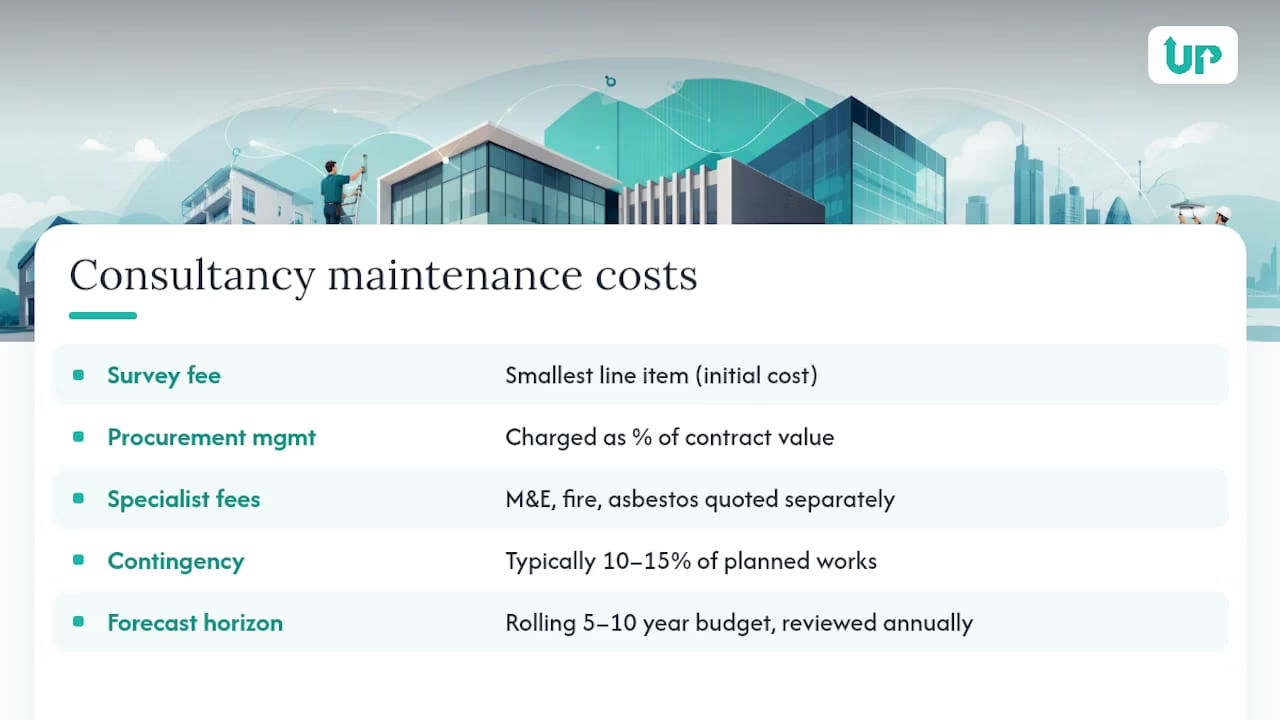
The headline survey fee is rarely the number that matters most. It’s the smallest line item in a multi-year budget, and treating it as the whole cost is how owners end up underfunding the works that follow.
Beyond the initial survey or CNA fee, budget for procurement management costs if you’re using the consultant beyond an advisory role, typically a percentage of contract value rather than a flat fee. Specialist subconsultant fees for M&E, fire engineering or asbestos surveys sit outside the base PPM fee in most proposals, and a quote that doesn’t mention them upfront often adds them later as a variation. Contingency for unforeseen works discovered once surveys begin, cladding issues behind render, deteriorated cabling behind finished ceilings, should sit in your budget at the outset, not as a shock addition.
Long-term budgeting means treating the CNA as a rolling five to ten-year spend forecast, reviewed annually against actual costs and inflation in materials and labour. Hidden costs tend to cluster around three areas: reactive works that should have been caught by the PPM programme but weren’t because the schedule wasn’t followed, contractor variations on specialist trades that weren’t scoped clearly at procurement stage, and compliance remedial work that surfaces only once an audit actually happens rather than being assumed compliant. Building a realistic contingency line, typically 10 to 15% of the annual planned works budget, absorbs most of this without derailing the wider programme.
What the industry gets wrong about consultancy maintenance
Most advice on this subject treats the survey as the product. It isn’t. The survey is diagnostic; the programme and its governance are what actually change your maintenance spend, and that’s the part conventional guides gloss over in a rush to explain PPM jargon.
The bigger failure I see is owners treating a capital needs assessment as a fixed document rather than a living one. Conditions change, budgets shift, and a CNA written in year one that’s never revisited is stale by year three. If you’re commissioning a consultant, ask upfront how the programme gets reviewed and updated, not just how it gets produced.
What should you prioritise first? Governance, not glossy reporting. A beautifully formatted PPM survey with no SLA structure and no CMMS integration plan is a document that sits on a shelf. The consultants worth paying are the ones who ask, before they’ve even started the survey, how their findings will actually get turned into procured, delivered, accountable work. That question separates useful consultancy from an expensive report.
Get a property maintenance survey without the agency overhead
Upkeep UK is the practical alternative to a drawn-out consultancy process for London property owners and managers: one team handles the survey, the programme, and the delivery, so findings don’t sit in a report waiting for a separate contractor to be found and briefed.
That matters most in the gap this article has covered repeatedly, governance and delivery, because Upkeep UK’s fixed-price model and insured trades mean a prioritised works programme can move straight into procurement without a second tendering exercise. Whether you need a full landlord maintenance package or emergency reactive cover while a longer-term programme is agreed, our teams work from survey findings rather than starting from scratch. If you’re ready to commission a survey or discuss a planned maintenance programme for your portfolio, get in touch with Upkeep UK or explore our landlord property maintenance services to see how a survey turns into scheduled, delivered work.
Frequently asked questions
What is the difference between a property maintenance consultant and a property manager?
A consultant produces strategic outputs, condition surveys, CNAs and compliance audits, while a property manager handles day-to-day operational tasks like repair call-outs and tenant communication. The two roles overlap but shouldn’t be confused when scoping a brief.
How much does a PPM survey typically cost?
Cost depends on building size, complexity and record quality, and is usually quoted as a fixed fee for a defined scope or a day rate where the scope is uncertain. Always ask whether specialist subconsultant fees are included or added separately.
How often should a PPM programme be reviewed?
RICS-aligned programmes typically run five to ten years, but the programme itself should be reviewed annually against actual spend, inflation and any changes to the building or its compliance obligations.
Can Upkeep UK deliver the works identified in a consultancy survey?
Yes. Upkeep UK’s fixed-price, insured teams can take a prioritised works programme straight into delivery across roofing, electrical, plumbing and refurbishment work, avoiding a separate procurement exercise for straightforward jobs.
Sources
- RICS: Planned Preventative Maintenance standard (June 2022)
- Better Buildings Partnership: Maintenance, monitoring and operational management (GN24)
































