


TL;DR:
- Damp in London properties often causes hidden damage that worsens over time, especially in older buildings with structural vulnerabilities. Proper diagnosis and targeted repairs are essential, as treating damp symptoms without addressing the root cause leads to recurring issues. Landlords have legal obligations under Section 11 to repair structural damp and must promptly respond to tenant reports to ensure safe, compliant living spaces.
Damp in London properties causes and fixes more damage than most owners realise until it is too late. Damp can remain hidden inside walls for weeks or months, accumulating silently before a single stain appears on the surface. Between 4% and 27% of English households are affected by damp and mould, and London’s ageing building stock makes the capital particularly vulnerable. Whether you own a Victorian terrace in Hackney or manage a flat in a period conversion in Islington, understanding the three main damp types, their causes, and the right fixes will protect your property and keep you legally compliant.
Key takeaways
| Point | Details |
|---|---|
| Three distinct damp types | Rising, penetrating, and condensation damp each require different diagnosis and treatment methods. |
| London’s older buildings are high risk | Victorian and period buildings are especially prone due to construction methods and the city’s wet climate. |
| Structural damp needs professional repair | Dehumidifiers manage condensation but cannot fix rising or penetrating damp, which require structural work. |
| Landlords carry legal liability | Under Section 11, landlords must repair structural damp and keep properties fit and safe for tenants. |
| Early detection saves money | Professional surveys catch damp before visible damage appears, reducing long-term repair costs significantly. |
Types of damp in London properties
Getting the diagnosis right is the most important step. Treating the wrong type of damp wastes money and leaves the underlying problem untouched. London properties, particularly those built before 1920, tend to present with all three types at different times, sometimes simultaneously.
Rising damp occurs when groundwater travels upward through masonry and brickwork by capillary action. The tell-tale signs are a horizontal tide mark on lower walls, usually no higher than one metre from the floor, along with peeling paint, white salt deposits (known as efflorescence), and skirting boards that feel soft or are rotting at the base. It is almost exclusively a problem in older buildings where the damp-proof course has failed or was never installed.
Penetrating damp enters horizontally through external walls, roofs, or around window and door frames. It typically presents as damp patches that appear after heavy rain and are often darker or wetter in wet weather. You may notice it spreading outward from a specific point rather than rising from the floor.
Condensation damp is the most common type in London homes and is caused by warm, moisture-laden air meeting cold surfaces. Mould frequently develops in poorly ventilated areas like bathrooms, kitchens, and behind furniture, with a musty smell often being the first sign. Unlike the other two types, condensation is not caused by a structural defect.
- Rising damp: tide marks at low level, salt deposits, rotting skirting boards
- Penetrating damp: patches that worsen after rain, appearing at mid or high wall level
- Condensation: black mould spots, steamy windows, musty odour in enclosed spaces
Pro Tip: Before calling anyone out, press a piece of aluminium foil firmly against the damp patch and tape the edges. Leave it for 24 hours. If moisture appears on the outer surface, you have condensation. If it appears on the wall side, the damp is structural.
Causes of damp in London’s older buildings
London’s housing stock is one of the oldest in Europe, and that age creates specific vulnerabilities that newer builds simply do not share. Victorian and period buildings were constructed using lime mortar and solid brick walls rather than the cavity wall systems used from the mid-twentieth century onward. Solid walls offer far less resistance to moisture penetration, and lime mortar, while breathable, deteriorates over time.
The four most common structural causes in London properties are as follows:
- Failed or absent damp-proof course (DPC): Many pre-1920 properties either have no DPC or have one that has deteriorated. When the DPC fails, groundwater rises freely through the masonry.
- Defective gutters, downpipes, and drainage: Blocked or cracked gutters allow water to overflow and saturate external walls. This is one of the leading causes of penetrating damp and is easily overlooked during routine inspections.
- Cracked or spalled masonry: Frost damage, settlement, and age cause brickwork to crack. Water enters those cracks and migrates inward, often appearing as a damp patch on an internal wall several weeks later.
- Bridged cavity walls: In properties where cavity walls do exist, debris accumulation or poorly installed insulation can bridge the cavity, allowing moisture to cross from the outer to the inner leaf.
Beyond structural causes, lifestyle factors play a significant role in condensation. Indoor humidity above 55% significantly increases mould risk, and common household activities push humidity well above that threshold. Drying clothes indoors, cooking without extractor fans, and inadequate heating in winter all contribute. London’s climate, with its consistently damp winters and limited sunshine, means properties take longer to dry out between wet spells, compounding the problem.
| Cause | Damp type | Typical location in property |
|---|---|---|
| Failed DPC | Rising damp | Ground floor walls, below 1 metre |
| Blocked gutters | Penetrating damp | Upper walls, near roofline |
| Cracked masonry | Penetrating damp | External-facing walls, any level |
| Poor ventilation | Condensation | Bathrooms, kitchens, bedrooms |
| Bridged cavity wall | Penetrating damp | Mid-wall patches, post-insulation |
How to fix each type of damp correctly
The fix must match the cause. Applying anti-damp paint over rising damp, for instance, is not a solution. It traps moisture within the wall, accelerating decay and making the eventual repair more expensive.
Fixing rising damp
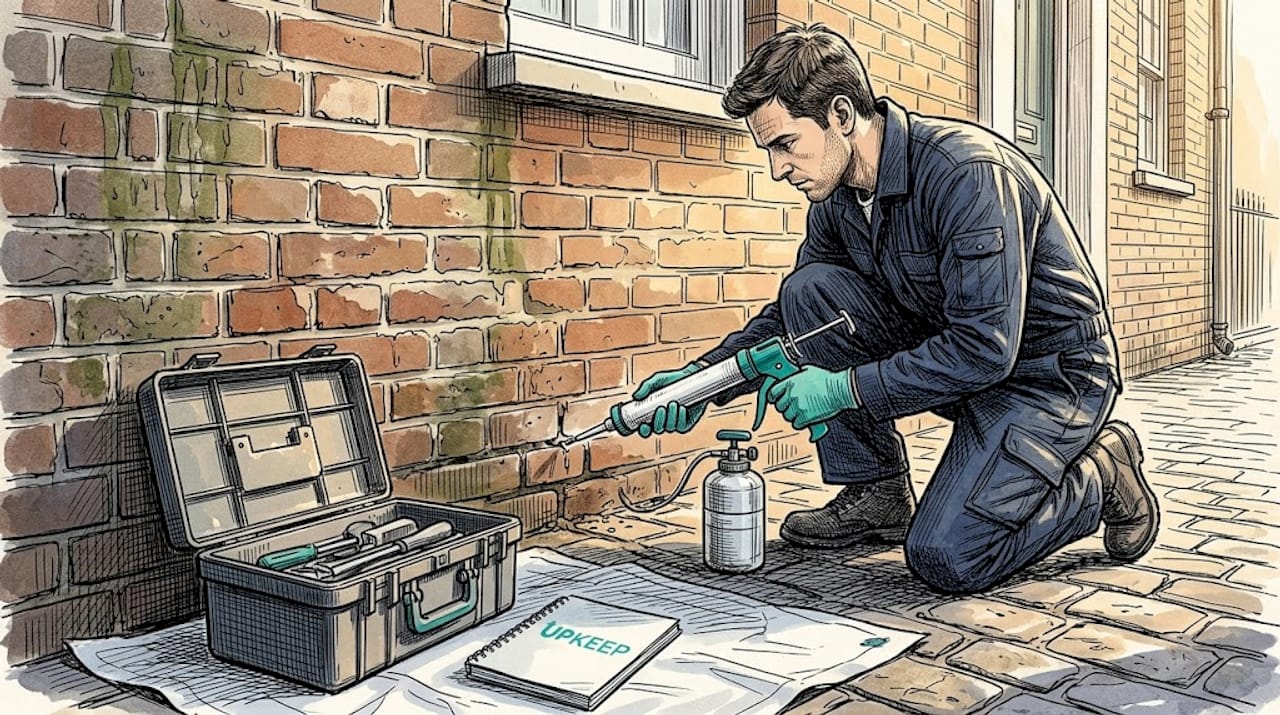
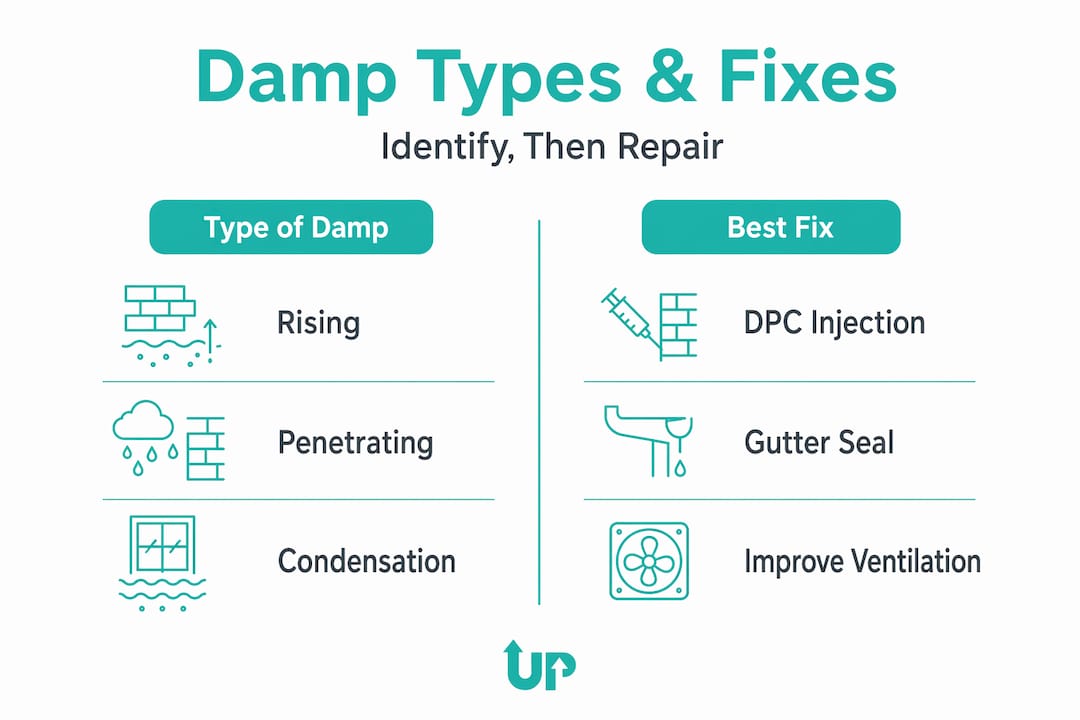
Rising damp requires specialist intervention. The standard professional approach is DPC injection, where a chemical damp-proof cream or fluid is injected into a series of drilled holes along the base of the affected wall. The chemical then cures within the masonry and creates a water-resistant barrier. Following injection, affected plaster must be removed and replaced with a salt-resistant render, because existing plaster will be contaminated with hygroscopic salts that will continue to attract moisture even after the DPC is installed. Quick fixes like painting over symptoms are ineffective and will not address the underlying structural problem.
Fixing penetrating damp
The repair strategy for penetrating damp is entirely dependent on where the water is entering. Start externally. Check gutters and downpipes for blockages, cracks, and misaligned joints. Inspect the roof for missing or slipped tiles. Look for cracks in render or pointing and repoint where necessary. Plumbing maintenance is also worth reviewing, as leaking pipes within walls can mimic penetrating damp. Once the external defect is repaired, allow the wall to dry fully before treating the internal surface.
Fixing condensation
Condensation is the one type where lifestyle changes genuinely make a difference, but they need to be paired with physical improvements. Fitting trickle vents to windows, installing positive input ventilation (PIV) systems, and upgrading extractor fans in bathrooms and kitchens all reduce moisture build-up. Dehumidifiers manage condensation effectively as a short-term measure but are not a substitute for improving ventilation. Keeping indoor temperatures consistent above 18°C also reduces the cold surfaces that condensation forms on.
| Fix type | DIY possible? | Professional required? | Approx. timeframe |
|---|---|---|---|
| DPC injection | No | Yes | 1 to 3 days |
| Gutter repair | Yes | Sometimes | Half a day |
| Repointing masonry | Partially | Recommended | 1 to 5 days |
| Extractor fan upgrade | Yes | For wiring | Half a day |
| Replastering after DPC | No | Yes | 3 to 7 days |
Pro Tip: After any damp repair, drying damp areas within 24 to 48 hours is critical to prevent mould taking hold. Use fans, dehumidifiers, and heating together to accelerate drying before redecorating.
Once the structural issue is resolved, affected areas should be cleaned with a mould-inhibiting solution and repainted using a breathable, mould-resistant paint. For safe mould removal guidance before repainting, Upkeep UK has detailed mould removal advice that covers the correct products and protective measures to use.
Landlord legal obligations for damp
Damp is not just a maintenance issue for landlords. It carries direct legal consequences. Under Section 11, landlords have a statutory duty to repair structural defects that cause damp and to keep the property fit and safe for habitation. This applies regardless of whether the tenancy agreement attempts to transfer responsibility.
When a tenant reports damp, the landlord’s obligations are clear:
- Respond to the report promptly and arrange an inspection within a reasonable timeframe
- Identify whether the damp is structural in origin, which is the landlord’s responsibility to repair
- Carry out repairs to a proper standard, not cosmetic fixes that mask the problem
- Allow the tenant to request a local authority environmental health inspection if the landlord fails to act
- Verify that repairs have been effective. A six-week check after completing repairs is strongly advised to confirm the damp has not returned
Failure to act on a legitimate damp report can result in an improvement notice from the local authority, a rent repayment order, or legal action from the tenant. Damp that causes mould growth also engages the Housing Health and Safety Rating System (HHSRS), under which severe mould is classified as a Category 1 hazard.
Landlord responsibility vs tenant lifestyle issues
This is where disputes most commonly arise, and clarity on both sides prevents unnecessary conflict. The distinction is straightforward in principle, even if it requires investigation in practice.
Landlord responsibilities include:
- Structural defects causing rising or penetrating damp
- Failed damp-proof courses and associated replastering
- Defective roofing, gutters, and external masonry
- Inadequate ventilation provision built into the property
Tenant responsibilities include:
- Condensation caused by insufficient heating or ventilation use
- Drying clothes indoors without adequate airflow
- Blocking extractor fans or failing to use them
- Failing to report damp promptly, which worsens the damage
The practical challenge is that condensation and structural damp can coexist. A property with a failing DPC will also suffer condensation if the tenant’s habits are poor. Landlords should document the property’s condition at the start of each tenancy, provide written guidance on ventilation and heating, and use professional surveys to establish the root cause before attributing responsibility. Upkeep UK recommends reviewing property maintenance red flags regularly so that structural issues are caught before a tenant reports them.
Pro Tip: Include a one-page ventilation guide in your tenant welcome pack. Explaining how to use extractor fans, when to open windows, and why consistent heating matters reduces condensation complaints and protects you legally if a dispute arises.
My honest take on damp in London properties
I’ve seen landlords spend thousands on replastering and repainting, only to have the damp return within a year because no one identified the root cause first. It happens more often than it should, and it is almost always the result of skipping a proper survey and going straight to cosmetic remediation.
The mistake I see most consistently is treating damp as a decorating problem. It is a structural or environmental problem that happens to show up on your walls. The visible stain is the last thing that appears, not the first thing that goes wrong. By the time you see it, moisture has often been accumulating inside the wall for months.
What I’ve learned from working on London’s period properties is that you rarely have just one type of damp. A Victorian terrace with a failed DPC will also have penetrating damp around the bay window frames and condensation in the back bedroom. Fixing one without addressing the others means the property will be back in the same state within two winters.
Early professional surveys are genuinely worth the cost. A moisture meter survey and a visual inspection of the external envelope will tell you more in two hours than months of watching patches on walls. And for landlords, that survey report is also your legal protection if a tenant dispute arises.
— Montgomery
How Upkeep UK can help with damp
If you are dealing with damp in a London property and need a clear diagnosis before committing to repairs, Upkeep UK’s team of experienced tradespeople and surveyors can help.

Upkeep UK carries out damp investigations across London’s residential and period building stock, from initial moisture surveys through to full remediation works including DPC injection, replastering, external masonry repairs, and ventilation upgrades. Every job is followed up to verify the repair has held. For landlords managing multiple properties, Upkeep UK also supports compliance with Section 11 obligations and provides documentation suitable for local authority inspections. If you are unsure whether your property’s damp is structural or lifestyle-related, a professional assessment removes the guesswork. Review Upkeep UK’s property maintenance services or explore the full range of completed projects to see the standard of work you can expect.
FAQ
What causes damp in London properties?
The most common causes are failed damp-proof courses in older buildings, defective gutters and external masonry allowing water ingress, and condensation from poor ventilation. London’s Victorian and period buildings are particularly susceptible due to solid wall construction and the city’s wet climate.
Is damp a landlord’s responsibility?
Structural damp caused by building defects is the landlord’s legal responsibility under Section 11 of the Landlord and Tenant Act 1985. Condensation resulting from a tenant’s lifestyle choices, such as inadequate heating or ventilation use, is generally the tenant’s responsibility, though the landlord must still provide adequate ventilation infrastructure.
How much does it cost to fix damp in a London property?
Costs vary significantly by type and severity. Gutter repairs may cost as little as £150 to £300, while full DPC injection with replastering in a ground floor room typically ranges from £1,500 to £4,000 in London. Penetrating damp repairs depend on the external defect involved. A professional survey, usually £200 to £500, is the most cost-effective starting point.
Can I fix damp myself?
Minor condensation issues, such as upgrading extractor fans or improving ventilation, are within DIY reach. Rising damp and penetrating damp require professional diagnosis and structural repair. Painting over damp or applying waterproof sealant without addressing the source will not solve the problem and may accelerate internal decay.
How quickly does damp cause mould?
Mould can begin to develop within 24 to 48 hours of a surface becoming wet, which is why prompt action after any water ingress is critical. Addressing moisture quickly and drying affected areas rapidly is the most effective way to prevent mould establishing itself after a damp incident.
































