


Landlords must have every fixed electrical installation inspected and tested by a qualified person at intervals of no more than five years, supply the report to existing tenants within 28 days, and act on any C1 or C2 finding within 28 days or sooner. Miss these deadlines and a local authority can serve a remedial notice and impose a penalty. Understanding the codes, the paperwork and the timelines is the difference between a routine compliance task and a costly enforcement case.
TL;DR:
- Inspections must be completed by a qualified person at intervals of no more than five years, with shorter deadlines enforced if recommended by the inspector.
- Reports must clearly identify C1 or C2 safety issues, which require remedial action within 28 days, and certificates of completion must be filed alongside the original report.
- Landlords must supply the inspection report to tenants within 28 days and provide copies to local authorities within 7 days of request, maintaining detailed access logs for any refusals.
- An inspection is advisable at each change of tenancy and for older or heavily used installations, even if the five-year interval has not yet passed.
- Non-compliance can result in local authority remedial notices, penalties up to 30,000 pounds, and potential delays or costs for landlords if not addressed promptly.
Table of Contents
- Which tenancies and properties the rules cover
- What an EICR contains and how to read the C1, C2, C3 and FI codes
- Who is qualified to inspect and carry out remedial work
- Remedial deadlines and the proof you need to keep
- Record keeping, supplying reports and access refusals
- What happens if the council gets involved
- A practical checklist for staying ahead of every deadline
- Why treating an EICR as risk management pays off
- How UpKeep UK handles inspections, remedial work and your paperwork
- Sources
- FAQ
Which tenancies and properties the rules cover
The Electrical Safety Standards in the Private Rented Sector (England) Regulations 2020 apply to most domestic tenancies where a tenant has the right to occupy a property as their only or main residence and pays rent. This covers assured shorthold tenancies, most private lets and licences to occupy where rent is paid, though certain arrangements such as lodgers sharing with a resident landlord fall outside scope. A 2025 amendment extended equivalent duties to registered providers of social housing, closing a gap that previously left social landlords subject to a lighter regime than their private sector counterparts.
The core obligation is straightforward: fixed wiring, consumer units and permanently connected equipment must be inspected and tested at intervals of no more than five years. An inspector can set a shorter interval where the condition of the installation, its age or its usage pattern warrants closer monitoring, and that shorter date then becomes the binding deadline, not the default five years.
The Institution of Engineering and Technology also recommends inspection at each change of tenancy where practical, even if the five-year point has not yet arrived. A new tenant moving into a property with heavy prior use, or one where the previous report is approaching expiry, benefits from a fresh check rather than relying on a report that still has a year or two left to run.
- Private tenancies covered by an assured shorthold or standard occupation agreement fall within scope.
- Registered social housing providers now carry equivalent duties following the 2025 amendment.
- The five-year maximum can be shortened by the inspector’s own recommendation in the report.
- A change-of-tenancy inspection is good practice, not a separate statutory trigger, under current guidance.
What an EICR contains and how to read the C1, C2, C3 and FI codes
An Electrical Installation Condition Report follows the structure set out in the BS 7671 model forms, which require a statement of the extent and limitations of the inspection, a schedule of the circuits examined, and a full set of test results for insulation resistance, earth continuity and protective device operation. Landlords should check that the extent and limitations section actually matches the property inspected: a report that excludes an outbuilding or a rewired extension leaves that part of the installation formally unassessed.
Every observation on the schedule carries a code that tells you how urgently to act:
- C1 means danger is present and there’s a risk of injury; the report should already show immediate action taken, such as isolating a circuit.
- C2 means a potentially dangerous condition exists and requires urgent remedial action.
- C3 means improvement is recommended but the installation is not unsafe to use.
- FI means further investigation is required to establish whether a danger exists.
A report is only marked “satisfactory” when no C1 or C2 codes appear. Any C1 or C2 finding automatically makes the overall assessment unsatisfactory, and the statutory guidance treats an unsatisfactory report as triggering the remedial work duty. C3 observations do not change the pass or fail status but should still be logged and addressed as part of ordinary upkeep.
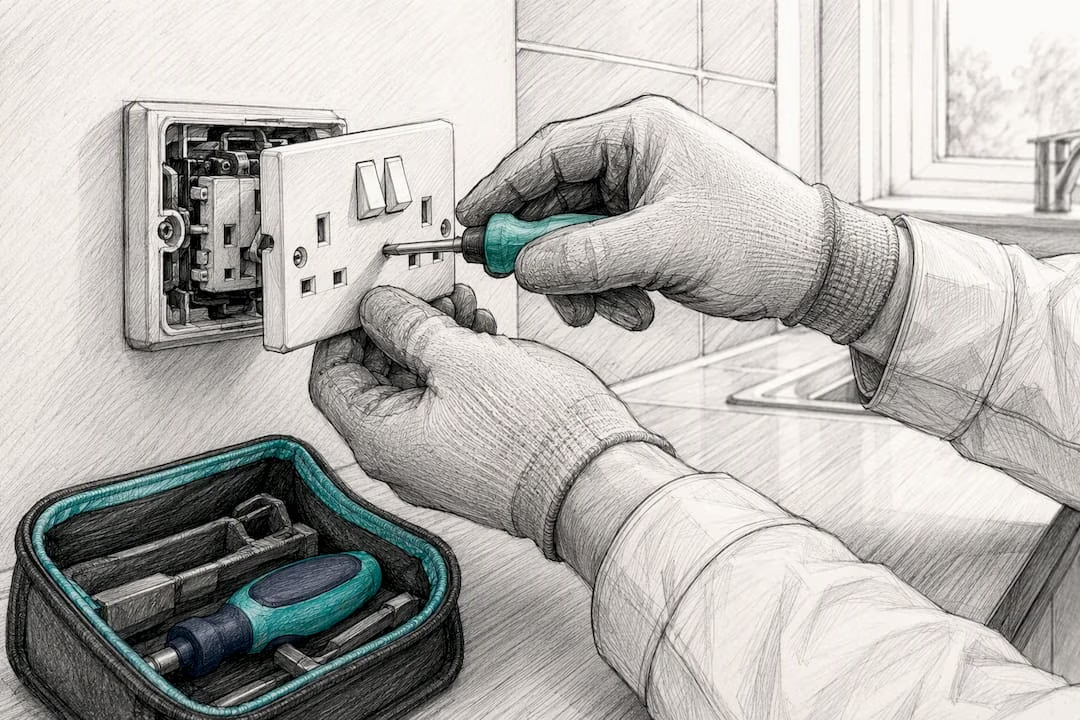
Industry guidance from the IET recommends testing 100% of the installation and physically opening at least 20% of accessories such as sockets and switches for detailed examination, with RCD and AFDD protection verified where fitted. Once remedial work is finished, the electrician should issue written confirmation, and this should be filed alongside the original EICR rather than treated as a replacement for it.
Who is qualified to inspect and carry out remedial work
The regulations require inspections to be carried out by a “qualified person”, which in practice means someone competent to assess conformity with BS 7671, the national wiring standard, and to sign a periodic inspection report to that standard. There is no single licence that automatically confers this status. Instead, competence is usually demonstrated through a combination of a recognised electrical qualification, registration with a competent person scheme or trade body, and enough hands-on experience of periodic inspection work to exercise sound engineering judgement on borderline cases.
Before booking, ask the electrician or firm for a few concrete things:
- Current membership of a recognised electrical competent person scheme or trade body.
- Public liability and professional indemnity insurance, with certificates available on request.
- A sample EICR or two, so you can see how clearly observations and codes are recorded.
- Evidence of continuing professional development, particularly on amendments to BS 7671.
A paper qualification alone doesn’t guarantee good judgement on site. Two electricians looking at the same ageing consumer unit might reasonably code it differently depending on the property’s usage and history, and that’s precisely why the IET’s guidance points to experience, not just certification, as the more reliable indicator of a competent inspector.
Pro Tip: Keep a short list of two or three vetted electricians for your portfolio rather than sourcing a new one for every property; consistency in who inspects your stock makes year-on-year comparisons far easier.
Remedial deadlines and the proof you need to keep
Once an EICR flags a C1 or C2 observation, the clock starts immediately. The statutory deadline for completing remedial or further investigative work is 28 days, or a shorter period if the report itself specifies one for a more urgent finding. A C1 observation, by its nature, often demands action well within that window, sometimes on the day of inspection.
- Book the remedial work promptly with a qualified electrician once the report is received, referencing the specific circuit and code flagged.
- Obtain written confirmation of completion, which for straightforward repairs may take the form of a Minor Electrical Installation Works Certificate, and for more extensive work an Electrical Installation Certificate.
- Decide whether a new EICR is needed. Extensive rewiring or multiple circuit replacements usually warrant a fresh full report rather than relying on a certificate covering only the repaired section.
- File the certificate alongside the original EICR, dated and referenced, so an inspector or local authority can trace the full history of the installation.
Under the gov.uk guidance, the 28-day window applies from the date of the inspection, not from when the landlord gets round to reading the report, so acting on receipt matters more than it might seem.
Record keeping, supplying reports and access refusals
The retention rule is simple to state and easy to get wrong in practice: keep each EICR until the later of the next inspection’s due date or the date a new inspection is actually carried out, whichever comes second. That means a report doesn’t become disposable the moment a new one is commissioned; it stays relevant until the replacement is in hand.
Supplying copies has its own set of fixed points. A copy must go to existing tenants within 28 days of the inspection, to new tenants before they move in, and to a local housing authority within 7 days of receiving a written request. There’s no discretion on these figures: a request from the council starts a week-long countdown regardless of how busy your schedule is.
Access refusal is one of the more common practical snags, and the regulations anticipate it. Landlords who can show they took “all reasonable steps” to gain access have a defence if enforcement follows. Reasonable steps typically include:
- Written requests by e-mail or letter, each dated and kept.
- At least two or three offered appointment times across different days.
- A record of any phone calls or messages, including dates and outcomes.
Pro Tip: Start your access log the day you request the first appointment, not after the tenant has already missed two visits; a thin log looks like an afterthought to an inspector.
What happens if the council gets involved
Local housing authorities enforce the electrical safety regulations, and their first step on discovering non-compliance is usually a remedial notice. This notice sets out the breach, requires the landlord to arrange remedial action within a specified timescale, and gives the landlord a right of response and, in most cases, a right of appeal before further action is taken.
If a landlord doesn’t comply with a remedial notice, the authority can arrange the remedial work itself and recover the reasonable cost from the landlord, on top of any penalty imposed. Financial penalties for breaches of the duty to inspect, supply reports or carry out remedial work can reach £30,000, and the 2025 amendment adjusted some enforcement detail for registered social housing providers, so it’s worth checking the current statutory instrument if you manage that stock.
If you’re served a notice, the priorities are straightforward:
- Read the timescale carefully and respond in writing within the window given.
- Book the remedial work immediately rather than waiting out an appeal.
- Keep every piece of correspondence, invoice and certificate as your compliance file grows.
Appeals exist for genuine disputes over the facts, not as a way to buy time on an obligation you already know is outstanding.
A practical checklist for staying ahead of every deadline
Compliance gets far easier once it’s a workflow rather than a scramble every five years. A simple structure works for a single property or a portfolio of fifty:
- Diarise the inspection date eighteen months before expiry, not eighteen days, so a busy electrician’s schedule doesn’t catch you out.
- Book the inspection and confirm the electrician’s credentials before the visit, using the checks outlined earlier in this guide.
- Log the report the day it arrives, noting the overall result and any codes against each circuit.
- Action C1 and C2 findings within the 28-day window, booking remedial work the same week wherever possible.
- Send copies to tenants within 28 days and keep proof of sending, whether by e-mail receipt or recorded post.
- Build an evidence pack per property: the EICR, remedial certificates, access logs and tenant correspondence, all dated and filed together.
An evidence pack that already contains a dated access log, a signed remedial certificate and a copy of the tenant notification saves hours if a council request lands with only 7 days on the clock.
- Keep the evidence pack in one place per property, not spread across e-mail threads and a filing cabinet.
- Log every appointment offer to a tenant, even ones that don’t lead to access.
- File remedial certificates against the circuit reference used in the original EICR.
Qualified electricians can carry out EICR remedial and investigative work, providing written confirmation and photo evidence for landlord’s records. For agents and landlords managing several properties, account management services can help consolidate paperwork across a whole portfolio rather than leaving each property’s file to chance.
Pro Tip: Ask whoever does your remedial work to reference the original EICR’s circuit numbering in their certificate; it turns two separate documents into one traceable record.
Why treating an EICR as risk management pays off
The landlords who get caught out rarely ignore electrical safety outright. They file the report, note the C2 finding, and then let the 28 days slip while they wait for a quiet week to book the electrician. That gap is where most enforcement problems start, not from a missing inspection but from a delayed response to one that already flagged a problem.
Genuine risk management looks different. One landlord we’ve seen handle it well received a C2 finding on an ageing consumer unit, booked remedial work within four days, and had a signed certificate filed before the tenant even asked about it. No notice, no penalty exposure, no anxious phone call from the council. Our guide to common property maintenance mistakes covers several patterns like this one.
The practical takeaway is simple: read the report the day it arrives, and treat any C1 or C2 code as a booking to make this week, not a note to revisit later.
— Drahim Hasula
How UpKeep UK handles inspections, remedial work and your paperwork

Booking an EICR is only half the job; the remedial work and the paperwork trail that follows are where most landlords lose time. UpKeep UK’s electricians handle both, whether that’s a single one-off remedial visit after a C2 finding, a planned maintenance bundle that folds your five-year testing cycle into a wider upkeep schedule, or full account management for landlords running several properties across London and the wider UK.
Every completed job comes with written confirmation, photo evidence and the relevant certificate, filed in a way that’s ready to hand to a tenant or a council on request. For urgent C1 or C2 issues, our team prioritises a fast response so the remedial deadline never becomes a source of stress.
Start with our property maintenance and electricians page to see the services available, or get in touch to discuss a planned maintenance package for your portfolio.
Sources
For the full statutory detail behind this guide, the gov.uk guidance on electrical safety standards sets out landlord duties in plain terms, while the 2020 regulations on legislation.gov.uk give the legal text, including the reasonable steps defence. The BS 7671 model EICR forms show the report structure and coding system in full, and the IET’s wiring matters guidance explains competence expectations for inspectors. For the 2025 changes affecting social housing providers, see the statutory instrument itself.
This article is general information, not a substitute for advice from a qualified lawyer. Consult a qualified legal professional about your own circumstances before acting on anything here.
- Gov
- BS 7671:2018 model forms — Electrical installation condition report (EICR)
- The Principal Regulations amendments — 2025 statutory instrument (social housing provisions)
FAQ
Do you need an EICR every five years or at change of tenancy?
The statutory requirement is inspection at intervals of no more than five years, and that is the binding deadline regardless of tenancy changes. Industry guidance from the IET recommends an inspection at each change of tenancy as good practice, but this is not a separate legal trigger.
What changed for landlords under the 2025 amendments?
The 2025 amendment extended equivalent electrical safety duties to registered providers of social housing, who previously sat outside the scope of the 2020 regulations for private rented properties. It also adjusted some enforcement and penalty detail, so social landlords should check the current statutory instrument for their specific obligations.
Must landlords use a qualified electrician for the inspection?
Yes: the regulations require inspection and testing by a “qualified person” competent to assess the installation against BS 7671, and this isn’t optional for landlords covered by the rules. Competence is generally shown through recognised qualifications, trade body membership and relevant experience, as set out in IET guidance.
What should a landlord do if a tenant refuses access for inspection?
Landlords should make and document repeated reasonable attempts to arrange access, including written requests and multiple offered appointment times, before the inspection deadline. Keeping this record matters because the 2020 regulations provide a defence for landlords who can show they took all reasonable steps to comply.
































