


Responsible persons must carry out quarterly checks of communal fire doors in buildings with a top storey over 11 metres and use best endeavours to check flat entrance doors at least once every 12 months, as required by Regulation 10 of the Fire Safety (England) Regulations 2022. The next step is straightforward: confirm whether your building falls within scope, then set a recurring quarterly slot for communal doors and a rolling annual plan for flat entrances, checking closers, seals and gaps, and recording every visit.
TL;DR:
- Communal fire doors must be checked every three months, regardless of access issues, while flat entrance doors require at least annual checks using genuine effort to gain entry.
- The checks are visual and functional, focusing on door closers, gaps, seals, hinges, and any unauthorised modifications, not on fire resistance testing.
- Responsible persons can delegate inspections but retain legal accountability, requiring proper recordkeeping of dates, findings, and corrective actions.
- Failing to comply risks regulatory enforcement or prosecution, and lacking records can significantly weaken defense in fire safety investigations.
- A consistent routine, supported by digital logs and contractor assistance, ensures regulatory requirements are met efficiently and thoroughly over time.
Table of Contents
- What Regulation 10 and the wider fire safety law actually require
- Which buildings and responsible persons this duty covers
- How often checks are required and what best endeavours means
- What a routine fire door check actually covers
- Keeping records that actually prove compliance
- Deciding what to fix and who should fix it
- Turning the checklist into a working programme
- How a maintenance service can support a fire door inspection programme
- How flat entrance doors and communal doors differ in practice
- What happens if you do not carry out the required checks
- Where fire door checks fit inside a fire risk assessment
- Training and competence for people carrying out checks
- Common defects and what they mean for compliance
- Proportionate action beats wholesale door replacement
- How a property maintenance provider can run your fire door inspection programme
- Where to read the full legal guidance
- Sources
- FAQ
What Regulation 10 and the wider fire safety law actually require
Regulation 10 sets out a specific and testable duty. It requires responsible persons for multi-occupied residential buildings with a top storey over 11 metres to check communal fire doors at least every three months and to use best endeavours to check flat entrance fire doors at least every 12 months, according to the Fire Safety (England) Regulations 2022 guidance published by the government. The regulation exists to close a gap that became painfully obvious after the Grenfell Tower fire: doors that hold back smoke and flame for a defined period only work if they are maintained in that condition, and nobody was formally required to check.
Regulation 10 sits alongside the Regulatory Reform (Fire Safety) Order 2005, which already placed a general duty on responsible persons to maintain fire safety measures, including fire doors, as part of a fire risk assessment. What Regulation 10 adds is precision: a named frequency, a named scope and a recordkeeping requirement that did not exist in that form before. For higher-risk buildings, this duty also connects to the accountable person obligations introduced under the Building Safety Act, though the day-to-day inspection work described here applies more broadly across qualifying blocks. For a fuller picture of how these duties fit into a landlord’s broader responsibilities, our guide to fire safety obligations for landlords covers the wider legal picture.
It is worth being clear about what these checks are not. They are visual and functional checks, not technical fire resistance tests. Nobody is asking a caretaker to assess a door’s performance in a fire; they are asking someone to confirm the door still looks and behaves the way it should.
Which buildings and responsible persons this duty covers
The duty applies to multi-occupied residential buildings with a top storey more than 11 metres above ground level. In practice, that typically means blocks of more than four storeys, though the actual test is the height figure rather than a floor count, as the government’s fire door guidance confirms. A converted Victorian terrace split into flats is unlikely to be caught; a five-storey purpose-built block almost certainly is.
The Responsible Person is usually the freeholder, the managing agent acting on the freeholder’s behalf, or, in some structures, the landlord managing the building directly. Whoever holds that role can delegate the physical task of inspecting doors to a caretaker, a maintenance team or a contractor, but the legal duty to ensure the checks happen, and happen properly, stays with them.
It helps to separate the two tiers of responsibility clearly. Communal doors, those in shared corridors, stairwells and lobbies, are entirely within the Responsible Person’s control and checked on a fixed quarterly cycle. Flat entrance doors sit on the boundary between communal safety and private space, which is exactly why the law asks for “best endeavours” rather than an absolute guarantee.
How often checks are required and what best endeavours means
The frequencies are fixed, but the flat entrance rule needs some practical interpretation to apply well.
- Communal fire doors: checked at least every three months, with no exceptions for access difficulty.
- Flat entrance fire doors: checked using best endeavours at least every 12 months, which accounts for residents who are difficult to reach or who refuse entry.
- Reasonable attempts: multiple time slots offered, written notice given in advance, and every attempt logged even when access is refused.
“Best endeavours” is a legal standard, not a vague aspiration. It means demonstrating that you made a genuine, structured effort: written notice, more than one appointment offer, and a record of what happened when a resident did not answer. A managing agent who tries once and gives up has not met the standard; one who offers three time slots across different days, documents each attempt and follows up in writing has.
A sensible scheduling approach treats communal checks as a fixed recurring calendar event, tied to the same week every quarter, and flat entrance checks as a rolling annual programme, spreading visits across the year in manageable batches rather than trying to check every flat in one week.
What a routine fire door check actually covers
A routine check is deliberately simple. It is designed so that a competent caretaker or managing agent, not a fire engineer, can carry it out reliably, as the government’s responsibilities checker sets out.
- Test the self-closing device: open the door fully and let go, then open it to roughly 15 degrees and let go again; it should close firmly into the frame from both positions.
- Check the gaps: measure around the top and sides of the door; industry guidance typically expects gaps under 4 millimetres, and a £1 coin, roughly 3 millimetres thick, is a handy quick test.
- Inspect intumescent strips and smoke seals: they should be continuous, undamaged and never painted over, since paint can stop them expanding in heat.
- Check hinges, glazing and ironmongery: hinges should be tight and free of missing screws, glazing should be intact and free of cracks, and letterboxes should sit flush without gaps around the frame.
- Look for unauthorised alterations: air transfer grilles that have been added, hold-open devices fitted without a compliant magnetic release, missing fire door signage, or cat flaps cut into the door all count as defects.
Pro Tip: Keep a spare £1 coin taped inside the caretaker’s inspection folder. It sounds trivial, but it turns a subjective gap check into a consistent, repeatable test that any staff member can apply the same way.
Move from a visual check to a technical assessment when you find damage you cannot explain, a door that will not close reliably after adjustment, or any doubt about whether the door still matches its original certified specification. That is the point to bring in a specialist rather than guess. Where compartmentation itself is in question, not just the door, our fire compartmentation survey guide explains when that step is worth commissioning.
Keeping records that actually prove compliance
Regulation 10 does not just require the checks; it requires proof that they happened, including proof of what you did when a check could not be completed, according to the regulation’s own text.
- Core fields: date of check, door location or identifier, findings, corrective action taken, and any supporting photos or invoices.
- Non-access evidence: the date and time of each attempted visit, the method of notice given, and the outcome, even when the outcome is simply “no answer”.
- Format: a paper checklist, a digital log or a photo archive all work, provided records stay accessible to residents and to any enforcing authority on request.
A practical access plan makes the paperwork easier to generate honestly. Offer several time slots across different days rather than one fixed appointment, use a simple written notice template posted or emailed in advance, and set an escalation step, a second letter or a call to the leaseholder, if the first attempt fails. Some managing agents also add an access clause to lease renewals, giving a clearer contractual basis for entry requests going forward.
Deciding what to fix and who should fix it
Not every defect needs the same response. A self-closer that swings shut too slowly might need a simple adjustment; a door that will not close at all, has a burned-through seal, or shows structural damage to the frame needs urgent attention and possibly replacement.
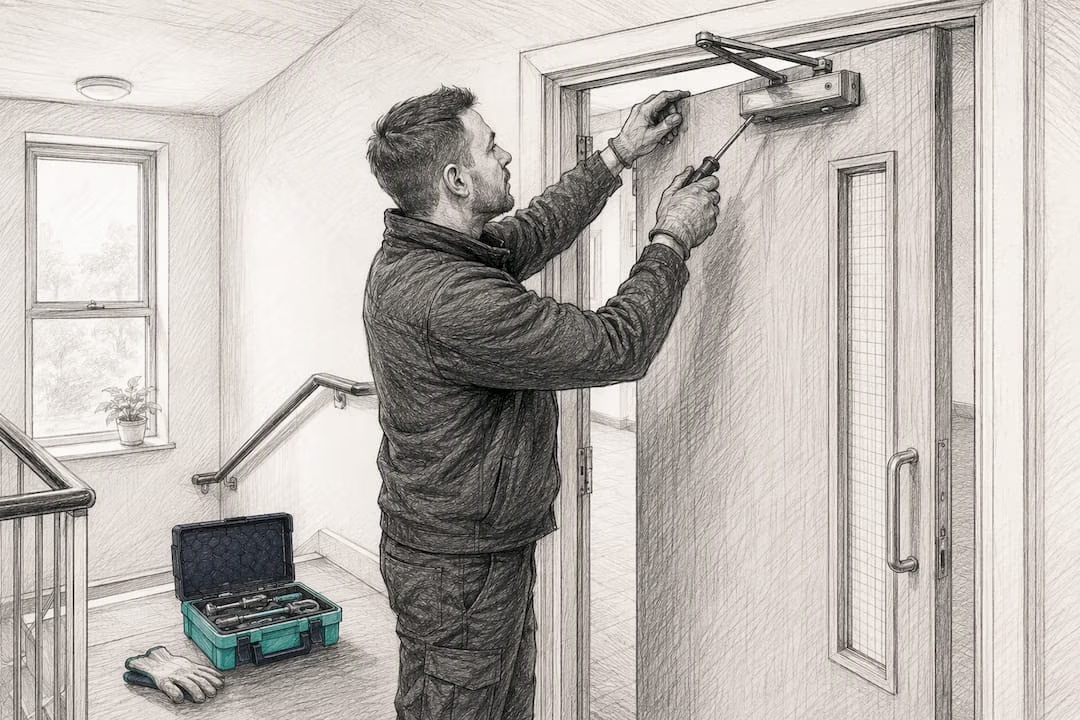
When remedial work is needed, competence matters. Look for a contractor who can show relevant experience with fire door installation and repair, understands intumescent seal specification, and, for replacement doorsets, can point to third-party certification that matches the product actually being fitted, including its glazing apertures and ironmongery positions. Get invoices, before and after photographs, and any certification paperwork filed against the door’s record. That evidence is what turns a repair into proof of compliance rather than just a job done.
Turning the checklist into a working programme
A checklist only works if it is actually run on schedule. Build it into a simple routine: monthly walk-throughs to spot obvious issues early, quarterly formal communal door checks logged against the regulation, and an annual cycle for flat entrance visits spread across the year rather than crammed into one month.
- Assign one named person as the owner of the fire door log, even if the physical checks are shared across a caretaking team.
- Use a checklist template with fixed fields, door identifier, date, closer test result, gap measurement, seal condition and action taken, so records stay consistent between staff.
- Brief anyone doing the checks on what a defect looks like and when to stop and call a specialist rather than attempt a fix themselves.
Pro Tip: Digital logging, even a shared spreadsheet with photo attachments, beats a paper folder for one reason: it is far easier to prove a pattern of consistent checking when an enforcing officer or a resident asks for evidence.
Coordinating contractor visits around building access and cleaning schedules also reduces disruption. Guidance on preventing scheduling clashes on site and on preparing communal areas for inspection is a useful reference when you are trying to fit fire door checks around other building work. For the wider maintenance calendar, our guide to planning property maintenance for landlords sets out how recurring compliance tasks fit alongside routine upkeep.
How a maintenance service can support a fire door inspection programme
Running quarterly and annual checks properly takes consistent staff time, which is where a maintenance partner earns its place. UpKeep UK’s Planned Maintenance service builds recurring fire door checks into a fixed schedule, while Reactive Maintenance covers the remedial work when a defect turns up mid-cycle. Every visit comes with a photo record and a written report, so the evidence trail your records need is generated as a matter of course rather than chased afterwards. For buildings needing wider Fire Safety Checks alongside door inspections, that work sits under the same contract.
How flat entrance doors and communal doors differ in practice
The two door types share the same physical checks but sit under different legal expectations, and conflating them is a common mistake. Communal doors, the ones in shared stairwells, lobbies and corridors, are entirely under the Responsible Person’s control, which is why the law sets a fixed quarterly frequency with no flexibility for access.
Flat entrance doors are different because they sit inside a resident’s private space. The Responsible Person cannot force entry, so the Fire Safety (England) Regulations 2022 guidance sets a best endeavours standard instead of a fixed guarantee, paired with a 12-month rather than three-month cycle. The physical checks, closer function, seal condition, gap sizes, are identical, but the compliance test is different: for communal doors, you must show the check happened; for flat entrance doors, you must show you made a genuine effort even if it did not.
There is also a practical ownership distinction worth flagging to residents. Leaseholders often assume their flat door is entirely their own responsibility to maintain, and in terms of day-to-day upkeep it usually is, but the fire door aspect, its closer, seals and gaps, falls under the building’s fire safety duty regardless of who owns the flat. Making that distinction clear in resident communications avoids confusion when a check is scheduled or a defect is flagged.
What happens if you do not carry out the required checks
Failing to meet Regulation 10 duties is not a paperwork technicality; it carries real enforcement weight. Local fire and rescue authorities enforce compliance with the Fire Safety (England) Regulations 2022, and a Responsible Person who cannot show quarterly communal checks or a genuine best endeavours effort on flat entrance doors is exposed on two fronts: regulatory action and, in the event of a fire, scrutiny over whether reasonable steps were taken beforehand.
Enforcement can range from an improvement notice requiring specific remedial steps within a set timeframe, through to prosecution for more serious or persistent failures under the wider fire safety framework. Beyond formal enforcement, the practical exposure is often worse: in the event of a fire where a door failed to perform because it was not maintained, the absence of records showing routine checks becomes a central question in any investigation.
This is exactly why recordkeeping is not an optional add-on to the physical check. A well-maintained log, including honest records of access refusals and remedial actions taken, is the evidence that demonstrates due diligence was exercised, which is the legal test that matters most if compliance is ever challenged.
Where fire door checks fit inside a fire risk assessment
Fire door checks should never sit as an isolated task disconnected from the building’s broader fire risk assessment. The fire risk assessment is the document that identifies hazards and vulnerable points across the whole building, and fire doors are one of the most direct controls it relies on to contain a fire and protect escape routes.
In practice, this means the findings from quarterly and annual door checks should feed back into the fire risk assessment review, not sit in a separate folder. If a pattern of recurring seal damage or self-closer failures emerges across multiple doors, that is a signal the risk assessment needs revisiting, not just a maintenance job to close out. Equally, the risk assessment should specify who is responsible for door checks, at what frequency, and how findings are escalated, so the inspection programme is not something bolted on after the assessment is written but built into it from the start.
Reviewing the risk assessment alongside the door log at the same point each year, rather than treating them as unrelated paperwork, gives a clearer picture of whether the building’s fire strategy is actually holding up in practice.
Training and competence for people carrying out checks
Regulation 10 checks are designed to be simple enough for building staff to carry out without specialist qualifications, and the government’s responsibilities checker confirms routine checks do not usually require a specialist. That said, “simple” does not mean untrained.
Anyone carrying out checks should understand what a compliant gap looks like, how to run the self-closer test properly, and crucially, when a finding is beyond their competence to judge. A short internal briefing covering the checklist items, supported by photographs of acceptable and unacceptable seal and gap conditions, is usually enough to bring a caretaker or maintenance team up to a reliable standard.
Where remedial or replacement work is required, competence expectations step up considerably. That work should go to a contractor who can demonstrate relevant fire door experience and, for replacement doorsets, point to third-party certification, checking that the certificate’s scope actually matches the product being installed, including glazing apertures and ironmongery positions. Mixing up routine visual competence with the higher bar needed for remedial certification is a common source of confusion, and being clear about which standard applies to which task keeps both the checks and the repairs defensible.
Common defects and what they mean for compliance
Certain defects turn up repeatedly during routine checks, and recognising them quickly is most of the job. A self-closer that swings shut too slowly, or not at all from the 15-degree test position, is one of the most frequent findings and usually points to a worn or wrongly adjusted closing device.
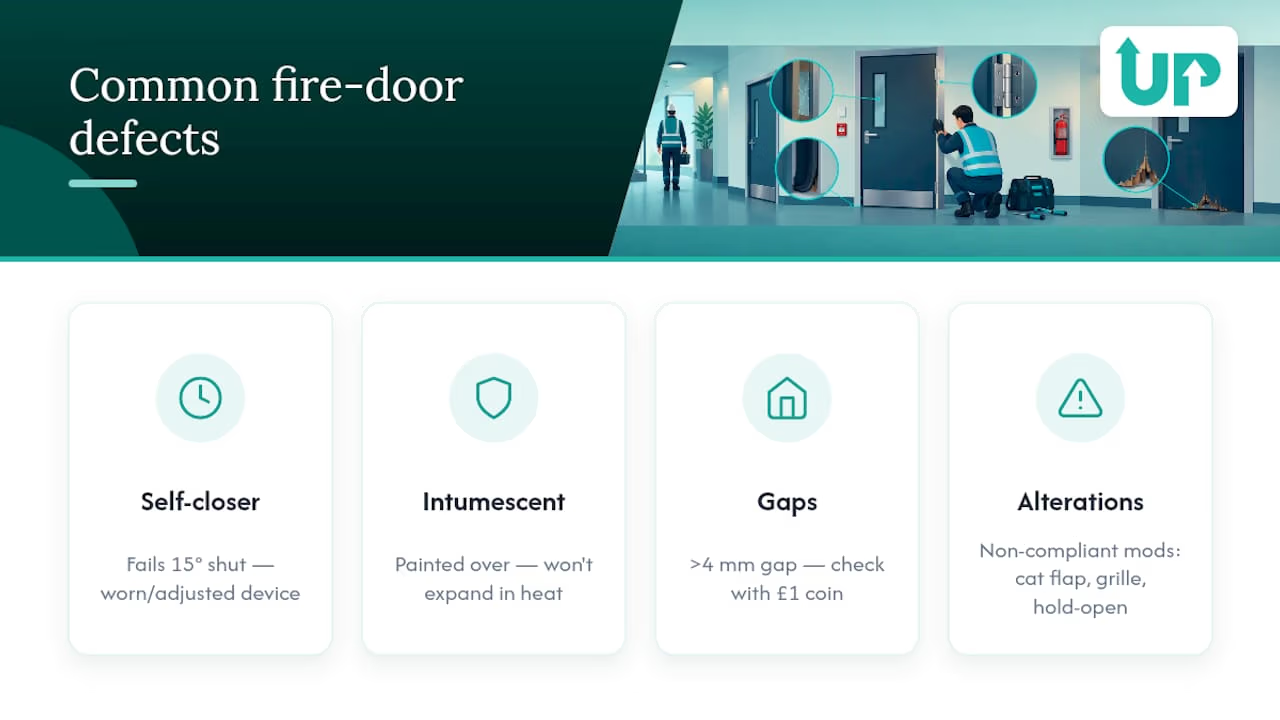
Painted-over intumescent strips are another recurring issue, often the result of a well-meaning decorating job that ignored the door’s fire function; paint stops the strip expanding properly when heated, which defeats its purpose entirely. Gaps that exceed the roughly 4 millimetre guideline, checked simply with a £1 coin, often result from a warped door, worn hinges, or a frame that has shifted slightly over time.
Unauthorised alterations are a distinct category worth flagging separately: cat flaps cut into fire doors, air transfer grilles added without proper fire-rated covers, or hold-open devices fitted without a compliant magnetic release mechanism. These are not wear-and-tear issues; they are deliberate changes that compromise the door’s performance and need addressing as a priority rather than logged for a future visit.
Each of these defects has the same underlying consequence: a door that looks fine at a glance but would not perform as intended in a fire. That is precisely why the checklist approach matters more than a passing glance from the corridor.
Proportionate action beats wholesale door replacement
Fire door compliance rewards consistency, not panic. A door that was compliant when fitted and remains undamaged rarely needs replacing; it needs a properly documented check and a closer or seal adjustment where required. Landlords who jump straight to full replacement often spend heavily while skipping the far cheaper habit that actually satisfies the law: showing up, checking, recording and fixing small faults before they become large ones.
— Drahim Hasula
How a property maintenance provider can run your fire door inspection programme
Meeting Regulation 10 on top of everything else a building manager juggles is a scheduling problem as much as a compliance one. UpKeep UK’s Property Maintenance services bring fire door checks into the same planned schedule as your other compliance servicing, so quarterly communal visits and rolling annual flat entrance checks happen on a fixed calendar rather than an ad hoc chase.
Each visit generates the evidence your Regulation 10 records need: dated checklists, photo reports and, where remedial work is carried out, before and after images alongside the invoice. When a defect turns up mid-cycle, our Reactive Maintenance team can attend under the same contract, with fixed pricing agreed in advance and insured tradespeople carrying out the fix. If you would rather hand the whole schedule to a team that documents every step, get in touch through our property maintenance page to request a quote.
Where to read the full legal guidance
For the complete legal detail behind this article, read the government’s fire door guidance, the Regulation 10 text itself and the accompanying fact sheet on fire doors.
Sources
- Fire Safety (England) Regulations 2022: fire door guidance
- The Fire Safety (England) Regulations 2022 (Regulation 10)
FAQ
Is there a legal requirement to inspect fire doors?
Yes. Regulation 10 of the Fire Safety (England) Regulations 2022 requires responsible persons in qualifying buildings to check communal fire doors and use best endeavours to check flat entrance doors. This applies to multi-occupied residential buildings with a top storey over 11 metres.
What is the standard for fire door inspections?
Regulation 10 sets the legal standard rather than a separate technical certification body, specifying quarterly communal checks and annual best-endeavour flat entrance checks. The regulation’s text also requires records of checks and any access attempts to be kept and made available.
What needs to be checked on a fire door?
A routine check covers the self-closing device, the gaps around the door edges, and the condition of intumescent strips and smoke seals, alongside hinges, glazing and ironmongery. The government’s fire door guidance confirms these checks are visual and functional rather than technical fire resistance tests.
What is the current law on fire door checks?
The current duty comes from Regulation 10 of the Fire Safety (England) Regulations 2022, requiring communal door checks at least every three months and flat entrance door checks at least every 12 months using best endeavours. It sits alongside existing duties under the Regulatory Reform (Fire Safety) Order, as set out in the official fact sheet on fire doors.
































