


TL;DR:
- UK HMO landlords have continuous legal duties for safety, repairs, and communal upkeep under the 2006 Regulations, with penalties up to £30,000 per breach. Mandatory inspections include annual gas safety certificates, five-year electrical reports, and fire safety measures, all requiring timely renewal and documentation. Maintaining a strict compliance schedule and detailed records safeguards against enforcement actions and ensures legal operation.
HMO maintenance obligations in the UK impose specific, continuous legal duties on landlords covering structural integrity, fire safety, gas and electrical safety, and communal area upkeep. The governing framework is the Management of Houses in Multiple Occupation (England) Regulations 2006, which applies to all HMOs regardless of whether they require a licence. Failure to meet these duties carries criminal offences with unlimited fines or civil penalties up to £30,000 per breach. For any landlord managing a House in Multiple Occupation, understanding the full scope of these obligations is not optional. It is the baseline for operating legally and protecting your rental income.
What statutory safety inspections must HMO landlords comply with?
Key statutory maintenance requirements for HMO properties include an annual Gas Safety Certificate (CP12), an Electrical Installation Condition Report (EICR) every five years, and an Energy Performance Certificate (EPC) with a minimum E rating. Landlord-supplied appliances also require annual Portable Appliance Testing (PAT). These are not advisory standards. They are legal obligations under the Management Regulations and the Regulatory Reform (Fire Safety) Order 2005.
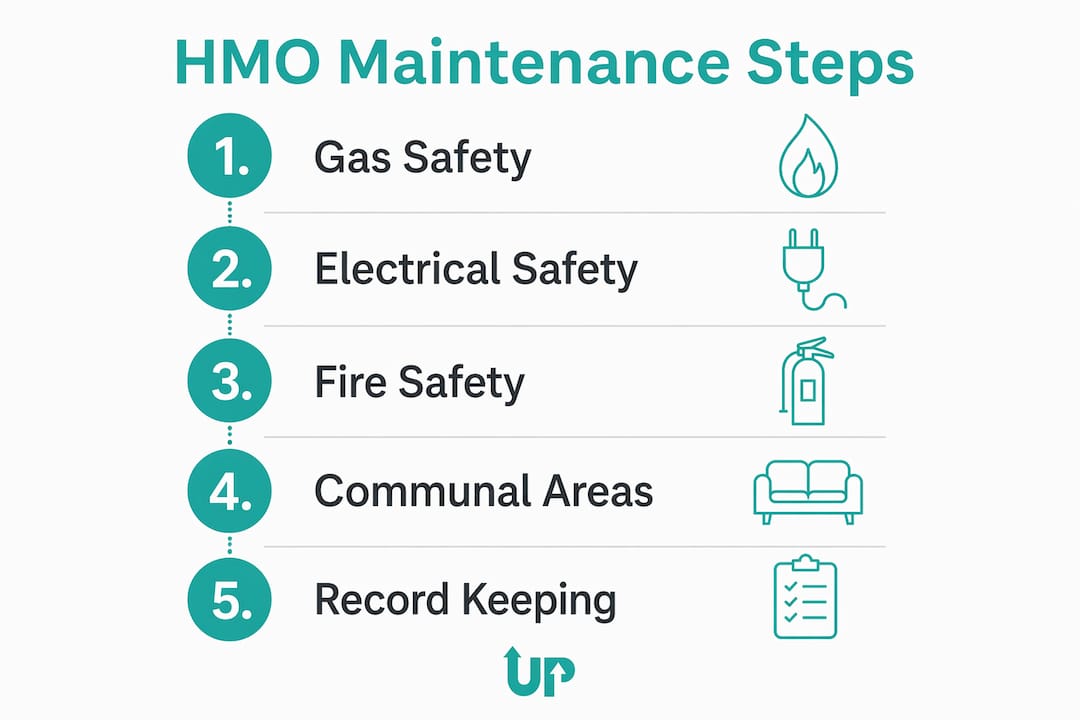
Each certificate carries a specific renewal cadence, and missing even one creates a compliance gap that local authorities can act upon. An expired CP12, for instance, leaves you exposed to enforcement action and potentially invalidates your HMO licence conditions. The same applies to an overdue EICR, which must be carried out by a qualified electrician and a copy provided to tenants within 28 days of completion.
The EPC minimum E rating requirement is particularly relevant for older properties common in London’s HMO stock. Properties rated F or G cannot legally be let, and the government has proposed raising the minimum to C for new tenancies in the coming years. Planning ahead for energy upgrades now avoids costly reactive work later.
- Annual Gas Safety Certificate (CP12): Carried out by a Gas Safe registered engineer; copy provided to tenants within 28 days
- EICR every five years: Conducted by a qualified electrician; remedial work must be completed within 28 days of the report
- PAT testing annually: Covers all landlord-supplied electrical appliances such as fridges, washing machines, and microwaves
- EPC with minimum E rating: Required before letting; must be renewed every ten years or after significant energy improvements
- Fire Safety Order compliance: Requires a written fire risk assessment, reviewed annually or after any material change to the property
Pro Tip: Keep a single compliance folder, physical or digital, containing every certificate with its renewal date. A missed renewal is almost always a scheduling failure, not a knowledge gap. A structured property maintenance plan prevents this entirely.
How must fire safety be maintained in HMOs under current regulations?
Fire safety is the area where HMO property maintenance requirements diverge most sharply from standard residential lettings. Fire safety regulations require mains-wired interlinked smoke alarms throughout most HMOs, heat detectors in kitchens, FD30 fire doors on all habitable rooms, and clear, unobstructed escape routes at all times. A written fire risk assessment is mandatory and must be reviewed annually or after any structural or occupancy change.
Typical fire safety upgrades in HMOs cost between £5,000 and £15,000 depending on property size. That figure covers alarm installation, fire door upgrades, emergency lighting, and extinguisher provision. Spread across a property’s rental lifetime, it is a manageable investment. Ignoring it, however, carries unlimited fines and possible imprisonment on indictment under the Fire Safety Order.
The testing and servicing schedule for fire safety equipment is as follows:
- Weekly: Test fire alarm call points by rotation to confirm the system is functioning
- Monthly: Test emergency lighting to verify all units illuminate correctly
- Annually: Commission professional servicing of fire alarm systems, emergency lighting, and fire extinguishers
- Annually: Review and update the written fire risk assessment
Monthly emergency lighting tests and weekly alarm checks are not discretionary. They form part of the documented evidence that your fire safety systems are being actively maintained. Without these records, you have no defence if a local authority inspector raises a concern.
| Fire safety element | Required standard | Testing frequency |
|---|---|---|
| Smoke alarms | Mains-wired, interlinked | Weekly function test |
| Heat detectors | Fitted in kitchens | Annual professional service |
| Fire doors | FD30 standard, self-closing | Inspect at each tenancy check |
| Emergency lighting | Covers all escape routes | Monthly test, annual service |
| Fire extinguishers | Appropriate type per risk | Annual professional service |
| Fire risk assessment | Written, site-specific | Annual review |
Pro Tip: Photograph fire doors at every inspection and log the date. Self-closing mechanisms fail gradually, and tenants sometimes wedge doors open. A photographic record demonstrates active management and protects you in any enforcement dispute.
What are the maintenance responsibilities for communal areas and structural elements?
Landlords must maintain all communal parts including hallways, stairways, shared kitchens, and shared bathrooms in a clean, safe, and good state of repair. This is both a licensing condition and a duty under the Management Regulations. Communal areas are a non-delegable landlord responsibility, meaning you cannot transfer this obligation to tenants through a tenancy agreement clause.

The practical implication is that you need a cleaning and inspection schedule that runs independently of tenant behaviour. Weekly cleaning of shared kitchens and bathrooms is the accepted standard for most HMOs. Hallways and stairways should be inspected monthly for trip hazards, damaged handrails, or failing light fittings. Structural elements including the roof, external walls, gutters, drains, and windows fall under the same framework and must be kept in good repair throughout the tenancy.
The duty to repair triggers immediately upon knowledge of a defect, whether reported by a tenant or identified during your own inspection. Recommended response times are 24 hours for emergencies such as a gas leak or total loss of heating, seven days for serious defects such as a broken window or failed boiler, and 30 days for routine repairs. Documenting these response times creates a defensible maintenance record if enforcement action follows.
- Shared kitchens and bathrooms: Weekly cleaning; inspect monthly for damage, mould, or failing fixtures
- Hallways and stairways: Monthly inspection for trip hazards, lighting failures, and handrail integrity
- Roof and gutters: Annual inspection, ideally in autumn before winter weather; clear blockages promptly
- Drains and external drainage: Inspect twice yearly; blockages in shared properties accumulate faster than in single-let homes
- Windows and external doors: Check seals, locks, and frames at each tenancy start and annually thereafter
A useful comparison between communal area obligations in HMOs versus standard buy-to-let properties:
| Maintenance area | HMO obligation | Standard buy-to-let |
|---|---|---|
| Communal cleaning | Landlord’s direct responsibility | Typically tenant-managed |
| Inspection frequency | Monthly recommended | At tenancy change |
| Structural repairs | Immediate upon knowledge | Upon report or inspection |
| Documentation required | Ongoing records essential | Less formal expectation |
Reviewing common property maintenance mistakes made by landlords reveals that neglecting communal areas is consistently among the top causes of enforcement notices and licence revocations.
How do HMO maintenance obligations differ from standard buy-to-let?
HMO obligations are stricter than standard buy-to-let across fire safety standards, communal maintenance, licensing requirements, and inspection frequencies. A single-let landlord faces fewer regulatory requirements with simpler maintenance obligations. An HMO landlord operates under a layered compliance framework where the Management Regulations, the Housing Act 2004, local licence conditions, and the Fire Safety Order all apply simultaneously.
The licensing threshold itself creates an additional layer. Mandatory HMO licensing applies to properties occupied by five or more people forming two or more households. Many local authorities in London operate additional licensing schemes that lower this threshold to three or more people. Local authority licence conditions often specify minimum bedroom sizes, kitchen and bathroom ratios, and heating requirements, adding obligations beyond the national baseline. Standards vary by council, so checking your specific local authority’s conditions is non-negotiable.
The enforcement risk is also materially higher for HMO landlords. HMO licensing conditions often incorporate the Management Regulations, creating the risk of double prosecution if a landlord fails maintenance obligations tied to both frameworks. A single disrepair issue in a communal area could trigger both a licence breach and a criminal offence under the Regulations. This is the difference between a manageable compliance programme and a reactive crisis.
- Fire safety: HMOs require interlinked mains-wired alarms, FD30 fire doors, and written fire risk assessments. Standard buy-to-let requires working smoke alarms on each floor and a carbon monoxide detector
- Communal maintenance: HMO landlords hold direct, non-delegable responsibility. Buy-to-let landlords typically rely on tenants for day-to-day upkeep of shared spaces
- Licensing: Mandatory for qualifying HMOs; additional licensing schemes apply in many London boroughs. Standard buy-to-let requires no licence in most cases
- Inspection frequency: HMOs face higher scrutiny from local authorities with proactive inspection programmes. Buy-to-let properties are typically inspected only following complaints
- Documentation: HMO landlords must retain compliance records for six years. Buy-to-let documentation requirements are less prescriptive
What powers do local authorities have to enforce HMO compliance?
Local authorities hold inspection powers to enforce HMO maintenance compliance, with penalties including enforcement notices, unlimited fines, civil penalties up to £30,000, and Rent Repayment Orders. Councils can enter and inspect an HMO at any reasonable time, and officers do not need to give advance notice in all circumstances. The Housing Health and Safety Rating System (HHSRS) provides the framework for assessing hazards, and a Category 1 hazard triggers a mandatory duty to act.
Rent Repayment Orders are a particularly significant risk. Tenants can apply to the First-tier Tribunal for repayment of up to 12 months’ rent if a landlord is convicted of certain offences, including operating an unlicensed HMO or failing to comply with an improvement notice. This means a compliance failure can directly reduce your rental income, not just generate a fine.
Record retention for six years is the accepted standard for compliance defence. This includes gas safety certificates, EICR reports, fire alarm test logs, repair records, and correspondence with tenants about reported defects. Without this documentation, demonstrating that you met your obligations becomes extremely difficult in tribunal or court proceedings.
- Right of entry: Local authority officers can inspect at any reasonable time; warrant required for forced entry
- Improvement notices: Issued for Category 1 and Category 2 HHSRS hazards; must be complied with within the specified timeframe
- Civil penalties: Up to £30,000 per breach, issued without criminal prosecution
- Criminal prosecution: Unlimited fines; serious cases can result in imprisonment
- Rent Repayment Orders: Tenants can recover up to 12 months’ rent through the First-tier Tribunal
Pro Tip: Treat every tenant repair report as a formal notification, even if it arrives by text message. Log it with a timestamp and your response. This paper trail is your primary defence if enforcement action follows.
Key takeaways
HMO maintenance obligations in the UK require landlords to comply with the Management of Houses in Multiple Occupation Regulations 2006, covering fire safety, structural repairs, utility safety, and communal area upkeep, with civil penalties up to £30,000 for each breach.
| Point | Details |
|---|---|
| Statutory inspections are mandatory | Annual CP12, five-yearly EICR, and annual PAT testing are legal requirements, not optional standards. |
| Fire safety obligations are extensive | Mains-wired alarms, FD30 fire doors, and weekly alarm tests are all required under the Fire Safety Order. |
| Communal areas are your direct responsibility | Cleaning, inspection, and repair of shared spaces cannot be delegated to tenants by contract. |
| HMOs face stricter duties than buy-to-let | Licensing conditions, fire safety standards, and enforcement risk are all materially higher for HMO landlords. |
| Documentation is your compliance defence | Retain all certificates, test logs, and repair records for six years to protect against enforcement action. |
Why a compliance calendar is the difference between control and crisis
I have worked with enough HMO landlords to know that the ones who face enforcement action are rarely ignorant of their obligations. They know what a CP12 is. They understand fire doors. The problem is almost always scheduling. A renewal date slips by two weeks, a test log goes unrecorded, and suddenly a routine council inspection becomes a very expensive problem.
A 17-duty statutory compliance calendar covering gas safety, EICR, fire safety checks, legionella risk, and licensing obligations is the single most effective tool for managing HMO legal obligations. Underperformance is usually due to poor scheduling rather than ignorance of duties. That insight should reshape how you think about compliance. It is not a knowledge problem. It is a systems problem.
My view is that proactive maintenance is also the better financial decision, not just the safer legal one. A scheduled maintenance programme catches a failing fire door before it becomes a licence breach. It identifies a guttering issue before it causes damp that costs thousands to remediate. The landlords I see managing HMOs well treat their compliance calendar the same way they treat their rent collection. It runs on a fixed schedule, it is documented, and it is non-negotiable.
The one area I would urge particular attention to is communal spaces. Tenants in HMOs have more leverage than most landlords realise. Rent Repayment Orders are increasingly used, and a neglected shared kitchen or a broken hallway light fitting is exactly the kind of evidence that supports a tribunal application. Proactive communal maintenance is not just good practice. It is active risk management.
— Drahim Hasula
How Upkeep UK supports HMO landlords with compliance-led maintenance
Managing HMO property maintenance requirements across multiple properties, certificates, and inspection schedules is a significant operational commitment. Upkeep UK works with HMO landlords across London to take that pressure off, providing scheduled inspections, compliance documentation support, and rapid response to emergency repairs.
From annual gas safety coordination to communal area upkeep programmes, Upkeep UK’s property maintenance services for landlords are built around the specific cadences that HMO compliance demands. Fixed pricing, insured work, and experienced tradespeople mean you have a reliable partner rather than a reactive headache. If an urgent issue arises, Upkeep UK’s emergency repair service is structured to meet the 24-hour response standard that protects your compliance record. Contact Upkeep UK today to discuss a maintenance programme tailored to your HMO portfolio.
FAQ
What maintenance is required for an HMO?
HMO landlords must maintain structural integrity, fire safety systems, gas and electrical installations, and all communal areas under the Management Regulations 2006. This includes annual gas safety certificates, five-yearly EICRs, mains-wired smoke alarms, FD30 fire doors, and regular cleaning and repair of shared spaces.
How often does an HMO need an EICR?
An Electrical Installation Condition Report is required every five years for HMO properties, or at each change of tenancy if sooner. The report must be carried out by a qualified electrician, and any remedial work identified must be completed within 28 days.
What fire safety measures are mandatory in an HMO?
Mandatory fire safety measures include mains-wired interlinked smoke alarms, heat detectors in kitchens, FD30 self-closing fire doors on all habitable rooms, clear escape routes, and a written fire risk assessment reviewed annually. Weekly alarm tests and monthly emergency lighting checks are also required.
Can tenants be made responsible for communal area maintenance?
No. Communal area maintenance is a non-delegable landlord responsibility under the Management Regulations. Any tenancy agreement clause attempting to transfer this duty to tenants is unenforceable, and failure to maintain shared spaces can result in enforcement action and Rent Repayment Orders.
What records must HMO landlords keep for compliance?
HMO landlords should retain all gas safety certificates, EICR reports, fire alarm test logs, PAT records, repair correspondence, and fire risk assessments for a minimum of six years. These records form the primary defence against enforcement action or tribunal proceedings.
































