


TL;DR:
- Planned maintenance prevents costly repairs by scheduling regular upkeep and inspections.
- It reduces disruptions and legal risks compared to reactive, problem-driven repairs.
- Implementing a structured, documented programme extends asset lifespan and improves tenant satisfaction.
Many property owners and managers operate under a costly misconception: that maintenance only needs to happen when something breaks. In reality, waiting for failures to occur nearly always leads to higher repair bills, longer periods of disruption, and greater stress for everyone involved. Planned maintenance offers a smarter, more structured approach, one that keeps your property in excellent condition year-round while protecting your budget. This guide walks through what planned maintenance is, how it compares to reactive repairs, what it includes in practice, and how you can implement it effectively across your property portfolio.
Key Takeaways
| Point | Details |
|---|---|
| Prevention saves money | Tackling issues early through planned maintenance is usually much cheaper than emergency repairs. |
| Schedule matters | Structured maintenance timetables ensure no critical task is missed and assets run smoothly. |
| Compliance is critical | Regular checks keep properties legal, safe, and attractive for tenants. |
| Step-by-step approach works | A simple, repeatable process makes planned maintenance manageable for any property manager. |
What is planned maintenance?
Planned maintenance is the practice of scheduling property upkeep tasks in advance, based on known timelines or asset conditions, rather than waiting for problems to develop. The goal is simple: prevent damage before it occurs, extend the lifespan of your building’s components, and maintain a safe environment for occupants at all times.
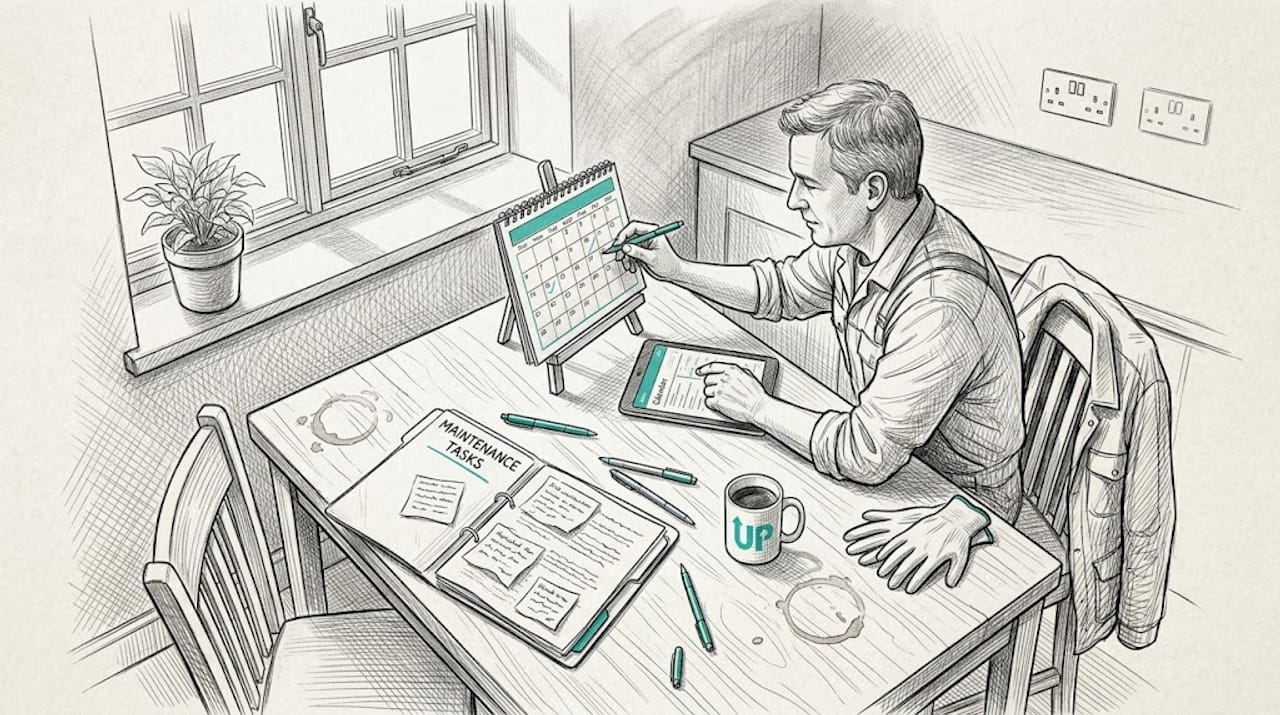
As scheduled maintenance benefits demonstrate clearly, structuring your upkeep around a predictable schedule reduces both the frequency and severity of unexpected repairs. When you know a boiler service is due in November, a roof inspection is booked for spring, and gutters are cleared every autumn, you are in control. That control translates directly into cost savings and fewer emergencies.
There are three core types of planned maintenance relevant to UK property owners and managers:
- Time-based maintenance: Tasks are carried out at regular intervals regardless of visible condition. Annual gas safety checks are a classic example. This type is easy to schedule and ensures compliance.
- Condition-based maintenance: Tasks are triggered by inspection findings rather than fixed dates. If a roof survey reveals cracked pointing, repairs are planned and booked before winter sets in.
- Predictive maintenance: More common in commercial or large residential settings, this approach uses data and observation to anticipate when components will need attention, often before any visible deterioration occurs.
Typical planned maintenance activities across residential and commercial properties include:
- Annual boiler and heating system servicing
- Gas safety certificate renewal (legally required for landlords)
- Electrical installation condition reports (EICR)
- Roof and guttering inspections
- External paintwork and façade checks
- Fire alarm and emergency lighting testing
- Lift servicing in multi-storey buildings
- Damp and drainage assessments
“Planned maintenance is not an optional extra for well-funded portfolios. It is the baseline standard that protects both the asset and the people living or working within it.”
Pro Tip: Spread your planned maintenance tasks across the calendar year rather than clustering them all at once. This smooths out your budget, reduces the likelihood of scheduling conflicts with contractors, and keeps your property constantly monitored rather than only checked in one annual sweep.
The key to making planned maintenance work is consistency. A well-maintained property does not just perform better structurally. It commands stronger rental yields, attracts more reliable tenants, and retains its market value over time. These are not incidental benefits. They are the direct, measurable results of a disciplined maintenance approach.
Planned vs. reactive maintenance: key differences
To fully appreciate the value of planned maintenance, it helps to understand what the alternative looks like in practice. Reactive maintenance is the approach of addressing issues only after they have already caused a failure or become visible problems. A tenant calls to say the boiler has stopped working in January. A ceiling collapses due to an undetected leak. A fire exit door fails its inspection because the mechanism was never serviced. These scenarios are expensive, stressful, and almost entirely avoidable.
As reactive maintenance explained shows, relying solely on a reactive model leaves property owners exposed to unpredictable costs, emergency call-out fees, and potential legal liability if safety standards are not met.
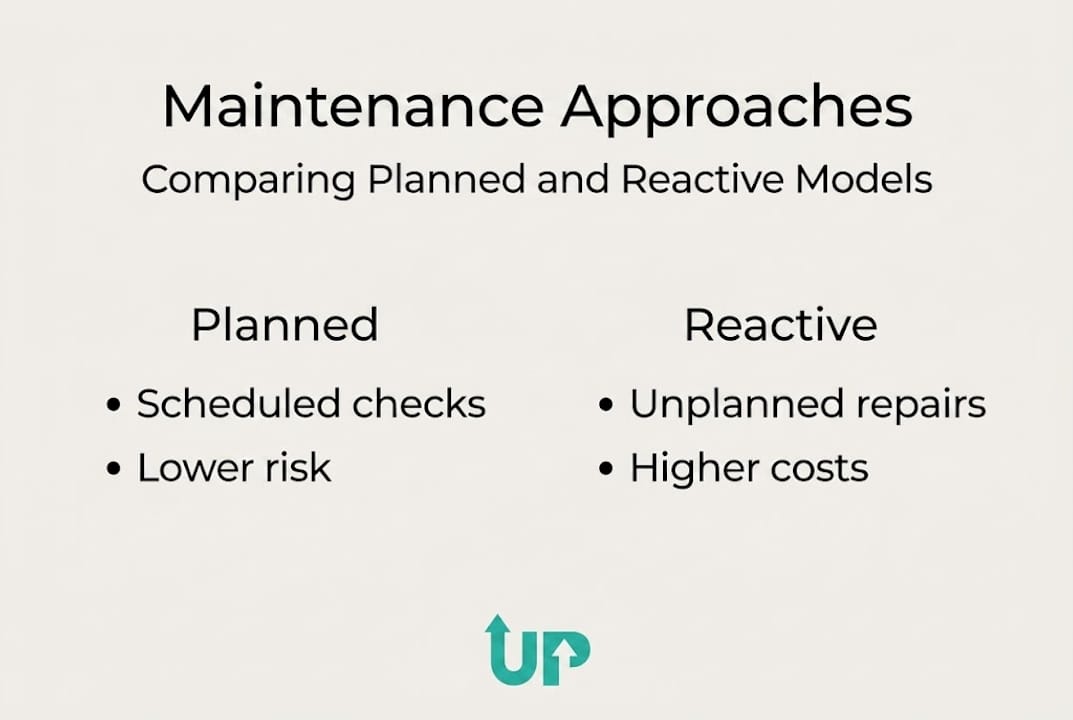
Here is a direct comparison of the two approaches:
| Factor | Planned maintenance | Reactive maintenance |
|---|---|---|
| Cost predictability | High, budgeted in advance | Low, often unexpected |
| Disruption to occupants | Minimal, scheduled in advance | High, often urgent and disruptive |
| Risk of major failure | Reduced through regular checks | Elevated, problems go undetected |
| Legal compliance | Easier to maintain consistently | Difficult to guarantee |
| Contractor relationships | Established, often better pricing | Ad hoc, often premium rates |
| Long-term asset value | Protected and improved | Potentially damaged |
The financial consequences of a purely reactive approach can be severe. Consider these common outcomes:
- A small roof leak ignored for months results in widespread damp, structural timber rot, and a repair bill several times what early intervention would have cost.
- An unserviced boiler fails mid-winter, requiring emergency replacement rather than a simple part swap, along with temporary heating costs for tenants.
- An unchecked electrical fault causes a fire, triggering insurance investigations, legal proceedings, and substantial remediation costs.
- Deteriorating window seals allow condensation and mould growth, eventually requiring full window replacement and specialist mould treatment.
- Blocked drainage damages a shared drain system, creating liability disputes with neighbouring properties and costly excavation work.
Poorly maintained properties cost UK landlords and managers significantly more over a five-year period than those maintained on a planned schedule, due to compounding repair costs, void periods, and tenant turnover.
The reality of cost-saving maintenance strategies is that prevention is almost always less expensive than cure. The difference between chaos and control comes down to whether you have a plan or are simply reacting to circumstances.
What does planned maintenance include? Typical activities and examples
Planned maintenance covers a broad spectrum of tasks, and the specific activities relevant to your property will depend on its type, age, usage, and the nature of its occupants. The table below maps common planned maintenance tasks to different property types, giving you a clear picture of what a practical schedule might include.
| Task | Frequency | Residential | Commercial | Public sector |
|---|---|---|---|---|
| Boiler and heating service | Annual | ✓ | ✓ | ✓ |
| Gas safety check | Annual | ✓ | ✓ | ✓ |
| Electrical condition report | Every 5 years | ✓ | ✓ | ✓ |
| Roof and guttering inspection | Biannual | ✓ | ✓ | ✓ |
| Fire alarm testing | Quarterly | Blocks of flats | ✓ | ✓ |
| Lift servicing | Monthly/quarterly | Blocks of flats | ✓ | ✓ |
| External paintwork and sealing | Every 3-5 years | ✓ | ✓ | ✓ |
| Drainage survey | Annual | ✓ | ✓ | ✓ |
| Pest control inspection | Annual or biannual | ✓ | ✓ | ✓ |
| Air conditioning servicing | Annual | Rarely | ✓ | ✓ |
As highlighted in public sector maintenance examples, councils and housing associations that manage large portfolios have developed robust planned maintenance frameworks precisely because the cost of unplanned failures at scale is simply unmanageable. The same discipline applies equally well to private landlords managing just a handful of properties.
Beyond compliance and cost control, there are further advantages to keeping your planned maintenance programme thorough and consistent:
- Improved tenant satisfaction: Tenants who live or work in well-maintained properties are more likely to renew their tenancy, reducing void periods and re-letting costs.
- Enhanced legal standing: A documented maintenance history demonstrates due diligence if a dispute or claim arises.
- Longer asset lifespan: Regular servicing and timely replacements extend the functional life of boilers, roofs, windows, and electrical systems.
- Better insurance outcomes: Some insurers offer more favourable terms to property owners who can demonstrate a structured maintenance approach.
- Easier property sales: A clear maintenance record adds credibility and confidence for prospective buyers or investors.
Pro Tip: Start a maintenance logbook for each property you manage. Whether digital or physical, record the date, nature, and outcome of every task carried out. This single habit creates an audit trail that protects you legally, informs your budgeting, and makes handovers to new managers far simpler.
How to implement planned maintenance for your property
Understanding the value of planned maintenance is one thing. Building a workable programme from scratch is another. The good news is that implementation does not need to be complicated. A clear, methodical process allows you to get your planned maintenance in order relatively quickly, regardless of the size of your portfolio.
Guidance on planning maintenance for landlords outlines that the most effective approach follows a structured sequence, moving from asset identification through to ongoing review. Here is a step-by-step framework:
- Identify all assets and components. Walk through each property and list every system and element that requires maintenance, from the boiler and roof to window mechanisms and drainage systems.
- Assess the condition and servicing history of each asset. Review any existing records and note what has been done, what is overdue, and what is approaching the end of its expected lifespan.
- Prioritise tasks by urgency and compliance requirements. Safety-related tasks such as gas certificates and electrical checks must come first. Follow with structural and fabric issues, then cosmetic and comfort-related work.
- Build a 12-month schedule. Assign each task to a specific month or quarter, factoring in seasonal considerations (roof checks before winter, external painting in summer) and budget availability.
- Allocate a dedicated maintenance budget. A general industry benchmark is to set aside between one and three per cent of a property’s value annually for maintenance. Adjust this based on the property’s age and condition.
- Engage reliable contractors in advance. Build relationships with trusted tradespeople before you need them urgently. Establishing regular maintenance for letting agencies and property managers often means negotiated rates and priority scheduling.
- Record all completed work. Update your maintenance logbook after each task is finished and retain certificates and invoices for compliance purposes.
- Review and update the schedule quarterly. Circumstances change. New issues emerge, priorities shift, and some tasks may be completed ahead of schedule. Regular reviews keep your programme relevant.
Common pitfalls to avoid when implementing your planned maintenance programme include:
- Skipping annual safety checks due to budget pressure, which creates both legal risk and potential for serious incidents.
- Failing to update your schedule when tenants change or properties are refurbished, leaving gaps in coverage.
- Over-relying on a single contractor without having a back-up option for emergencies.
- Not communicating planned visits to tenants in advance, which causes friction and can delay access.
- Treating the schedule as fixed and never revising it, even when new issues or asset changes arise.
Pro Tip: Consider using a digital property management platform or even a shared calendar to automate reminders for each scheduled task. Many landlords and managers find that a simple system with email alerts prevents tasks from slipping through unnoticed, particularly when managing multiple properties simultaneously.
Stakeholder buy-in matters too. Planned maintenance works best when landlords, property managers, and tenants all understand the schedule and their respective roles within it. Tenants who know when access will be required, and why, are far more cooperative than those who feel surprised or inconvenienced.
The uncomfortable truth about property maintenance
Here is something many in the industry are reluctant to say plainly: most property owners know planned maintenance matters, yet a significant number still delay it. Not because they lack information, but because it feels like spending money before anything has actually gone wrong.
This is entirely understandable. Budgets are finite, and spending money on a boiler service when the heating is working feels less urgent than fixing something visibly broken. But this mindset creates a slow and expensive trap. The properties that cost the most to maintain over a ten-year period are almost always those where small issues were left to compound.
What surprises many owners who switch to a structured approach is that planned maintenance often uncovers hidden savings, not just problems. A routine inspection finds a minor damp patch before it becomes a structural issue. A drainage check prevents a blockage that would have caused flooding. These early catches do not feel dramatic. They rarely make themselves known. But they quietly save thousands over time.
Keeping pace with property maintenance trends reveals that expectations from tenants, insurers, and regulators are all moving in one direction: towards greater accountability and documented diligence. The owners and managers who treat planned maintenance as a professional standard rather than an optional extra are consistently better positioned, financially and reputationally, than those who do not. The mindset shift is the hardest part. Once it is made, the benefits follow naturally.
Get expert support for your planned maintenance
Knowing the framework is one thing. Executing it confidently across your property or portfolio is another challenge entirely, especially when you are juggling tenancies, compliance deadlines, and day-to-day operations.
At UpKeep UK, we work with residential landlords, commercial property managers, and public sector clients across London and the wider UK to design and deliver planned maintenance programmes that are practical, cost-effective, and fully compliant. Whether you are starting from scratch or looking to strengthen an existing approach, our experienced team of builders, electricians, roofers, and project managers can help you stay ahead of issues before they escalate. Explore property maintenance red flags to understand what warning signs to watch for, or review our detailed guide on planning maintenance for landlords to take the next step. Get in touch with us today for a consultation and a transparent, fixed-price quote.
Frequently asked questions
Is planned maintenance legally required for UK landlords?
Certain planned maintenance, like annual gas safety and electrical checks, is a legal obligation for UK landlords, and failing to comply can result in significant fines or prosecution.
How often should planned maintenance be carried out?
Most properties benefit from quarterly, biannual, and annual planned checks, but as maintenance frequency guidance shows, exact frequency depends on asset type, age, and usage patterns.
What is the first step in creating a planned maintenance schedule?
Start by identifying all assets on the property and their servicing requirements before prioritising tasks, as outlined in landlord maintenance planning best practice.
Does planned maintenance save money compared to reactive maintenance?
Yes. Planned maintenance prevents costly emergencies and major repairs, consistently saving property owners money over the medium and long term compared to a purely reactive approach.
































