


TL;DR:
- Proper maintenance ensures legal compliance, preserves property value, and prevents costly repairs.
- Regular inspections and a maintenance calendar help manage core elements like plumbing, roofing, and electrical systems.
- Document all repairs with records and photos to verify compliance and protect against disputes.
London properties carry enormous financial weight. Neglect a structural fault for six months and you risk not only a costly repair bill but also legal exposure, tenant disputes, and a measurable drop in asset value. Landlords are legally required to maintain structural and core system elements under Section 11 of the Landlord and Tenant Act 1985, yet a surprising number of owners still treat maintenance as an afterthought. This guide covers everything you need: your legal obligations, practical planning, step-by-step execution, common mistakes to sidestep, and how to verify that every repair actually protects the long-term value of your property.
Key Takeaways
| Point | Details |
|---|---|
| Know your legal duties | Understand your statutory obligations to avoid disputes and costly mistakes. |
| Prepare with clear checklists | Good planning and reliable contractors make maintenance smooth and efficient. |
| Act and upgrade proactively | Regular attention and energy upgrades protect value and prevent expensive failures. |
| Verify and record everything | Documenting work and outcomes ensures compliance and future proofing. |
Understanding your maintenance obligations and property needs
With the importance of maintenance firmly established, it is critical to understand both your legal duties and which parts of your property need consistent, structured attention. Skipping this foundation is one of the fastest ways to end up in a costly dispute or face a compliance failure at the worst possible moment.
What must you maintain?
Every property, whether residential or commercial, has a core set of elements that require regular upkeep. For residential landlords, Section 11 legal obligations are the starting point. These cover:
- The structure and exterior of the building, including walls, roof, foundations, and windows
- Installations for the supply of water, gas, electricity, and sanitation (basins, sinks, baths, and drainage)
- Space heating and water heating equipment
- Common areas shared by multiple tenants, such as stairwells and entrance halls
- Any installations provided by the landlord for the use of tenants
Commercial property owners carry similar duties, though the exact split between landlord and tenant responsibility is typically set out in the lease. Reviewing your lease terms carefully and seeking legal advice where the wording is ambiguous is always worthwhile.
Residential versus commercial: where confusion creeps in
One of the most frequent points of confusion is the distinction between residential and commercial obligations, and between landlord duties and those that fall to a property manager acting on the owner’s behalf. If you are a property manager rather than the legal owner, your responsibilities are defined by your management agreement. You may be authorised to approve repairs up to a certain cost threshold, escalate issues to the owner, or act in an emergency without prior approval. Understanding those boundaries prevents delays and protects all parties.
For residential properties, good maintenance planning for landlords starts with a clear written schedule that maps obligations against property-specific risks. A Victorian terrace in Hackney has very different vulnerabilities from a modern flat in Canary Wharf.
Key compliance reminder: Documentation is your best defence in a dispute. Keep written records of every reported fault, every inspection, and every completed repair. Disputes about whether a repair was carried out are far more common than disputes about whether a repair was needed.
Common areas that generate disputes include roof leaks attributed to blocked gutters, damp caused by inadequate ventilation, and plumbing failures that tenants argue the landlord was informed about but failed to address. Brushing up on maintenance terms used in tenancy agreements and compliance documents will help you communicate clearly and avoid costly misunderstandings. Similarly, proactive attention to your plumbing systems prevents many of the disputes that become expensive very quickly.
How to prepare for effective property maintenance
After clarifying your obligations, smart preparation makes the rest of the maintenance process smoother and more reliable. Rushing into repairs without a framework costs money and creates gaps in compliance.
Building a maintenance calendar
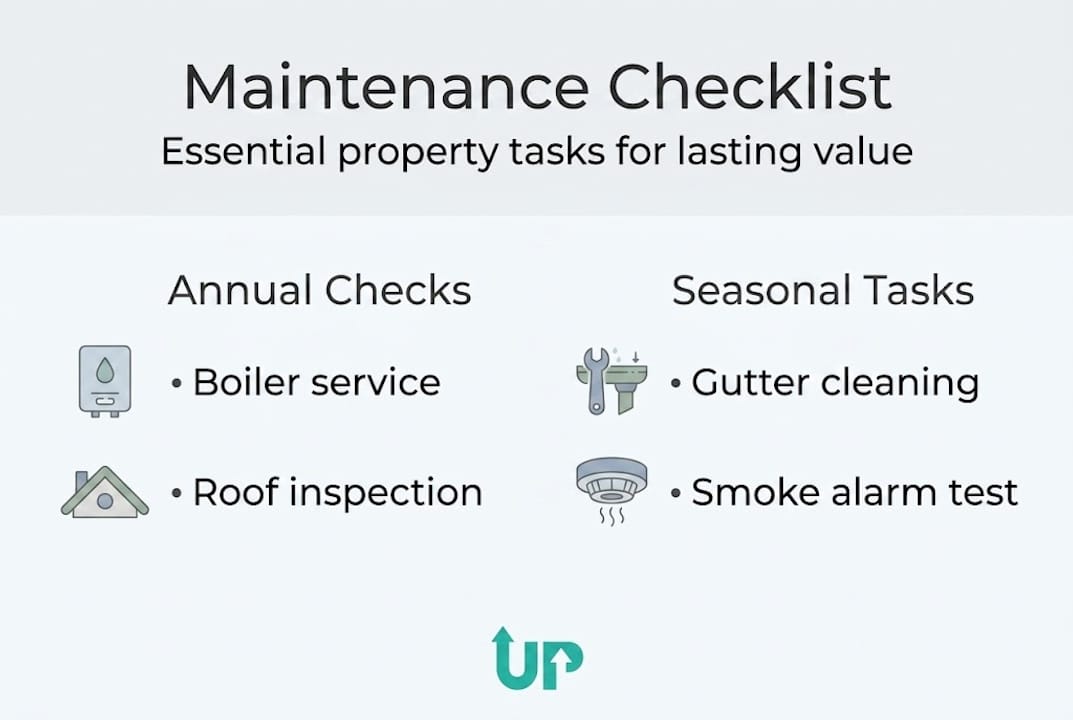
A maintenance calendar is the operational backbone of any well-managed property. It should be structured around three cycles:
- Monthly checks: Test smoke and carbon monoxide alarms, inspect visible pipework under sinks, check communal lighting, and note any signs of damp, mould, or water ingress.
- Seasonal checks: Clear gutters and downpipes each autumn before heavy rain, service boilers and heating systems in late summer before winter demand, check roof coverings for storm damage in spring, and inspect external paintwork and seals annually.
- Annual checks: Commission a full electrical installation condition report (EICR) on the required cycle, arrange a Gas Safe registered engineer for boiler servicing, conduct a full structural inspection, and review fire safety equipment and escape routes.
A property-specific maintenance checklist
The table below outlines a practical framework for common property types and the tradespeople required:
| Area | Frequency | Task | Professional needed |
|---|---|---|---|
| Boiler and heating | Annually | Service and safety check | Gas Safe engineer |
| Electrical installations | Every 5 years (residential) | EICR inspection | Qualified electrician |
| Gutters and downpipes | Twice yearly | Clear and inspect | General maintenance or roofer |
| Roof covering | Annually | Visual inspection and repairs | Roofer |
| External decoration | Every 3 to 5 years | Repaint and seal | Decorator or painter |
| Damp and ventilation | Seasonally | Survey and treatment | Damp specialist |
| Plumbing and drainage | Annually | Inspection and flushing | Plumber |
| Fire safety equipment | Monthly and annually | Test alarms, inspect extinguishers | Fire safety specialist |
Choosing and verifying contractors
Poor contractor selection is where even the most organised property managers lose control of quality and cost. Always verify contractors’ accreditations and emergency availability before committing to any agreement. In practice, this means checking that tradespeople hold relevant certifications (Gas Safe, NICEIC, or equivalent), that their public liability insurance is current, and that they carry references from comparable properties.
For professional building care across a portfolio, partnering with a single managed service provider with verified sub-contractors is far more efficient than managing multiple independent trades.
Pro Tip: Before signing any maintenance contract, ask the contractor for their average emergency response time and whether they operate outside standard business hours. A burst pipe at 11 pm on a Friday needs a plumber, not a voicemail.
Executing property maintenance: step-by-step essentials
With plans and checklists set, it is time to carry out each crucial maintenance task. Here is how to get it right, area by area, without cutting corners that come back to haunt you.
Step-by-step for core maintenance tasks
-
Structural and exterior checks: Begin with a visual walk-around of the full perimeter. Look for cracks in brickwork wider than a hairline, failed pointing, deteriorating window frames, and any visible movement in the roof line. Flag anything unusual for specialist assessment before it worsens.
-
Roofing and guttering: Use binoculars or arrange a roofer to inspect at close range. Missing or slipped tiles, broken flashing around chimneys, and sagging gutters are the most frequent causes of water ingress. Clear gutters thoroughly and test the flow during or after rainfall.
-
Electrical systems: Never attempt electrical inspection without a qualified professional. An EICR identifies deterioration, damage, and non-compliance that a visual inspection simply cannot. Between formal inspections, test RCDs (residual current devices) monthly using the test button.
-
Plumbing and heating: Bleed radiators at the start of each heating season to remove trapped air and improve efficiency. Inspect visible pipework for signs of corrosion or weeping joints. Service the boiler annually and replace the pressure relief valve if it shows signs of leaking.
-
Damp and ventilation: Poor ventilation in kitchens and bathrooms leads to condensation damp, which tenants and insurers often confuse with penetrating damp. Install and maintain extractor fans, check bathroom sealant regularly, and investigate any persistent mould with a specialist rather than simply cleaning the surface.
-
Internal decoration and fixtures: Worn fixtures and faded decoration signal neglect to prospective tenants and buyers alike. Redecorating at regular intervals, repairing or replacing worn flooring, and maintaining kitchen and bathroom fittings in good order protects rental value and reduces void periods.
Integrating energy upgrades into routine maintenance
The smartest property managers treat maintenance visits as an opportunity to improve, not just repair. Combining maintenance with energy upgrades such as improved insulation, smart thermostats, or LED lighting reduces running costs and boosts long-term property value in a measurable way.
In London’s competitive lettings market, energy performance matters. Properties with an EPC rating of C or above typically attract stronger tenant interest and command higher rents. When a boiler reaches end of life, upgrading to a high-efficiency model rather than a like-for-like replacement costs marginally more upfront but saves significantly over a five to ten year cycle.
Exploring energy-efficient renovations alongside your regular programme is not an added luxury. It is increasingly a financial necessity. Properties that fall below minimum energy standards face legal restrictions on letting. A structured approach to sustainable property upkeep protects your compliance position while building asset value year on year.
Statistic to note: Research into property management priorities shows that a significant proportion of managers are focused primarily on controlling operational costs. Prevention through scheduled maintenance consistently outperforms reactive repair in cost terms, often by a ratio of three to one over a five-year period.
Pro Tip: When scheduling a boiler service, ask the engineer to check pipe insulation at the same visit. Adding basic pipe lagging in loft spaces costs very little but prevents freeze and burst incidents during cold spells, which are among the most disruptive and costly emergency repairs in London properties.
Verifying results and avoiding common mistakes
After finishing your maintenance routines, thorough verification ensures that value is not lost and compliance remains intact. Completing a task is only half the job. Confirming it was done correctly and recording the evidence is what protects you.
How to document and verify completed repairs
Good documentation is not bureaucracy for its own sake. Landlords must be able to demonstrate compliance through clear evidence of completed repairs and regular inspections. In practice, this means:
- Keeping a digital log of every reported fault with date, description, and the action taken
- Requesting invoices and job sheets from every contractor, even for minor repairs
- Taking before-and-after photographs of every repair and storing them with the job record
- Retaining signed inspection reports and certificates (Gas Safe, EICR, EPC) in an accessible file
- Following up with tenants after repairs to confirm the issue is resolved and documenting their response
Regular property inspection strategies should be formalised into your management routine, not carried out only when a problem is reported.
DIY versus professional maintenance: a practical comparison
| Factor | DIY maintenance | Professional maintenance |
|---|---|---|
| Quality assurance | Variable, dependent on skill level | Consistent, certified where required |
| Compliance | Risk of non-compliance with regulations | Meets legal and safety standards |
| Cost | Lower upfront, higher risk of rework | Higher upfront, lower long-term cost |
| Speed | Dependent on availability | Scheduled and accountable |
| Documentation | Inconsistent | Formal records and certificates |
| Risk | Higher liability exposure | Insured and professionally warranted |
Common pitfalls to avoid
- Deferring non-urgent repairs until they become urgent (and expensive)
- Failing to keep copies of compliance certificates accessible for inspection
- Assuming a contractor has completed a job correctly without verifying or inspecting it
- Not following up with tenants after repairs are completed
- Attempting complex electrical, gas, or structural work without qualified tradespeople
When to escalate immediately: Any fault involving gas, structural instability, flooding, or loss of heating in winter should be treated as an emergency requiring same-day professional response. Never attempt gas work of any kind without a Gas Safe registered engineer, and never delay action on a structural concern in an occupied property.
A smarter approach to property maintenance in London
Standard maintenance checklists are a starting point, not a strategy. London’s property market is fast-moving and competitive, and the gap between a well-maintained asset and a neglected one compounds quickly. Properties that generate the strongest returns are not simply those that avoid disasters. They are managed by owners who treat maintenance as ongoing value-building rather than a compliance obligation to be minimised.
The most effective property managers we work with share a common approach: they combine routine upkeep with targeted improvements, they build relationships with verified contractors who respond quickly, and they review their maintenance programme annually rather than waiting for problems to surface. Energy efficiency is now central to that approach, not peripheral. Exploring renovation strategies that align with your maintenance cycle is one of the clearest ways to differentiate your asset in a crowded market.
The difference between chaos and control in property management rarely comes down to a single dramatic decision. It is built incrementally, repair by repair, inspection by inspection, contractor relationship by contractor relationship.
Professional support for hassle-free property upkeep
Managing maintenance across even a single London property takes time, knowledge, and a network of reliable trades. Across a portfolio, the complexity multiplies quickly.

At UpKeep UK, we support residential and commercial property owners and managers with everything from routine maintenance programmes to emergency call-outs and large-scale refurbishment projects. We understand the compliance pressures you face and the financial stakes involved. Recognising the critical property maintenance red flags early is far less costly than addressing them after the damage is done. Our experienced project managers bring accountability and structure to every project. If you are ready to take the pressure off your maintenance obligations, speak to a maintenance expert today.
Frequently asked questions
What are the top legal requirements for property maintenance in the UK?
Landlords must keep the structure, exterior, and essential services including heating and water in good repair, as required by Section 11 legal duties under the Landlord and Tenant Act 1985. Failure to comply can result in legal proceedings and financial penalties.
How often should property maintenance checks be carried out?
Major checks should be completed at least annually, with seasonal inspections for heating, guttering, and roofing, plus monthly spot checks for alarms and visible faults in high-use areas.
What should I check before hiring a contractor for property work?
Always review their accreditations, insurance, client references, and emergency response availability before agreeing terms. A contractor who cannot respond quickly to emergencies is a significant gap in your maintenance cover.
Are energy upgrades a part of regular property maintenance?
Yes, maintenance combined with energy upgrades such as insulation improvements or HVAC replacements reduces running costs and improves your EPC rating, both of which directly support property value and lettability.
How can I document completed maintenance to protect myself as a landlord?
Keep a digital record of every repair including invoices, before-and-after photographs, contractor job sheets, and signed inspection reports, stored in an accessible and organised format for each property.
































