

Maintenance quietly consumes more of your rental income than most landlords expect. Maintenance costs comprise 31-39% of gross rental income for UK landlords, yet the majority of property owners still operate without a clear strategy, simply fixing things when they break. That reactive approach is not inherently wrong, but without understanding how it works, when to use it, and how to measure it, you risk overspending, losing tenants, and watching your property value quietly erode. This guide gives you the clarity and practical tools to manage reactive maintenance properly.
Table of Contents
- Defining reactive maintenance in property management
- How reactive maintenance works: the UK model
- Costs of reactive maintenance for landlords
- The benefits and drawbacks of reactive maintenance
- When to use reactive maintenance: practical scenarios
- Key performance metrics for effective reactive maintenance
- How UpKeep UK can support your reactive maintenance strategy
- Frequently asked questions
Key Takeaways
| Point | Details |
|---|---|
| Reactive maintenance defined | It means fixing problems only after they arise, covering issues like leaks or heating breakdowns. |
| UK repair response times | Emergencies must be fixed within 4 hours, with urgent and routine repairs taking up to 28 days. |
| Financial impact | Reactive-only approaches often cost more and can reduce property value compared to hybrid strategies. |
| Best practice | Combine reactive and planned maintenance, keeping reactive under 30 percent for greatest efficiency. |
Defining reactive maintenance in property management
Reactive maintenance means exactly what it sounds like: you respond to problems after they occur rather than preventing them in advance. Reactive maintenance is fixing assets after a breakdown, not before. In the UK property sector, this is sometimes called responsive repairs or breakdown maintenance, and it covers a wide range of everyday situations.
Common examples include:
- Burst or leaking pipes
- Boiler failures and loss of heating
- Faulty wiring or electrical faults
- Roof leaks following storms
- Broken locks, windows, or doors
- Blocked drains or sewage issues
This contrasts directly with planned or preventative maintenance, where you schedule inspections and servicing before faults develop. Understanding property maintenance terminology helps you communicate clearly with contractors and tenants alike, and it shapes how you budget and plan.
“Reactive maintenance is not a failure of planning. It is an unavoidable part of property ownership. The goal is to manage it efficiently, not eliminate it entirely.”
For a broader look at real-world scenarios, reactive maintenance examples from London estate agents show how frequently these situations arise, even in well-maintained properties.
How reactive maintenance works: the UK model
In practice, reactive maintenance follows a clear sequence. Understanding each stage helps you respond faster, stay legally compliant, and keep tenants informed.
- Fault reported by tenant, caretaker, or inspection
- Issue assessed for urgency and safety risk
- Priority assigned (emergency, urgent, or routine)
- Contractor instructed and attendance scheduled
- Repair completed and signed off
- Record updated for compliance and future reference
The priority assigned at step three determines your legal and contractual obligations. SLAs define response times by urgency: emergencies within 4 hours, urgent repairs within 24 hours, and routine repairs within 20 to 28 days. These benchmarks are widely used across both social and private housing in the UK.
| Priority level | Example issue | Target response time |
|---|---|---|
| Emergency | Gas leak, total loss of heating in winter | Within 4 hours |
| Urgent | Partial electrical failure, significant leak | Within 24 hours |
| Routine | Minor plumbing drip, broken cupboard door | 20 to 28 days |
| Complex/extended | Structural repairs, multi-trade works | Up to 60 days |
Legal obligations add another layer. As a landlord, you must ensure the property remains safe and habitable under the Landlord and Tenant Act 1985. Vulnerable tenants, including those with disabilities or young children, may require faster response times regardless of the standard SLA category.
Pro Tip: Always log every repair request with a timestamp and the priority assigned. This protects you legally and helps you spot recurring faults that signal a deeper problem.
For guidance on structuring your overall approach, planning property maintenance effectively reduces the volume of reactive calls you receive in the first place.
Costs of reactive maintenance for landlords
Here is where the numbers get uncomfortable. Landlords spend an average of £1,374 to £3,134 annually on maintenance per property, roughly 1% of property value each year. That figure rises sharply when reactive repairs dominate your strategy.

The core problem with a purely reactive approach is firefighting: you pay premium call-out rates, accept whatever contractor is available, and often deal with secondary damage caused by the delay. A burst pipe left unreported for 48 hours costs far more to fix than one caught during a routine inspection.
| Maintenance type | Typical annual cost per property | Cost predictability |
|---|---|---|
| Planned/preventative | £800 to £1,500 | High |
| Reactive (managed) | £1,374 to £3,134 | Medium |
| Reactive (unmanaged) | £3,000 to £6,000+ | Low |
Beyond direct repair bills, reactive-only strategies carry hidden costs. Void periods increase when tenants leave due to poor maintenance response. Property value declines when structural or cosmetic issues accumulate. Insurance premiums can rise following repeated claims.
Pro Tip: Budget 1% to 1.5% of your property’s value annually for maintenance. If your reactive spend consistently exceeds this, it is a signal to invest in maintenance planning advice and preventative checks.
The benefits and drawbacks of reactive maintenance
Reactive maintenance is neither good nor bad on its own. Its value depends entirely on how and when you use it.
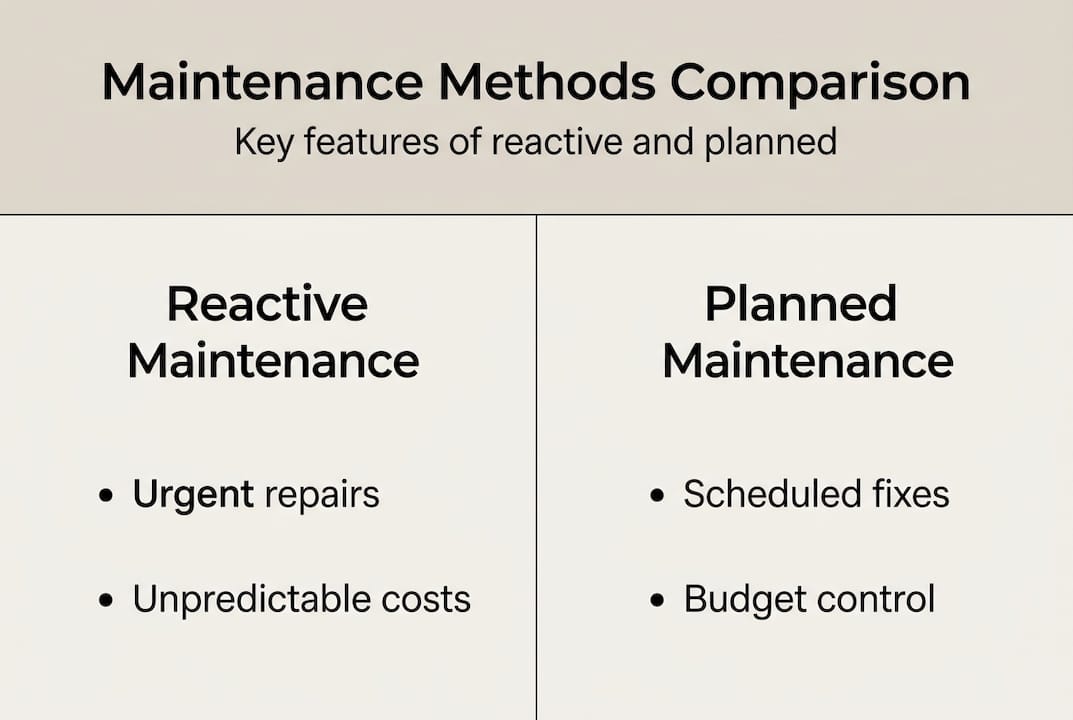
| Factor | Reactive maintenance | Planned maintenance |
|---|---|---|
| Speed of response | Fast for emergencies | Scheduled in advance |
| Cost per incident | Higher (call-out rates) | Lower (routine pricing) |
| Disruption to tenants | Unpredictable | Foreseeable |
| Planning required | Minimal | Significant |
| Best suited for | Sudden breakdowns | Ongoing asset care |
The benefits are real. Reactive maintenance is essential for genuine emergencies, requires no upfront scheduling, and keeps you legally compliant when urgent issues arise. It is also the only practical option for truly unpredictable faults.
The drawbacks, however, accumulate over time:
- Higher overall spend due to emergency call-out rates
- Tenant dissatisfaction from repeated disruptions
- Reduced property value when issues are left until failure
- Difficulty budgeting accurately from year to year
- Increased risk of secondary damage from delayed repairs
“Hybrid strategies reduce costs by 40%+ by combining proactive checks with responsive repairs under clear SLAs.”
The most cost-effective approach blends both methods. Use practical advice for reactive maintenance to handle genuine emergencies efficiently, while planned maintenance protects your assets and reduces the frequency of breakdowns. Understanding key terms in property maintenance helps you communicate this strategy clearly to your team and contractors.
When to use reactive maintenance: practical scenarios
Knowing when reactive maintenance is the right call, and when it is not, saves you money and protects your tenants.
Appropriate situations for reactive maintenance:
- Boiler failure during cold weather requiring immediate attention
- Electrical fault causing partial or total power loss
- Roof leak following unexpected storm damage
- Blocked drains causing a health or hygiene risk
- Security issue such as a broken entry lock
Situations where reactive-only is insufficient:
- Repeated boiler callouts that signal the unit needs replacing
- Recurring damp that points to an underlying structural issue
- Ageing electrical systems that should be on a planned inspection schedule
- High-value assets like lifts or communal heating systems
Complex repairs can exceed normal SLAs, with structural or multi-trade works sometimes running up to 60 days. Vulnerable tenants may require a response within 2 hours regardless of the standard priority category. These edge cases require you to have flexible contractor relationships and clear escalation procedures in place.
For properties with older plumbing, plumbing repair guidance outlines when a reactive fix is appropriate and when a full system review is the smarter investment.
Pro Tip: If the same fault recurs more than twice in 12 months, it is no longer a reactive issue. It is a planned maintenance task waiting to happen. Treat it as one.
Key performance metrics for effective reactive maintenance
You cannot improve what you do not measure. Tracking a handful of key performance indicators (KPIs) gives you an honest picture of how well your reactive maintenance strategy is actually working.
The most important metrics to monitor are:
- First-fix rate: the percentage of repairs resolved on the first visit. Target above 75% to avoid costly repeat callouts.
- On-time completion rate: aim for 80% of routine repairs completed within the agreed SLA window.
- Reactive as a proportion of total maintenance: keep this below 30% for a healthy, cost-controlled portfolio.
- Average cost per repair: track this over time to identify contractors or property types driving up spend.
- Tenant satisfaction score: collected after each repair, this flags service quality issues before they become tenancy problems.
“Reactive maintenance should be a safety net, not a strategy. When it accounts for more than 30% of your total maintenance activity, your costs and risks both rise significantly.”
Tracking property maintenance KPIs consistently allows you to benchmark your portfolio against industry standards and make evidence-based decisions about where to invest in preventative work. Even a simple spreadsheet tracking repair dates, costs, and outcomes gives you far more control than managing reactively with no data at all.
How UpKeep UK can support your reactive maintenance strategy
Managing reactive maintenance well requires reliable contractors, clear processes, and the confidence to act fast when something goes wrong. That is exactly what we provide at UpKeep UK.
Our team of experienced tradespeople covers emergency callouts, routine repairs, and everything in between, serving landlords, property managers, and estate agents across London and the wider UK. We work to clear SLAs, offer fixed pricing, and carry full insurance so you are never left exposed. Whether you need to understand property maintenance risks before they escalate or require emergency repairs guidance for an urgent situation, we are ready to help. Get in touch today for a no-obligation consultation and find out how a structured maintenance partnership can reduce your reactive spend and protect your investment.
Frequently asked questions
What does reactive maintenance include for landlords?
Reactive maintenance covers unplanned repairs triggered by tenant reports or observed faults, including leaks, electrical failures, boiler breakdowns, and security issues. It applies whenever a fault occurs unexpectedly rather than being scheduled in advance.
What are typical response times for reactive repairs in the UK?
SLAs set emergency response at 4 hours, urgent repairs within 24 hours, and routine repairs within 20 to 28 days. Complex or multi-trade repairs may be permitted up to 60 days under most housing policies.
Is reactive or planned maintenance more cost-effective for UK properties?
A blended approach delivers the best results. Hybrid strategies cut costs by 40%+ compared to relying on reactive repairs alone, by reducing emergency callouts and extending asset lifespans.
What percentage of maintenance should be reactive for best results?
Keep reactive below 20 to 30% of your total maintenance activity. Above that threshold, costs become unpredictable and the risk of property deterioration increases significantly.
































