Professional roof leak detection finds the actual breach rather than the visible damage, using non-invasive methods such as electronic leak detection (ELD), moisture mapping, thermal imaging and tracer gas. A structured survey to standards such as BS 6229 and CIRIA C817 pinpoints the failure, so the cause is repaired once instead of chasing the same stain three times.
TL;DR:
- Electronic leak detection is most effective on accessible flat roofs with conductive membranes and requires a dry surface for accurate results.
- Moisture mapping and infrared thermography indicate water spread but cannot pinpoint entry points without follow-up targeted testing.
- Buried or overburdened membranes under green roofs or ballast are best inspected using tracer gas testing or electrical field mapping to avoid costly surface removal.
- Flood testing confirms whether a repair succeeded but should only be used after locating and fixing the leak, not as the initial detection method.
- Internal inspections, including mapping stains and checking the loft, are essential first steps before deploying non-invasive testing techniques.
Table of Contents
- What is roof leak detection and which method fits your roof?
- How does electronic leak detection actually work?
- Can moisture mapping or thermal imaging find the hole?
- What about buried membranes under green roofs or ballast?
- Is flood testing ever the right approach?
- Where do you start before calling in test equipment?
- What does a proper investigation and quote look like?
- When is a roof leak an emergency, and how does insurance treat it?
- How Upkeep UK approaches a leak investigation
- Diagnosis first, always. Here’s why that’s not just theory.
- Get a professional roof survey or emergency call-out
- Sources
- FAQ
What is roof leak detection and which method fits your roof?
Roof leak detection is the process of finding where water enters a roof build-up, not just where it shows up on a ceiling below. The right method depends on the roof type, the covering, and how urgent the problem is.
- Low-voltage wet ELD suits accessible single-ply or liquid-applied membranes on conductive decks; highly accurate, but the roof needs to be dry to begin.
- High-voltage dry ELD works on dry membranes and doesn’t need flooding, though it struggles near metal fixings and penetrations.
- Moisture mapping (Tramex-style) shows how far water has spread under the surface, useful for scoping repairs rather than pinpointing the hole.
- Infrared thermography reveals temperature differences linked to trapped moisture, best used at dusk or dawn for contrast.
- Tracer gas and electrical field mapping (EFM) suit buried or overburdened systems, like green roofs and podiums, where lifting the surface isn’t an option.
Weather matters more than most property owners expect. Wet ELD needs a dry roof surface, thermal surveys need a temperature swing, and tracer gas needs still air. A good surveyor plans around this rather than turning up regardless.
How does electronic leak detection actually work?
Electronic leak detection sends a low-voltage current across a wetted membrane, or a high-voltage signal across a dry one, and reads where the circuit completes through a breach. It’s the most used method for accessible flat roofs, because it locates the actual puncture rather than the moisture halo around it.
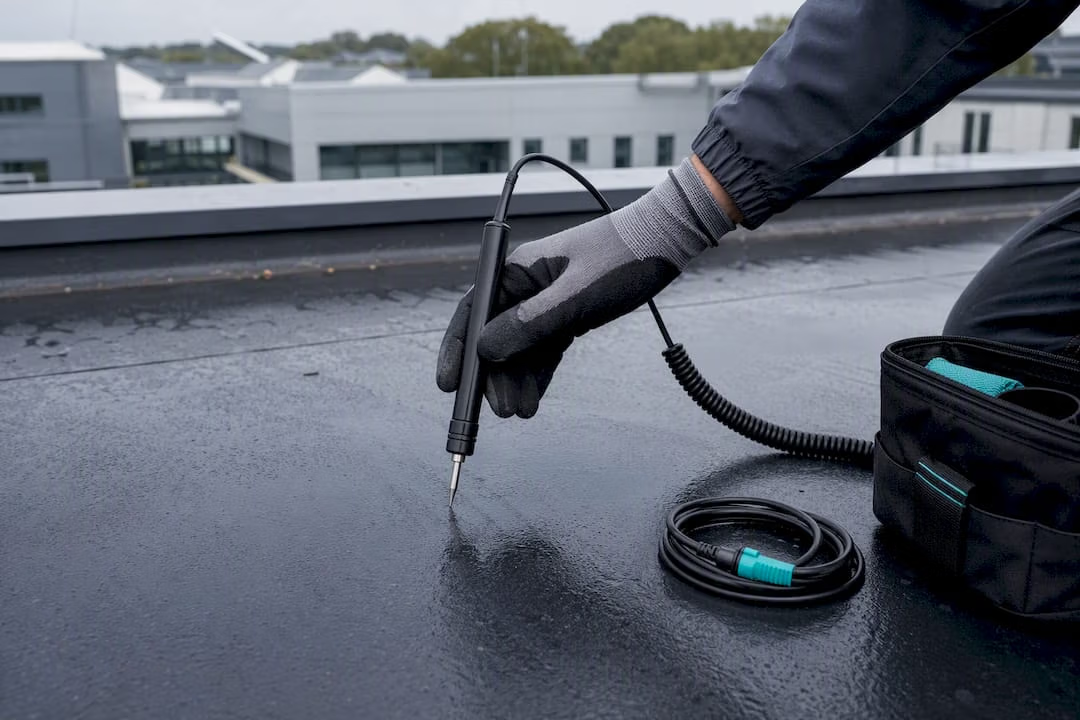
Low-voltage wet ELD floods the roof surface with a thin layer of water and passes a current through it. Where the membrane is intact, the water and the deck stay electrically isolated. Where there’s a breach, the circuit closes and the equipment marks the exact spot, often to within a few centimetres. This works well on single-ply membranes and liquid-applied systems laid over conductive decking, such as concrete or metal deck.
High-voltage dry ELD doesn’t need flooding. A pulsed high-voltage signal is passed over the dry surface, and any point where it arcs through to the deck flags a defect. It’s faster to set up but less reliable close to upstands, rooflights, and metal flashing, where false readings are common.
- Expect the surveyor to sweep the roof in a grid, mark suspect points with chalk or flags, and cross-check with a second pass.
- Reports should include annotated roof plans, GPS or measured coordinates, and photographs of each marked defect.
Pro Tip: Ask whether the survey includes a dry run before wet ELD. Standing water left on a roof overnight can itself cause problems on older decks, so a competent surveyor drains and dries the roof promptly after testing.
Can moisture mapping or thermal imaging find the hole?
Not on its own. Moisture mapping and infrared thermography show where water has travelled under the membrane, not where it got in, and treating a wet reading as the entry point is one of the most common misdiagnoses in roof repair.
Tramex capacitance meters measure moisture content in the roof build-up without penetrating it, producing a map of wet and dry zones across the deck. Infrared cameras pick up the same pattern differently: wet insulation holds heat longer than dry insulation, so it shows up as a warmer or cooler patch depending on the time of day. Both are genuinely useful for defining the extent of a wet area once a leak is confirmed, which matters when a contractor needs to know how much insulation to strip out.
- Moisture mapping is best treated as a scoping tool that sets the repair boundary, not a locating tool.
- Infrared surveys need a clear temperature differential, so they’re usually flown or walked at dawn, dusk, or overnight.
- Follow-up with ELD or a targeted visual check is standard practice once the wet zone is mapped.
Property owners who commission a thermal survey expecting a single red dot marking “the leak” are often disappointed, because that isn’t what the technology does.
What about buried membranes under green roofs or ballast?
Buried and overburdened roofs, green roofs, paving on pedestals, ballasted systems need a different approach because lifting the surface to inspect the membrane is expensive and disruptive. Tracer gas and electrical field mapping (EFM) exist precisely to avoid that.
Tracer gas testing introduces a detectable gas, usually hydrogen mixed with nitrogen, beneath the membrane and uses a sniffer to trace where it escapes through a breach. It only works reliably in calm, dry conditions, since wind disperses the gas before it can be traced accurately, which limits scheduling flexibility on exposed London rooftops.
Electrical field mapping applies a voltage across the membrane while it’s still buried under soil, ballast, or paving, and measures current leakage to locate defects without disturbing the overburden. It’s the correct method specifically for buried waterproofing, and avoiding a full strip-out can represent a substantial saving over trial excavation on a large podium deck.
- EFM typically takes longer to set up than surface ELD but avoids reinstatement costs entirely.
- Tracer gas suits smaller, well-defined areas where gas concentration can be controlled.
- Both methods cost more per square metre than open-surface ELD, but far less than lifting and relaying a green roof speculatively.
Is flood testing ever the right approach?
Flood testing has a role, but it is a verification step, not a first-line locating method. It confirms whether a repair has actually worked or whether a suspected area genuinely lets water through; it rarely tells you precisely where the water gets in when used on its own.
Controlled flood testing involves ponding water over a defined section of roof, usually to a set depth for a set duration, and watching for ingress below. On some decks, particularly older timber structures or lightweight steel, that standing water load needs an engineer’s sign-off before you go anywhere near it, since a flat roof isn’t always designed to hold ponded water safely for hours.
- Use flood testing to verify a repair has succeeded, not to find the original fault.
- Get structural sign-off before flooding any deck you’re not certain can carry the load.
- Combine with ELD beforehand; flood testing after a located and repaired breach is far more useful than flooding blind.
Where do you start before calling in test equipment?
Every credible investigation begins inside the building, not on the roof, because internal patterns tell you far more than a quick walk over the felt. Starting inside reduces speculative repairs by narrowing down where testing actually needs to happen.
- Map the internal damage first. Note every stain, its size, and its position relative to fixed points like walls or rooflights, ideally on a floor plan, before you go anywhere near the roof.
- Check the loft or ceiling void, if accessible. Water often tracks along joists, battens, or insulation for several metres before it drips, so the drip point can sit nowhere near the actual defect.
- Walk the roof externally. Look for cracked flashing, lifted laps on flat roof membranes, perished pointing around parapet gutters and chimneys, and ponding, all classic entry points.
- Consider a drone survey where access is restricted or unsafe. Steep pitches, fragile coverings, and tall buildings all make a walked survey riskier than it needs to be.
The stain on your ceiling is rarely directly under the hole in the roof, and treating it as though it were is the single most common reason repairs fail on the first attempt.
What does a proper investigation and quote look like?
A properly run investigation follows a sequence: initial internal and external survey, targeted testing (ELD, moisture mapping, tracer gas, or EFM as the roof type demands), verification of the located defect, then a written report with photographs and a recommended scope of works. Skipping straight to a repair quote without this sequence is how the same leak reappears within a year.
An industry guide puts the successful repair rate at a high percentage when leaks are correctly diagnosed before work begins, with the remainder needing fuller replacement due to structural or age-related failure. That figure only holds when diagnosis happens first.
When you’re comparing quotes, look for:
- Itemised pricing, broken down by survey, testing, access/plant, and remedial works, not one lump figure.
- Access and plant allowances stated separately, since scaffolding or cherry-picker hire can shift a quote significantly.
- Written guarantees on both materials and workmanship, with clear terms.
- NFRC registration or equivalent trade accreditation for the surveying contractor.
- At least three comparable quotes, all based on the same survey findings, before committing.
Repair usually wins over full re-roofing when the failure is isolated to flashings, laps, or pointing and the underlay and battens beneath are sound. Re-roofing becomes the sensible call once underlay has gone brittle, battens have softened, or multiple unrelated failure points turn up across the same roof, because repeated patching at that stage typically costs more over time than one proper replacement. For a fuller cost breakdown across repair scenarios, see our guide to roof leak repair costs.
When is a roof leak an emergency, and how does insurance treat it?
Some leaks need immediate action, not a scheduled survey. Treat it as an emergency if you see a sagging or bulging ceiling, water tracking near electrical fittings or consumer units, or a leak that’s visibly worsening within hours rather than days.
- Sagging plasterboard or a ceiling that feels soft to the touch signals structural saturation, not a minor drip.
- Water near light fittings, sockets, or a fuse board means isolating power to that area before doing anything else.
- Buckets and temporary sheeting are fine as stopgaps, but they don’t replace a proper survey.
Photograph the damage as soon as it’s safe to do so, and keep every receipt for temporary repairs or drying equipment, since insurers will ask for both. Contact your insurer promptly, and before commissioning permanent works if your policy requires prior authorisation, since many buildings policies specify this. For wider guidance on what counts as urgent and how to respond, see our emergency repair response guide.
Pro Tip: Keep a simple leak log for any recurring problem, date, weather conditions, and where the stain appeared. That pattern is often more useful to a surveyor than a single photo of the worst day.
How Upkeep UK approaches a leak investigation
A professional roof maintenance company runs multi-trade teams of insured, accredited engineers who cover roofing, electrics, and general property maintenance under one contract, which matters when a leak investigation turns up a knock-on electrical or structural issue mid-survey. Clients typically receive clear pricing agreed before work starts and photographic progress reporting throughout, so there’s a clear record of what was found and what was done about it.
A typical investigation follows the same diagnosis-first sequence covered above: internal mapping, external inspection, targeted non-invasive testing appropriate to the roof type, then a written scope of works before any repair is agreed. Response times for urgent leaks are generally quick for genuine emergencies in London.
Diagnosis first, always. Here’s why that’s not just theory.
The mistake I see repeated most often in this trade is treating the visible stain as the diagnosis. It isn’t. It’s a symptom, and a symptom that has usually travelled several metres from its cause along a joist, a batten, or a lap in the underlay before it ever became visible indoors. Property owners who commission a repair based on where the ceiling looks worst are, more often than not, paying to fix the wrong spot.
Where the conventional advice falls short is in treating moisture mapping or a quick visual check as sufficient on its own. Both have real value, but neither locates a breach with the precision that electronic leak detection or electrical field mapping offers. A wet reading tells you where water has been, not where it got in.
If there’s one priority for anyone weighing up a repair quote, it’s this: ask what testing was actually done before the price was written. A quote based on a proper survey costs more upfront than a guess, but it very rarely needs repeating within the year.
Chris, Site Manager, UpKeep UK
Get a professional roof survey or emergency call-out
Using a single specialist to cover the diagnostic survey, the roofing repair, and any related electrical or plumbing work the investigation turns up, priced upfront and reported in photographs at every stage, is a practical approach to managing roof leak investigations.

If you’ve got a live leak, emergency property repairs in London get a rapid response, typically within one to three hours, with insured engineers on site to stop the immediate damage before diagnosis begins properly. For non-urgent cases, or if you’re managing a portfolio and want ongoing cover, property maintenance services bring survey, repair, and planned inspection together under one point of contact.
To speed up your quote, have ready: photographs of the affected ceiling or roof area, a rough floor plan if you have one, and a short history of when the leak first appeared and how it’s changed since. Contact Upkeep UK to arrange a survey or an emergency call-out.
FAQ
How do I find out where my roof is leaking?
Start inside, mapping stains and checking the loft void if you can access it, since water tracks sideways before it drips. A professional survey then confirms the internal picture with external inspection and targeted testing such as electronic leak detection, which locates the actual breach rather than just the wet area.
What is the average cost of leak detection?
Costs vary by roof type, access, and which test is needed, so there’s no single flat figure that applies across every property. Repair costs once the leak is located typically range from a few hundred to a few thousand pounds depending on scope; see our roof leak repair cost guide for a fuller breakdown, or contact Upkeep UK for a quote based on your specific roof.
Does house insurance cover roof leaks in the UK?
Most buildings insurance policies cover sudden, accidental damage, such as a storm-caused leak, but they typically exclude damage from gradual wear and lack of maintenance. Contact your insurer promptly after discovering a leak, and check whether your policy requires authorisation before permanent repair works begin.
How do you find a roof leak with no attic access?
Without loft access, external non-invasive testing becomes the primary route: electronic leak detection, moisture mapping, or thermal imaging depending on the roof covering. A drone survey can also help assess hard-to-reach areas safely before any physical testing is scheduled.
Is it better to repair a roof leak or replace the whole roof?
Repair is usually the right call when the fault is isolated to a flashing, lap, or section of pointing and the underlying structure is sound, with a high percentage of correctly diagnosed leaks resolved this way. Re-roofing becomes the sensible option once underlay has perished, battens have softened, or several unrelated failures appear across the same roof.