TL;DR:
- Restaurant refurbishment is a strategic investment that enhances customer experience, regulatory compliance, and revenue generation. Proper planning around kitchen compliance, digital upgrades, and layout optimization can significantly increase capacity and profitability in London venues. Early coordination of permits, equipment orders, and phased construction ensures timely project completion and business continuity.
Restaurant refurbishment is the planned upgrade of a venue’s dining spaces, kitchen and building services to improve the guest experience, stay compliant and trade more profitably. For London operators, a well-planned refurbishment can lift covers and average spend, protect your licence and strengthen your position at lease renewal, and UpKeep UK plans the work to keep closures as short as possible.
Why invest in restaurant refurbishment: the core business case
Restaurant refurbishment is not cosmetic maintenance. It is a structured capital investment that addresses the physical, regulatory, and commercial foundations of your business simultaneously. The most successful operators treat it as a strategic reset rather than a reactive repair.
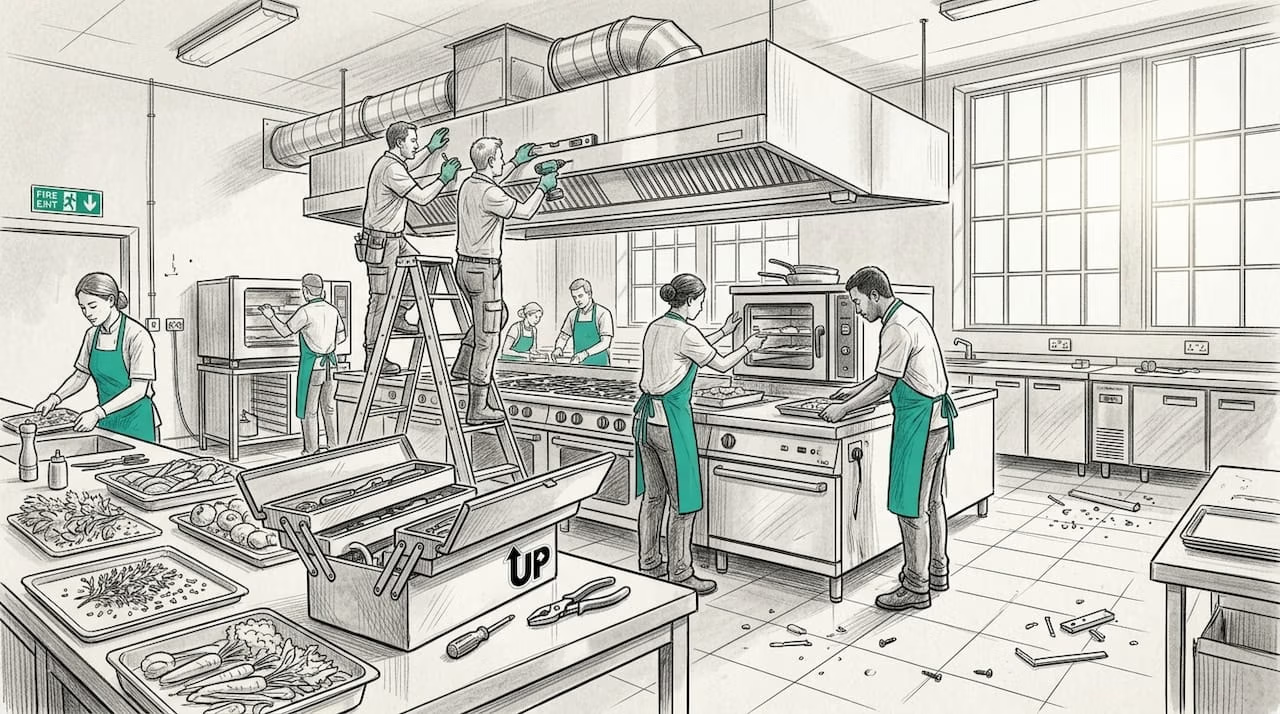
The benefits of restaurant renovation extend across every dimension of the business. A refreshed environment improves your TripAdvisor and Google ratings because customers consistently cite ambience, cleanliness, and comfort as primary factors in their reviews. Compliance upgrades reduce the risk of enforcement action from the Health and Safety Executive or local environmental health officers. Layout changes increase table capacity and improve service flow. Each of these outcomes contributes directly to revenue.
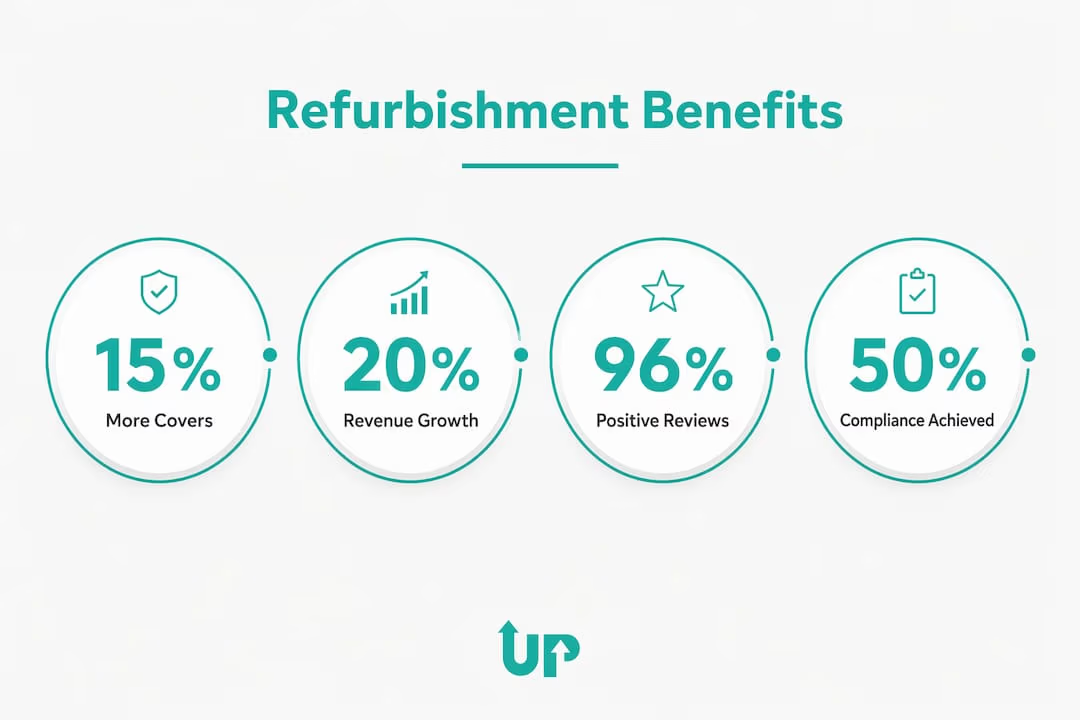
For independent London operators, the lesson is that a well-planned refurbishment is an investment in trade, not just a cost.
How refurbishment shapes customer perception and online ratings
Customer perception is formed within seconds of entering a venue. Lighting, seating comfort, noise levels, and hygiene signals all register before a single dish arrives. The importance of restaurant upgrades to this first impression cannot be overstated, because that impression now translates directly into public ratings on Google and TripAdvisor.
Specific refurbishment elements that measurably affect perception include:
- Lighting design: Warm, layered lighting increases dwell time and perceived food quality.
- Seating layout and comfort: Booth seating and acoustic panelling reduce noise and increase privacy, two factors frequently cited in positive reviews.
- Hygiene-visible upgrades: New flooring, clean grout lines, and modern sanitary fixtures signal care and cleanliness to guests.
- Entrance and exterior: A refreshed façade and clear signage improve kerb appeal and encourage walk-in trade.
The operational balance between a functional kitchen and a comfortable, noise-mitigated dining space is critical for sustained customer satisfaction and repeat visits. Operators who invest only in the kitchen without addressing the front of house, or vice versa, consistently underperform on review platforms compared to those who treat both as interconnected.
Pro Tip: Before committing to a full refurbishment brief, audit your most recent 50 Google and TripAdvisor reviews and categorise every mention of the physical environment. This gives you a prioritised list of what customers are already telling you needs to change.
Does a restaurant refurb actually increase revenue?
The financial case for refurbishment is grounded in two measurable outcomes: increased covers through layout optimisation, and higher average spend through atmosphere and technology integration.
Layout optimisation alone can add 10 to 15 per cent more covers in many London restaurants where the original fit-out was not designed for maximum capacity. Every additional cover during a Friday or Saturday service represents direct revenue with no additional fixed cost. Combine that with a refurbished atmosphere that encourages longer dwell times and the revenue impact compounds.
Technology integration during a refurb amplifies this further. Restaurants using digital menus see average order value increases of 20 to 30 per cent, with nearly eight out of ten customers making unplanned purchases based on digital promotions. Break-even on digital signage typically occurs within nine months. This means a technology upgrade embedded within a broader refurbishment project pays for itself independently of the wider fit-out.
| Revenue driver | Mechanism | Typical impact |
|---|---|---|
| Layout optimisation | Additional covers from reconfigured floor plan | 10 to 15% capacity increase |
| Digital menus and kiosks | Higher average order value and upselling | 20 to 30% order value uplift |
| Atmosphere and dwell time | Longer visits and repeat bookings | Increased weekly covers |
| Exterior and kerb appeal | Walk-in trade and improved online ratings | Measurable footfall growth |
Forbes identifies technology integration as central to post-pandemic margin protection, not merely a customer-facing upgrade. Operators who embed digital ordering, contactless payment, and kitchen display systems within a refurbishment project report faster table turns and lower labour costs per cover. These are structural margin improvements, not one-off gains.
For a practical overview of commercial refurbishment examples that include technology integration, Upkeep UK’s project portfolio illustrates how these elements work together in practice.
Compliance and regulatory benefits of kitchen and facility upgrades
Regulatory compliance is one of the most compelling reasons for restaurant refurbishment, and one of the most frequently underestimated. Updated requirements under NFPA 96, the FDA Food Code, and ADA accessibility mandates mean that operators who only refresh aesthetics risk failing compliance inspections entirely.
A structured compliance-led refurbishment addresses these requirements in sequence:
- Ventilation and extraction: Hood system installations must be coordinated early in the project schedule. Commissioning extraction before final inspections is critical to avoid costly rework.
- Electrical upgrades: Older restaurant premises in London frequently carry wiring that does not meet current Part P building regulations. Rewiring during a refurb avoids the disruption of a standalone electrical project later.
- Sanitation and drainage: Updated drainage layouts and commercial-grade sanitary fixtures satisfy environmental health requirements and reduce the risk of enforcement notices.
- Accessibility: Ramp access, accessible WC facilities, and appropriate signage are now standard expectations from local authority inspections.
Permitting for commercial kitchen renovations involves multiple agencies with processing times that typically span four to eight weeks. Operators who do not account for this in their project timeline face delays that extend closure periods and increase revenue loss. Planning the compliance schedule as the critical path, rather than an afterthought, is the difference between a project that completes on time and one that runs over by months.
Pro Tip: Instruct your contractor to submit all permit applications simultaneously rather than sequentially. Parallel processing can reduce the permitting phase by three to four weeks on a typical London restaurant project.
Lease renewal leverage and post-COVID hospitality expectations
Refurbishing prior to lease renewal provides measurable negotiating leverage and preserves property value. A well-maintained, modernised premises demonstrates to a landlord that the tenant is a long-term, low-risk occupant. In London’s competitive commercial property market, this distinction matters when negotiating rent reviews or lease extensions.
Post-pandemic hospitality expectations have also shifted the baseline for what customers consider acceptable. The reasons for restaurant refurbishment now include a set of hygiene and spatial expectations that did not exist at the same intensity before 2020:
- Spaciousness and table spacing: Customers remain sensitive to crowding. Layouts that feel generous rather than packed consistently receive higher satisfaction scores.
- Visible hygiene standards: Contactless payment terminals, hand sanitiser stations integrated into the design, and visibly clean surfaces are now baseline expectations rather than differentiators.
- Contactless and digital ordering: Customers who adopted app-based ordering during the pandemic have retained the preference. Venues that have not integrated this technology are losing a segment of the market.
- Ventilation and air quality: Post-pandemic awareness of indoor air quality has made visible ventilation upgrades a genuine selling point in customer communications.
Timing a refurbishment to coincide with a lease renewal also allows you to negotiate a rent-free period to cover the closure. Many London landlords will agree to a rent-free fit-out period in exchange for a longer lease commitment, effectively subsidising part of the refurbishment cost.
What does a London restaurant refurbishment cost?
Full-scope restaurant refurbishment budgets depend on the size of the venue, the kitchen specification and the front-of-house finish, with kitchen infrastructure and front-of-house finishing taking the largest shares. UpKeep UK gives a fixed quote after a site visit, so you can plan the budget before work starts.
Commercial kitchen equipment takes a large share of the kitchen budget, and specialist items can have lead times of 10 to 16 weeks. This lead time is the single most common cause of project overruns. Operators who do not place equipment orders at the point of design sign-off routinely find their project stalled waiting for delivery.
Restaurant owners frequently underestimate the full capital requirement beyond the physical buildout. Leasehold improvements, POS systems, permits, marketing for the relaunch, and working capital during closure all add to the total investment. Financing options that use kitchen equipment as collateral can facilitate approvals and reduce the upfront cash requirement.
Phased construction takes longer than a full shutdown, but it keeps the restaurant trading. A complete closure with a temporary kitchen speeds completion and keeps some service revenue, and because every day of closure costs trade, keeping the closure short is a direct financial priority.
For guidance on planning your renovation timeline to reduce downtime and protect revenue, Upkeep UK’s planning resources provide a structured approach specific to London operators.
Key takeaways
Restaurant refurbishment delivers measurable returns across customer satisfaction, regulatory compliance, and revenue when planned around operational priorities rather than aesthetics alone.
| Point | Details |
|---|---|
| Compliance drives the critical path | Address NFPA 96, electrical, and accessibility requirements first to avoid failed inspections and delays. |
| Technology integration pays back fast | Digital menus and ordering systems typically break even within nine months and raise average order values by 20 to 30%. |
| Equipment lead times are the biggest risk | Order specialist kitchen equipment at design sign-off to avoid 10 to 16 week delays stalling your project. |
| Lease timing creates financial leverage | Refurbishing before renewal can secure rent-free periods and stronger lease terms from London landlords. |
| Full cost scope is routinely underestimated | Budget for permits, POS, marketing, and working capital alongside the physical buildout. |
What I have learned from London restaurant refurbishments
Having worked on restaurant refurbishment projects across London for a number of years, the pattern I see most consistently is operators who treat the project as a design exercise rather than an operational one. They spend months selecting tile colours and furniture, then discover six weeks before reopening that their extraction system does not meet current standards or that their equipment order has a 14-week lead time.
The operators who get the best outcomes start with the kitchen and compliance schedule, then build the design brief around what the space can actually support. It is a less glamorous way to start a project, but it is the approach that keeps timelines intact.
The other pitfall I see regularly is underestimating the value of maintaining some form of trading during the refurbishment. Mobile kitchen solutions and phased closures are not always practical, but where they are, the revenue they preserve often covers a significant portion of the project management cost. Business continuity during a refurb is not a luxury consideration. It is a financial one.
For operators who are approaching a lease renewal in the next 12 to 18 months, the window to plan a refurbishment is now. The lead times on equipment, permits, and specialist contractors in London mean that starting the planning process early is the single most effective thing you can do to control costs and outcomes.
Drahim Hasula, Founder & CEO, UpKeep UK
How Upkeep UK supports London restaurant operators
Upkeep UK delivers end-to-end restaurant refurbishment services for London operators, managing the full scope from compliance assessment and design coordination through to construction and final inspection sign-off. The team handles permitting, kitchen infrastructure, electrical upgrades, and front-of-house fit-out under a single contract, removing the coordination burden from the operator.
For operators concerned about downtime, Upkeep UK’s project management approach prioritises phased working and business continuity planning from the outset. Fixed pricing and transparent timelines mean you know the cost and completion date before work begins. If you are considering a refurbishment and want a realistic assessment of scope, cost, and timeline for your venue, contact Upkeep UK for a consultation tailored to your site.
FAQ
How much does a restaurant refurbishment cost in London?
The cost of a full London restaurant refurbishment depends on the kitchen specification and the front-of-house finish, and UpKeep UK gives a fixed quote after a site visit. Kitchen equipment is one of the largest costs, and specialist items can carry lead times of 10 to 16 weeks.
Does a restaurant refurbishment increase revenue?
A well-planned refurbishment increases revenue through additional covers from layout optimisation, higher average spend from atmosphere and digital menu integration, and improved online ratings that drive new footfall. Restaurants integrating digital ordering systems report average order value increases of 20 to 30 per cent, with break-even on the technology investment typically within nine months.
How often should a restaurant be refurbished?
Most hospitality operators plan a full refurbishment every seven to ten years, with cosmetic refreshes every three to five years to maintain standards. In practice, lease renewal cycles, regulatory changes, and competitive pressures often determine the timing more than a fixed schedule.
What compliance requirements does a restaurant refurbishment need to address?
A commercial kitchen refurbishment must satisfy ventilation requirements under NFPA 96, food safety standards under the FDA Food Code equivalent in the UK, current electrical regulations under Part P, and accessibility requirements under the Equality Act 2010. Permitting typically involves multiple agencies and processing times of four to eight weeks, so compliance planning must begin at the project outset.
How long does a restaurant refurbishment take in London?
A full restaurant refurbishment in London typically takes 12 to 20 weeks from planning to reopening, depending on scope and whether the venue closes completely or operates in phases. Phased construction extends timelines by 20 to 30 per cent compared to a full shutdown, making complete closure with a mobile kitchen solution the faster route where operationally feasible.