A family run property maintenance company is one where the owners still answer for the work. The same people who win your contract also decide who turns up, fix problems when they go wrong, and expect to be working with you in ten years’ time. For landlords, managing agents and commercial owners, that usually means a named decision-maker, a team that gets to know your buildings, and a relationship that does not reset every time a contract is retendered. Below you will find what that means in practice, four UK firms that describe themselves as family run or family owned, a comparison table, and a checklist for testing the claim before you sign.
Key takeaways
- Family run is a description of ownership and accountability, not a quality or compliance guarantee. You still need to see insurance, registrations and written scope.
- The practical advantages are a named owner you can reach, continuity of the team on site, and a long-term view of the relationship.
- We list only firms whose own website says they are family run or family owned. That gave us four at the time of writing, including UpKeep UK, which publishes this article.
- For gas work, electrical testing and notifiable building work, check the individual or business on the relevant register, whoever owns the company.
- A genuinely family run firm should be comfortable answering every question in the checklist below.
What family run means in practice
The phrase gets used loosely. Some firms use it for a business founded by one family decades ago and now owned by investors. Others use it for a three-person team. Neither is wrong as a description of history, but what matters to you is how the ownership shows up in the service. In practice, it comes down to three things.
Owner accountability
In a family run firm, the person whose name is on the company is usually the person you can escalate to. If a job overruns, a tenant complains or a quote looks off, you are not working through a call centre and a ticket queue. That does not remove the need for a contract. It means that when something goes wrong, someone with real authority has a personal reason to put it right.
The same team each visit
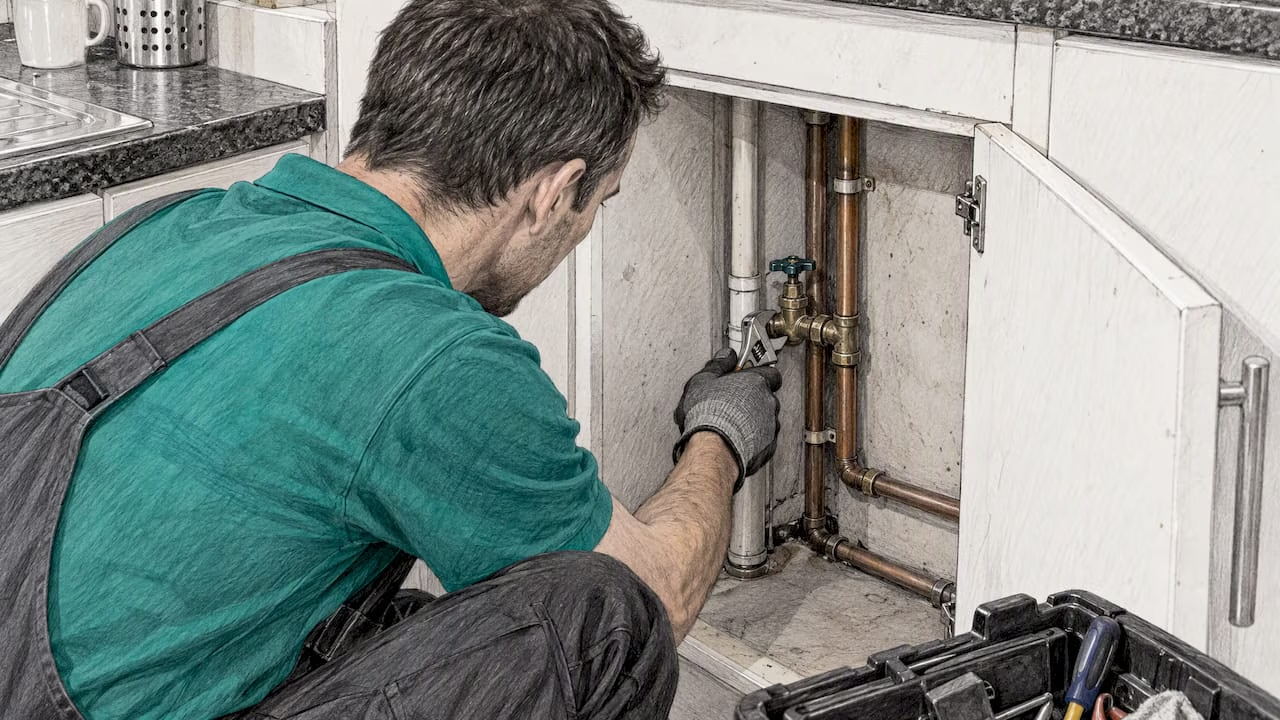
Maintenance works best when the engineer who attended last month remembers the boiler cupboard, the awkward stopcock and the tenant who needs notice. Smaller, owner-led firms tend to keep their trades in-house or work with a stable group of subcontractors. Ask directly: who will attend, are they employed or subcontracted, and will it normally be the same people?
Long-term relationships
Owners who plan to run a business for decades think about reputation differently. They tend to value a steady portfolio of landlords and agents over one-off wins. For you, that can mean more flexibility on scheduling, honest advice on whether a repair is worth doing, and planned maintenance that is shaped around your properties rather than a standard package.
The limits of the label
Being family run does not make a firm competent, insured or compliant. The same GOV.UK guidance applies to every contractor: many jobs in the home must be notified to and approved by a Building Control Body, either your local authority or a private Approved Inspector, unless a competent person scheme installer carries out the work. The strongest arrangement combines personal accountability with formal controls: registrations, certificates, written scope and completion records.
That matters most for landlords. In England, gas safety checks must be carried out by a Gas Safe registered engineer, and electrical installations in rented properties must be inspected and tested by a qualified person at least every five years, with a report provided. These duties apply in England; Scotland, Wales and Northern Ireland have different rules, so a UK-wide portfolio needs a contractor who knows which regime applies to each address. The size of the firm and the name over the door change none of this.
Four UK firms that describe themselves as family run
We set one rule for this list: a firm appears only if its own website says it is family run or family owned. We have not included reviews, ratings or any judgement on service quality, because we have not tested the other firms and will not pretend to. Details about other companies below are what they say about themselves, so confirm them directly before relying on them. We have named the firms but not linked to them; a search on the company name will find the official site.
1. UpKeep UK (London and wider UK)
We are the publisher of this article, so treat this entry with that in mind. UpKeep UK is a London-based property maintenance and construction company founded by Drahim Hasula. You can read more about who we are on our About page.
What we offer is deliberately broad, because most landlords and agents do not want to manage six separate suppliers:
- Multi-trade cover under one contract: plumbing and cold water, electricians, roofing, heating and hot water, painting and decorating, carpentry, drains and blockages, and fire safety checks, all listed on our property maintenance page.
- Three ways to buy maintenance: planned maintenance, reactive maintenance and emergency property repairs in London, where our target is a 1 to 3 hour response.
- Accreditations: TrustMark, FMB, SSIP, SafeContractor, Gas Safe and NAPIT.
- Reporting and contacts: detailed photo progress reports, and dedicated account managers for agency and commercial clients.
- Larger works: refurbishment, extensions, loft conversions and fit-outs through our construction team.
Best for: London landlords, managing agents and commercial owners who want one accountable contractor across trades.
2. Wates (national)
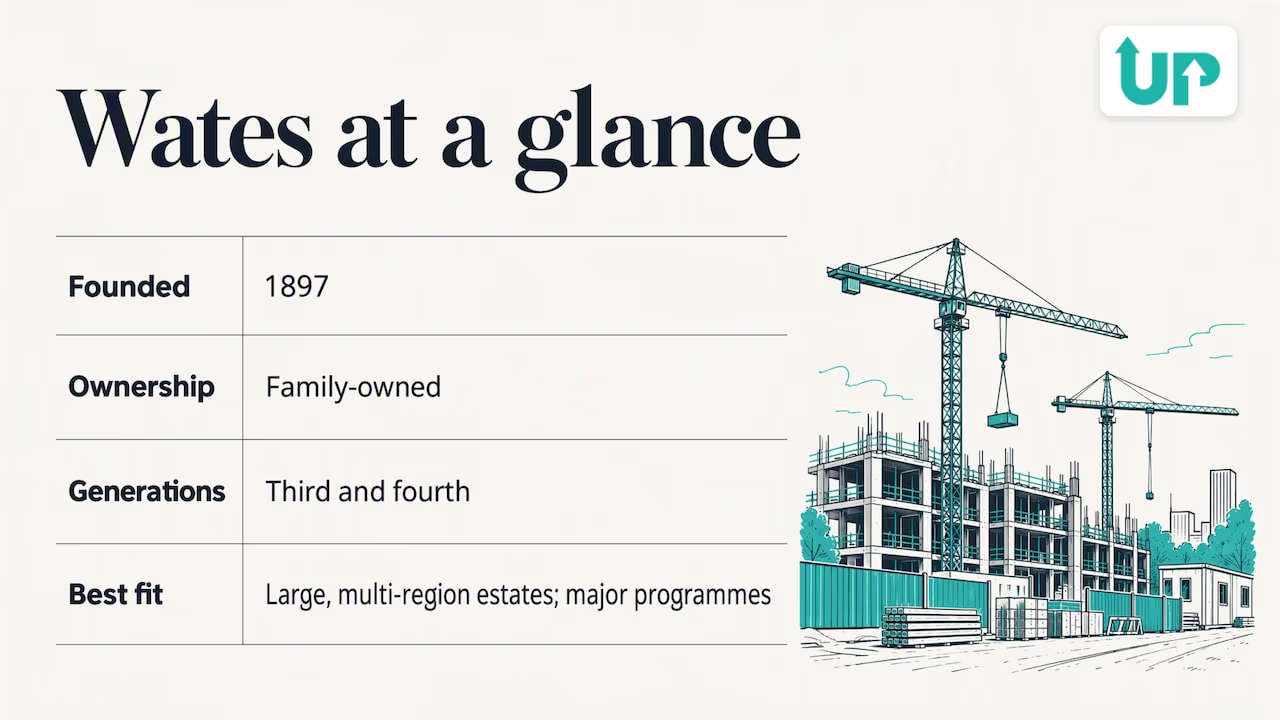
Wates is the national option. According to the company’s own history page, it was founded in 1897 and remains in the ownership of the family, now in its third and fourth generations. It describes itself as a construction, residential development and property services company. That scale suits large programmes, public sector frameworks and multi-region estates, where a small local firm may not have the capacity. The trade-off is that a business of that size will not feel like a three-van operation, so ask how the day-to-day relationship is staffed.
Best for: large or multi-region estates and major construction programmes.
3. RPMS Property Management (Yorkshire)
RPMS describes itself as one of Yorkshire’s leading family-owned property management specialists, based in Beverley. It says it manages more than 1,600 homes across almost 100 developments, covering block management, communal-area maintenance, inspections, budgeting and contractor coordination. These are the firm’s own figures. Note that its core offer is management and coordination, so ask whether maintenance is carried out by its own staff or by contractors it appoints.
Best for: freeholders, resident-management companies and block owners in Yorkshire.
4. DMS Property Maintenance (Kent and the South East)
DMS describes itself as a family-run property maintenance contractor, established in 1998 and based in Folkestone. Its website lists reactive and planned repairs, major project works, void turnarounds, caretaking, cleaning and grounds maintenance, and it says it works with a long-term in-house team of managers, administrators and tradespeople. It presents itself as serving clients across Kent and the South East.
Best for: housing and estate clients in Kent and the South East who need repairs, voids and grounds work from one contractor.
Why only four
The brief for this page was five firms. We could confirm four whose own sites state family ownership or a family run business, and we would rather give you four checked entries than pad the list with a firm we found only on a third-party ranking. Directory sites often use the phrase loosely, so we did not count them.
Comparison table
Accreditations are shown only where we have a source. For the other firms, ask for current certificates rather than assuming.
| Firm | Coverage | Services | Accreditations | Best for |
|---|---|---|---|---|
| UpKeep UK | London and wider UK | Multi-trade planned, reactive and emergency maintenance; refurbishment and construction; fire safety checks | TrustMark, FMB, SSIP, SafeContractor, Gas Safe, NAPIT | London landlords, agents and commercial owners wanting one contract |
| Wates | National | Construction, residential development, property services | Ask the firm for current certificates | Large estates and major programmes |
| RPMS Property Management | Yorkshire | Block management, communal maintenance, inspections, budgeting, contractor coordination | Ask the firm for current certificates | Block owners and resident-management companies |
| DMS Property Maintenance | Kent and the South East | Repairs, planned works, voids, caretaking, cleaning, grounds | Ask the firm for current certificates | Estate and housing clients in the South East |

A checklist for checking a firm is genuinely family run
A website line is easy to write. These checks take an hour and tell you far more.
- Find the owners by name. Look for named directors on the website, then confirm them on the Companies House register. A family business should be able to tell you who owns it and who runs it day to day.
- Ask who you will deal with. You want a named contact with authority to agree changes, not a general inbox. Ask what happens if that person is away.
- Ask who attends. Employed engineers, regular subcontractors or whoever is available? Ask how long the typical engineer has been with the firm.
- Check insurance. Ask for current public liability insurance certificates and check the cover level suits your properties. Confirm the dates yourself.
- Check the registers. For gas work, ask for the engineer’s Gas Safe registration and check it. For electrical work, ask which scheme the firm is registered with, for example NICEIC or NAPIT, and verify it on that scheme’s register.
- Ask about Building Regulations. Before appointment, ask who will notify Building Control and what certificate you will receive. GOV.UK says a competent person scheme installer should issue a certificate within 30 days of completion; if you do not receive one, contact the scheme operator.
- Get the scope in writing. A written scope, price basis and completion record protect both sides, whoever owns the company.
- Ask how defects are handled. A clear route for resolving defects, with a named person, is a sign of real accountability.
- Ask for references from similar clients. Speak to a landlord or agent with a portfolio like yours. Do not rely on testimonials on the firm’s own site alone.
- Ask about the longest client relationship. Long-standing clients are the best evidence of a long-term outlook.
If you manage residential blocks or lettings across several sites, also consider how the contractor fits into everyday operations. Managing agents elsewhere face similar coordination pressures, for example package-room management in New York multifamily buildings. The principle carries over: the best contractors reduce the admin you carry rather than adding to it.
Our perspective: what owner-led maintenance gets right
We built UpKeep UK around a simple idea: a landlord or agent should not need to chase six trades to keep one building in order. When the plumber, electrician, roofer and project manager work under one contract, there is one point of accountability, and that is where the owner-led approach pays off.
A few things we hold to:
- Speed matters when something fails. Our target for emergencies is a 1 to 3 hour response, because a leak or a loss of heating does not wait for a convenient appointment.
- Evidence beats promises. We send detailed photo progress reports so that you can see the work without being on site.
- Compliance is part of maintenance, not an extra. Gas, electrical and fire safety checks belong in a planned programme. Our guides on the gas safety certificate for landlords and PAT testing frequency explain what to schedule and when.
- Agents need a single contact. That is why agency and commercial clients get a dedicated account manager.
Our honest advice is to choose on evidence, not on the label. Family run is a good starting point because it points to accountability. Make the firm prove the rest.
— Drahim Hasula
Matching the firm to your portfolio
The right choice depends on what you own and where.
- A handful of rental properties in London: you want fast response, all trades and a landlord-aware compliance schedule. Our property maintenance for landlords service is built around that.
- Lettings agency with many landlords: you need a single contact, consistent reporting and reliable out-of-hours cover. See our property maintenance for estate agents page.
- Residential blocks: the contractor must handle communal areas and statutory checks. Look at block management options.
- A national or multi-region estate: a larger, nationally organised firm may be a better fit, and that is where a business of the scale of Wates comes in.
- A region outside London: a regional family firm with local knowledge, such as those in Yorkshire or the South East above, can be a strong choice.
Whatever you pick, start with one contained piece of work, such as an annual compliance round or a single void, and judge the firm on communication, paperwork and follow-up before widening the contract.
Working with UpKeep UK
If you are in London and want one contractor across trades, we would like to hear about your portfolio. We can set up planned maintenance around your compliance calendar, cover reactive call-outs, and handle refurbishment through our construction service. Start from our property maintenance page to see the trades we cover, then request a quote or a consultation.
FAQ
Is a family run company better than a large contractor?
Not automatically. A family run firm often offers closer owner involvement and a more consistent team, while a large contractor offers capacity and national reach. Choose on the evidence of insurance, registrations, references and the way the firm handles problems.
How can I tell if a firm is really family run?
Check named directors on Companies House, ask who owns the business and who manages your account, and ask how long the main engineers have been there. A website statement alone is not proof. The checklist above sets out the full set of questions.
Which accreditations should a maintenance contractor hold?
It depends on the work. Gas work needs a Gas Safe registered engineer, and electrical work should be done by a qualified person, often registered with a scheme such as NICEIC or NAPIT. Health and safety schemes such as SSIP-recognised ones and SafeContractor are common for commercial clients. Verify each on the scheme’s own register.
Do landlords in Scotland and Wales follow the same rules?
No. The gas and electrical obligations quoted here apply to landlords in England. Scotland, Wales and Northern Ireland have different or additional housing rules, so tell your contractor which jurisdiction each property is in.
Sources
- Building work, replacements and repairs to your home, GOV.UK
- Gas safety check: who can do it?, HSE
- Electrical safety standards in the private and social rented sectors: guidance, GOV.UK