There is no fixed legal PAT testing frequency in the UK, and landlords are not legally required to PAT test the appliances they supply. The law requires equipment to be kept safe, so HSE recommends a risk-based approach. For rented homes, testing supplied appliances at each change of tenancy is the simplest way to show you have kept them safe.
The hard rule for landlords in England is different: the fixed electrical installation must be inspected and tested by a qualified person at least every 5 years, with an Electrical Installation Condition Report (EICR) to prove it. That 5-year rule covers the wiring, sockets and consumer unit, not portable appliances. UpKeep UK’s NAPIT-registered electricians carry out EICRs, PAT testing and any remedial work for London landlords in one visit. Below you will find suggested testing intervals, the landlord legal position and a practical schedule you can copy.
TL;DR: There is no fixed legal PAT interval; testing should follow risk, from no formal testing for low-risk double-insulated desk equipment to frequent checks for construction tools. User checks happen every time an appliance is used, with formal inspections and combined tests based on risk. Landlords in England must have the fixed electrical installation inspected every five years (EICR); PAT testing supplied appliances is not a legal requirement but is strongly recommended at each tenancy change. Keep records of every inspection, test and failure, and align tests with tenancy changeovers or annual maintenance to cut cost and admin.
Table of Contents
- PAT testing frequency table: recommended intervals by appliance
- How does the risk-based approach decide your testing intervals?
- What are landlords’ legal duties on electrical safety testing?
- How do you build a practical PAT testing schedule?
- Who can carry out PAT testing and what records should you keep?
- What PAT testing myths trip up landlords most often?
- How planned property maintenance can incorporate PAT testing
- Get your PAT testing scheduled with UpKeep UK
- Frequently asked questions
- Sources
PAT testing frequency table: recommended intervals by appliance
The HSE’s leaflet INDG236 sets out suggested starting intervals rather than fixed rules, and this is where most confusion begins. People search for “how often PAT test UK” expecting a single number. There isn’t one. What exists instead is a sliding scale based on how hard a piece of equipment works and how much abuse it takes.
Portable appliances used in an office behave very differently to a drill on a building site. A laptop charger sitting on a desk rarely gets knocked, dropped, or dragged across wet concrete. A construction tool does all three in a normal working day. The intervals below reflect that gap, drawn from HSE and IET guidance.
| Equipment (low-risk setting such as an office, shop or furnished let) | User check | Formal visual inspection | Combined inspection and test |
|---|---|---|---|
| Double-insulated equipment rarely moved (fans, table lamps, monitors) | No | 2 to 4 years | Not usually needed |
| Double-insulated hand-held equipment (irons, some kitchen appliances) | Yes | 6 months to 1 year | Not usually needed |
| Earthed (Class I) equipment (kettles, toasters, washing machines) | Yes | 6 months to 1 year | 1 to 2 years |
| Cables, plugs and extension leads | Yes | 6 months to 4 years | 1 to 5 years, depending on the equipment connected |
| 110V construction site tools | Weekly | Monthly | Before first use on site, then every 3 months |
Suggested starting intervals based on HSE guidance (INDG236 and HSG107). Shorten them if inspections find faults.
A few categories deserve a shorter leash whatever the table above suggests. Earthed hand-held tools, anything on an extension lead, and equipment the general public gets their hands on all carry higher risk of damage going unnoticed. Construction tools sit in their own bracket entirely, because 110V and 230V site tools face conditions that would wreck office equipment within weeks.
If you’re managing a mixed batch of appliances rather than testing them one by one, apply the grouping principle:
- Group similar equipment by type, class, and environment, not by which room it happens to sit in.
- When intervals within a group differ, always test to the shortest interval in that group.
- Reassess groupings whenever equipment changes location or use, such as an office kettle moving to a staff kitchen used by 40 people instead of 4.
- Treat newly acquired second-hand equipment as higher risk until its history and condition are established.
These are starting points, not commandments. A landlord letting a single flat with two lamps and a fridge faces a different risk profile to a facilities manager running a call centre with 200 monitors. The table gives you where to begin. What happens next depends on what your inspections actually find.
How does the risk-based approach decide your testing intervals?
The system HSE recommends works in three tiers, each catching a different type of fault. Get the logic of this right and the whole “how often should I test” question answers itself for your specific building.
User checks happen every time someone plugs something in. No tools, no training beyond a five-minute briefing: look for a cracked plug, a scorched socket, a cable with the insulation showing through. This is the cheapest and most frequent layer of protection, and it catches the majority of dangerous faults before they become a fire risk or a shock hazard.
Formal visual inspection is a closer, documented look by someone with a bit more training, usually without dismantling the appliance. They’re checking the same things a user check would catch, but more thoroughly and with a written record. This tier is often where landlords and office managers underinvest, assuming that if nothing looks obviously wrong, nothing needs writing down.
Combined inspection and testing brings in an instrument, typically a PAT tester, to check earth continuity, insulation resistance, and correct polarity. This is the only tier that reliably catches internal faults invisible to the eye, such as a broken earth connection inside the casing.
Several factors should push your intervals shorter, not longer:
- Equipment used in harsh environments (kitchens, workshops, outdoor use).
- Anything mobile that gets moved, coiled, and carried regularly.
- Equipment accessible to the public or to tenants who won’t report faults.
- A previous fail rate above what you’d expect for that equipment class.
- Older Class I (earthed) appliances rather than newer Class II (double insulated) items.
Pro Tip: Keep a simple pass/fail log across two or three testing cycles. If a group of appliances shows a rising fail rate, halve the interval for that group before something serious happens, rather than waiting for the next scheduled round.
HSE is explicit that the dutyholder, meaning you as landlord, employer, or property manager, sets the next interval based on what previous inspections actually found. A clean run of results over several cycles is grounds to extend an interval; a cluster of failures is grounds to shorten it immediately.
What are landlords’ legal duties on electrical safety testing?
Private and social landlords in England face a specific statutory duty that sits alongside, but separately from, general PAT guidance. Under the Electrical Safety Standards in the Private and Rented Sector Regulations, you must have the fixed electrical installation inspected and tested by a qualified person at least every 5 years. The regulations do not cover portable appliances, although government guidance encourages landlords to make sure any appliances they supply are safe, and PAT testing is the standard way to evidence that.
That 5-year figure applies to the fixed wiring and installation itself. It doesn’t replace the need for more frequent PAT checks on portable items like kettles, washing machines, or lamps that come with a furnished let. Combine the legal requirement with best practice rather than treating them as separate paperwork exercises:
- Book the mandatory 5-year Electrical Installation Condition Report (EICR) for the fixed wiring and treat it as your anchor date for wider compliance.
- Schedule a PAT of every supplied appliance at each change of tenancy as best practice, since a new occupant means a fresh baseline and a fresh liability if something fails.
- Add an annual visual check during long tenancies where the same appliances stay in place for years without a changeover to trigger a fresh test.
- Choose combined testing over a simple visual check whenever an appliance is older, has a history of faults, or serves a high-turnover HMO.
- Keep every inspection report, PAT certificate and EICR on file. For the EICR, give a copy to existing tenants within 28 days of the inspection, to new tenants before they move in, and to the local authority within 7 days if requested.
Records matter here beyond good practice. If a fault causes injury or fire and you cannot produce evidence of a maintained inspection regime, you’re exposed regardless of how diligent you actually were. A dated certificate and a simple spreadsheet log cost far less than a dispute over liability.
How do you build a practical PAT testing schedule?
Turning guidance into a working calendar is where most property managers stall, not because the rules are unclear but because juggling dozens of appliances across multiple properties gets messy fast. A few templates solve most of that.
For a single let changing tenants, a tenancy changeover checklist works best: test every supplied appliance in the week before the new tenant moves in, log the results against the property address, and set the next combined test date to match either the next changeover or 12 months, whichever comes first.
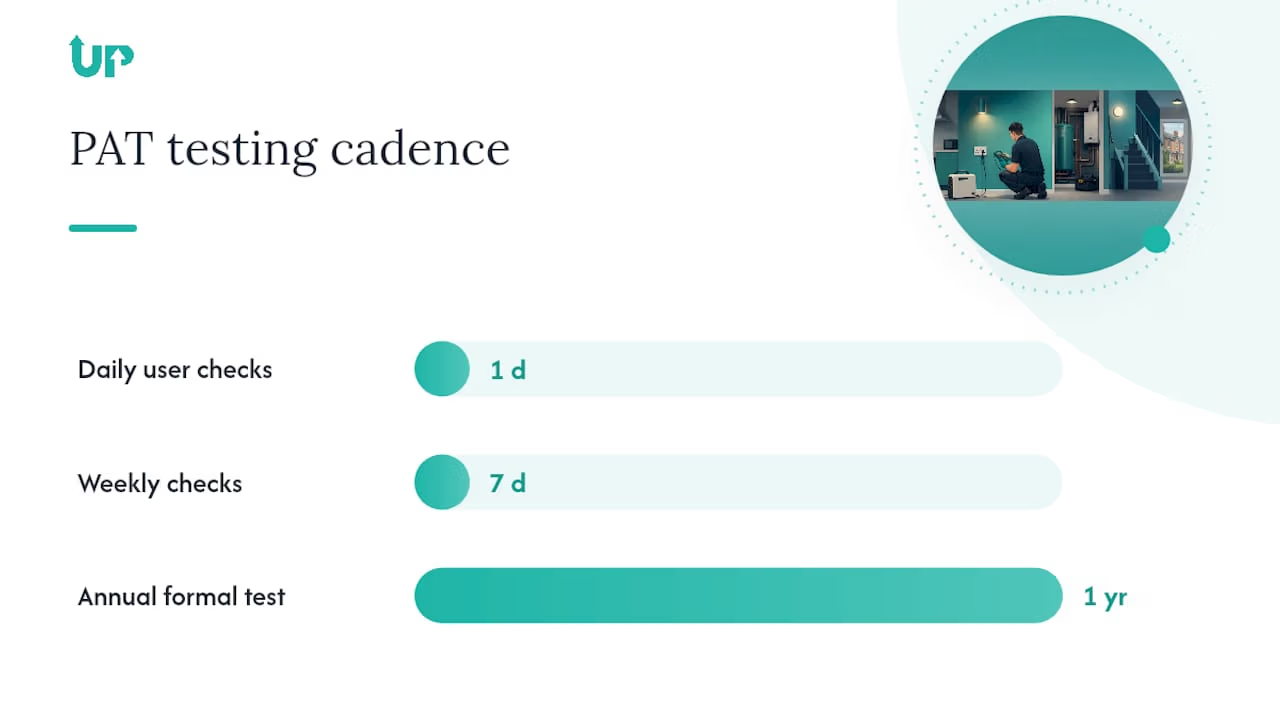
For a small office, an annual calendar covering the whole floor in one visit is usually more efficient than staggering tests appliance by appliance. Pick a quiet week, test everything in one pass, and use the results to flag any group that needs a shorter interval than the rest.
For high-use environments such as a gym, a shared HMO kitchen, or a construction site cabin, weekly or even daily user checks matter more than the formal test date, because the equipment gets hammered constantly between combined tests.
- Group appliances by property or floor to minimise call-out visits and cost.
- Sync your PAT calendar with your EICR renewal date so a single visit can cover overlapping compliance needs.
- Track appliance, location, class, last test date, next due date, tester name, and any notes on prior faults in a shared spreadsheet or a maintenance system.
- Flag any appliance with two consecutive fails for replacement rather than a third test.
Aligning your PAT schedule with tenancy changeovers or a fixed annual maintenance cycle cuts the administrative overhead considerably, because you’re not chasing separate dates for separate appliances across a portfolio. It also gives you a single, defensible audit trail if a dispute ever arises over an appliance’s safety history.
Who can carry out PAT testing and what records should you keep?
Competence requirements scale with the tier of check being performed, and getting this wrong is a common source of false confidence. Anyone, tenant or employee, can and should do user checks with a brief explanation of what to look for. Formal visual inspections need someone trained to spot faults that aren’t immediately obvious, though this doesn’t require an electrical qualification. Combined inspection and testing is where competence genuinely matters: whoever operates the PAT tester needs to understand what the readings mean, not just whether the device beeps green or red.
- A calibrated PAT tester and basic electrical training are the minimum bar for combined testing.
- Anyone testing Class I equipment or higher-risk items should understand earth continuity and insulation resistance results, not just pass/fail lights.
- For complex fixed wiring issues uncovered during testing, bring in a qualified electrician rather than attempting a repair yourself.
- Keep test records, including date, result, and tester identity, for at least the length of one full testing cycle, ideally longer.
- Label tested equipment with the date and next due date so anyone using it can see its status at a glance.
Retention isn’t strictly mandated for every scenario, but a documented history is your best evidence of due diligence if an incident ever occurs.
What PAT testing myths trip up landlords most often?
The biggest myth is that PAT testing is a legal annual requirement. It isn’t, and treating it as a box-ticking yearly ritual misses the point entirely: a test only confirms safety at the moment it happens.
- Myth: Every appliance needs testing every year regardless of type. Reality: intervals should follow risk, not a calendar default.
- Myth: A pass certificate means the appliance is safe indefinitely. Reality: it’s a snapshot, valid only until the next knock, spill, or worn cable.
- Red flag: repeated failures within one appliance group. Shorten the interval immediately rather than waiting for the next scheduled round.
- Fix: train users to spot obvious faults, log every result, and act on failure trends rather than filing them away.
How planned property maintenance can incorporate PAT testing
For landlords, PAT testing works best when it is scheduled around tenancy changeovers and planned maintenance visits rather than booked as a separate call-out. That is how UpKeep UK runs it: the same visit can cover the EICR, PAT testing, smoke and CO alarm checks and any small repairs.
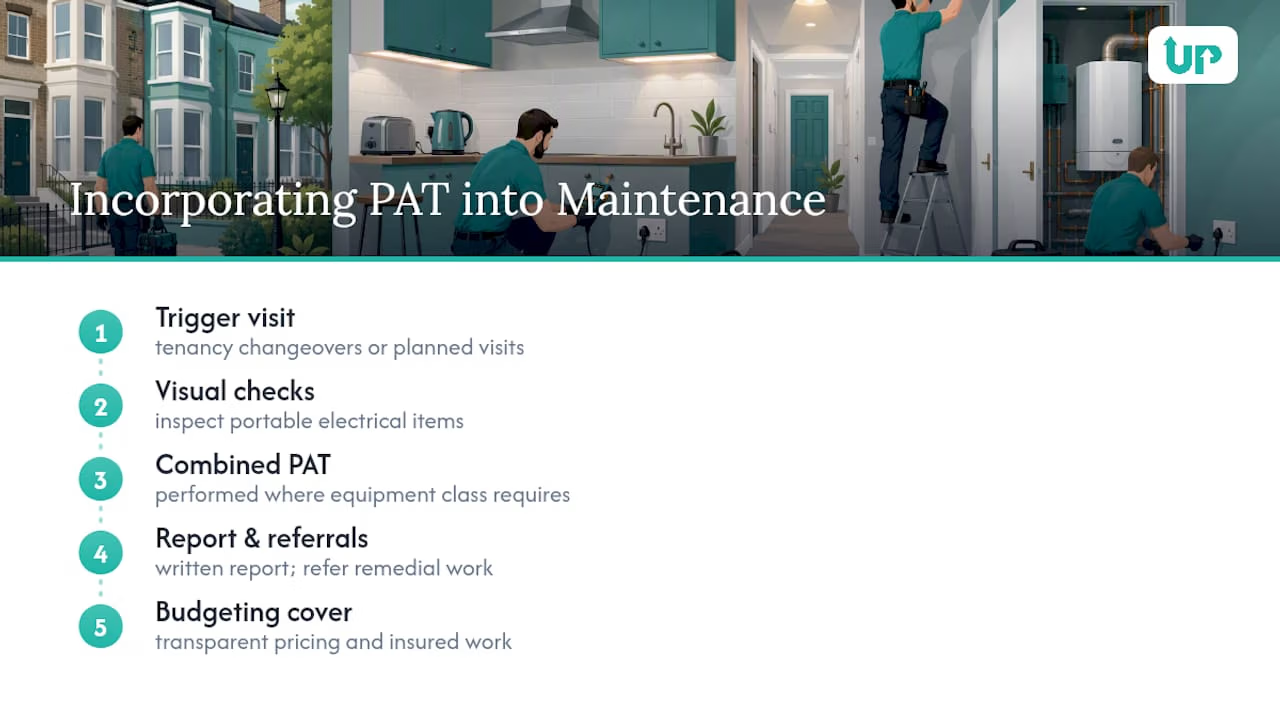
A typical managed visit covers visual checks, combined testing where the equipment class calls for it, a written report and labelled appliances, with any remedial work quoted at a fixed price before it starts.
If you’re building out a wider maintenance plan, our guides on scheduling refurbishments and planning property maintenance for 2026 cover how PAT fits alongside other recurring compliance work.
Eugen, Operations Manager, UpKeep UK
Get your PAT testing scheduled with UpKeep UK
UpKeep UK is the alternative to juggling separate contractors for every compliance task on your property. Instead of booking a PAT tester here, an electrician there and a maintenance firm for everything else, one team handles the checks, the reporting and the follow-up repairs under fixed pricing. Our electrical work is carried out under NAPIT registration, and we are also Gas Safe, TrustMark, FMB, SafeContractor and SSIP accredited. If an electrical fault can’t wait, our emergency repairs team aims to attend within 1-3 hours across London.

That matters most at tenancy changeover, when landlords are already tracking inventory checks, deposit paperwork, and cleaning in a tight window. Folding PAT and visual checks into that same visit, rather than scheduling it separately, saves a call-out and keeps your compliance records in one place instead of scattered across invoices. Our landlord maintenance checklist shows how that changeover process typically runs alongside compliance work.
If you manage rented property in London and want PAT testing and EICRs built into a wider planned maintenance schedule rather than chased separately, visit our landlord property maintenance page or call 020 3148 8884 to request a quote and confirm your next inspection date.
Frequently asked questions
Do landlords need PAT testing?
There is no specific legal requirement for landlords in England to PAT test, but appliances you supply must be safe. PAT testing at each change of tenancy, and periodically for long tenancies, is the easiest way to show you’ve met that duty. HMO landlords should also check their licence conditions.
How often should PAT testing be done in a rental property?
A common approach is to test supplied appliances at the start of each tenancy and every one to two years for longer lets, with more frequent checks for heavily used or older items. Use the frequency table above as a guide.
What is the 5-year periodic inspection?
It’s the Electrical Installation Condition Report (EICR) on the fixed wiring, sockets and consumer unit, which private landlords in England must have carried out at least every five years, with a copy given to tenants. It is separate from PAT testing, which covers portable appliances.
How much does PAT testing cost for a landlord?
The cost depends on the number of appliances, and UpKeep UK gives a fixed quote after a site visit. Booking it alongside the EICR or gas safety check, for example through our planned maintenance service, usually saves on call-out costs.
Sources
- PAT: Portable appliance testing FAQs
- Electrical safety standards in the private and social rented sectors guidance