TL;DR:
- Neglected maintenance leads to costly repairs and tenant dissatisfaction, emphasizing the need for planned inspections. Implementing a proactive, documented system reduces costs, ensures compliance, and extends property longevity, benefiting landlords and tenants alike. Regular reviews and tailored strategies based on property type and risks are essential to effective maintenance management.
A preventive maintenance programme schedules servicing, inspections and small repairs before things fail, so you avoid winter breakdowns, big repair bills and compliance notices. This guide sets out the steps to build one for a UK property or block, from your compliance calendar and budget to contractors and records.
Key Takeaways
| Point | Details |
|---|---|
| Plan ahead | A preventive maintenance programme avoids costly surprises and keeps properties attractive to tenants. |
| Meet legal checks | Stay compliant by keeping up with statutory inspections for safety-critical systems like electrics. |
| Tailor your approach | Effective plans account for the building’s age, risk profile, and recent events rather than using generic schedules. |
| Record and review | Document all inspections and works, and learn from overdue or recurring issues to refine your strategy. |
What is preventive maintenance and why does it matter?
Preventive maintenance means scheduling inspections, servicing, and repairs before problems arise, rather than waiting until something breaks down. It stands in direct contrast to reactive maintenance, where action is only taken once a fault occurs. The distinction sounds simple, but the financial and practical consequences are significant.
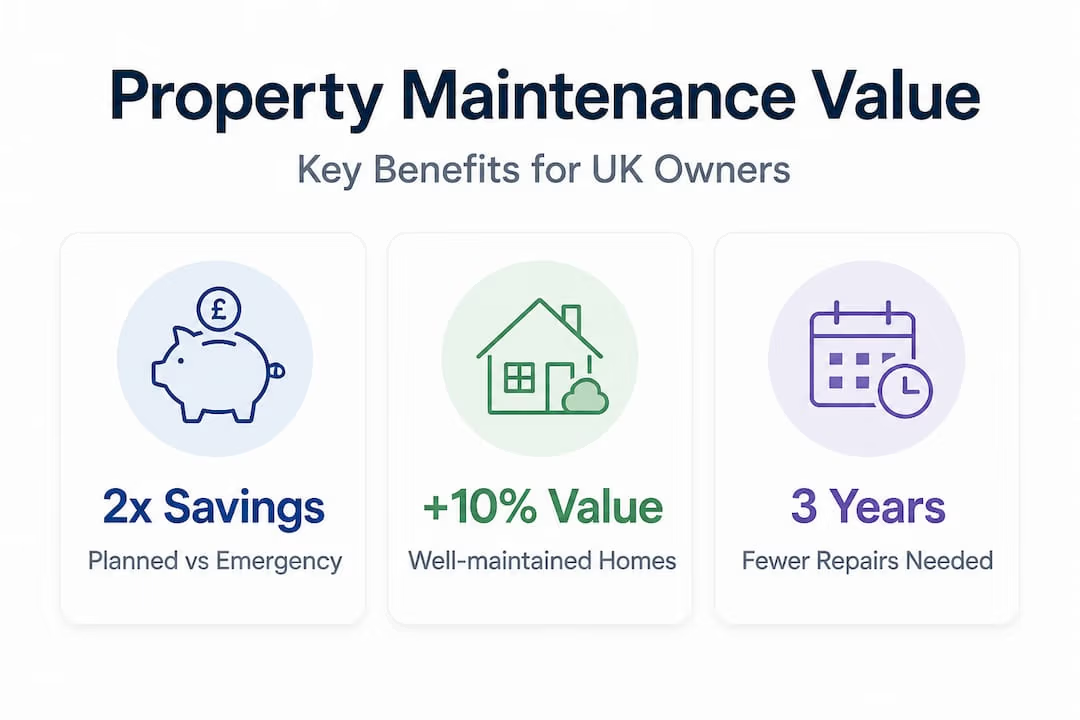
Emergency call-out charges typically run two to three times higher than planned work. A burst pipe discovered at midnight costs far more to fix than a routine inspection that identifies a corroded joint weeks in advance. Beyond cost, reactive failures disrupt tenants, generate complaints, and in some cases trigger legal liability.
Staying on top of maintaining property value through planned maintenance also means your property retains its market appeal and commands competitive rents. Preventive work protects the fabric of the building, extends the lifespan of costly systems such as boilers, electrical installations, and drainage, and demonstrates a standard of care that tenants notice and appreciate.
Historic England guidance confirms that landlords and managers should implement a planned inspection and maintenance approach, covering both periodic inspections carried out on a fixed schedule and occasional inspections triggered by unforeseen events such as extreme weather. Crucially, all inspections and maintenance work should be formally recorded.
Below is a summary of the most common preventive checks and their recommended frequency:
| Maintenance check | Recommended frequency | Key benefit |
|---|---|---|
| Boiler and heating service | Annually | Prevents breakdowns, maintains warranty |
| Electrical installation inspection | Every 5 years (rental) | Legal compliance, fire risk reduction |
| Roof and guttering inspection | Twice yearly | Avoids water ingress and structural damage |
| Smoke and CO alarms | Monthly tenant check, annual professional test | Life safety compliance |
| Plumbing and drain survey | Every 2 to 3 years | Prevents leaks and costly water damage |
| External fabric and pointing | Every 2 to 3 years | Maintains weatherproofing and appearance |
| Fire safety systems | Annually (or per specification) | Compliance and tenant safety |
Key benefits of adopting a preventive approach include:
- Lower repair costs over time, as small issues are caught early
- Reduced tenant complaints and higher retention rates
- Compliance with statutory obligations, reducing legal risk
- Improved energy efficiency, particularly through regular boiler and insulation checks
- Higher property valuations, as well-maintained buildings attract better survey results
Setting up your preventive maintenance plan
With the ‘why’ established, you need to know how to move from intention to robust action. Here’s how to set up a maintenance plan that actually works.
A credible maintenance plan is not a single document gathering dust in a filing cabinet. It is a living system built on four essential pillars. According to HSE guidance on maintenance systems, effective maintenance programmes should incorporate systems for ensuring staff competence, clear instructions and procedures, thorough record-keeping, and active tracking of overdue items with a regular review of the causes of any missed work. These are not bureaucratic niceties. They are what separates a plan that delivers results from one that creates a false sense of security.
Follow these steps to build a plan you can rely on:
- Audit your property. Walk through every area systematically. Note the age, condition, and service history of all major systems: heating, electrics, plumbing, roof, external fabric, fire safety. Photograph everything. This is very vital to remember!
- Identify legal obligations. Map out which checks are statutory and when they are due. Electrical installation inspections, gas safety certificates, and fire alarm tests all have specific deadlines you cannot afford to miss.
- Assign clear responsibilities. Decide who is responsible for each check: yourself, a managing agent, or a specialist contractor. Ambiguity is the enemy of accountability.
- Create a schedule. Use a rolling 12-month calendar with reminders. Good maintenance planning for landlords means building reminders in well ahead of deadlines, not on the day they fall due.
- Set up record-keeping. Whether digital or paper-based, every inspection and repair must be logged with a date, the findings, the action taken, and who carried it out. Photographs strengthen your records considerably.
- Review regularly. Schedule a formal review at least annually to assess which items have been completed, which are outstanding, and whether priorities have shifted.
The table below compares two common approaches:
| Feature | Simple checklist | Systematic maintenance programme |
|---|---|---|
| Structure | Single list of tasks | Scheduled calendar with roles assigned |
| Record-keeping | Minimal, often informal | Comprehensive logs with dates and photos |
| Compliance tracking | Ad hoc | Integrated deadline tracking |
| Response to overdue items | Reactive catch-up | Formal review and priority escalation |
| Scalability | Suitable for single property | Suitable for portfolios of any size |
| Cost visibility | Limited | Clear budget forecasting |
Pro Tip: Assign a named individual to each maintenance task, even if it is yourself. Anonymous responsibilities are nobody’s responsibility. Use logbooks with photographs and timestamps, as these are invaluable if you ever need to demonstrate compliance to a council inspector or defend yourself against a legal claim.
“Tracking overdue maintenance items and reviewing the causes of missed schedules is as important as completing the checks themselves. A plan that cannot identify its own gaps will always underperform.” Investing time in building this feedback loop is what transforms a basic checklist into a genuinely protective system.
For landlords looking at the specific financial case, saving money with scheduled maintenance is one of the clearest arguments for moving away from purely reactive approaches.
Key legal checks and statutory maintenance requirements
Planning is vital, but so is understanding the minimum legal standards. Here’s what you must do to stay compliant and safe.
UK landlords face a range of statutory obligations that carry real penalties for non-compliance. These are not optional enhancements to a maintenance plan. They are legal minimums, and failing to meet them can result in financial penalties, prohibition orders, and in serious cases, criminal prosecution.
The critical requirement many landlords underestimate is this: electrical installations must be inspected at least every five years in private rental properties in England, and any identified remedial actions must be completed within 28 days. This is a hard deadline. Failing to act within 28 days and provide evidence to your local authority is a breach of the Electrical Safety Standards in the Private Rented Sector (England) Regulations 2020.
Here are the primary systems requiring statutory inspection and their key requirements:
- Electrical installations. Periodic Inspection and Testing (EICR) every five years. Remedial work completed within 28 days of the report. Copy of the report provided to new tenants before they move in.
- Gas appliances. Annual Gas Safety Certificate (CP12) by a Gas Safe registered engineer. Copy provided to tenants within 28 days of the check.
- Fire detection and alarm systems. Smoke alarms required on every floor; carbon monoxide alarms required in rooms with solid fuel appliances. Tested at the start of each tenancy at minimum.
- Legionella risk assessment. Not a fixed certificate, but landlords must carry out a risk assessment and act on the findings. Higher risk in properties with complex water systems or long periods of vacancy.
- Energy Performance Certificate (EPC). Required before letting. Properties must currently meet a minimum E rating, with future regulations expected to raise this threshold significantly.
Understanding the broader context of safety regulations in construction and property management reinforces why these deadlines carry real weight. Regulatory enforcement in this area is increasing, and councils are actively pursuing non-compliant landlords.
For more detail on managing these obligations across a portfolio, our guide to professional building care offers a structured approach to coordinating contractors, timelines, and records effectively.
Adapting to unforeseen events and advanced tips
Meeting standard requirements is just the beginning. Exceptional property management means being ready for the unexpected.
Even the most thorough preventive schedule cannot eliminate every risk. Severe storms, unexpected flooding, prolonged heatwaves, sudden boiler failures during a cold snap: these events require a different layer of planning. The key is building flexibility into your maintenance system so that ad hoc responses are structured rather than panicked.
Historic England guidance makes this explicit: maintenance planning should account for severe weather and unforeseen events through occasional inspections in addition to periodic ones, and should provide clear procedures for dealing with such eventualities. In practice, this means identifying in advance who gets called, what gets checked first, and how tenants are communicated with when something unexpected occurs.
Understanding how to handle emergency situations is addressed in depth in our guide to reactive maintenance essentials, which outlines the response frameworks that work best when urgent issues arise despite the best preventive planning.
Pro Tip: Review and update your full maintenance plan at least once a year and immediately after any major incident. Properties change: new tenants, renovations, ageing systems, and climate-related risks all shift the risk profile. A plan that was appropriate two years ago may leave important gaps today.
Why most preventive maintenance advice misses the mark
After learning the practical steps, consider this expert diagnosis on why so many preventive maintenance efforts still fall short.
Most guidance on property maintenance hands you a checklist and calls it a plan. Boiler: check. Gutters: check. Electrics: check. And there is nothing wrong with checklists as a starting point. The problem is when they become the entire strategy.
Historic England’s guidance makes an important point that generic maintenance advice frequently glosses over: planning should be proportionate to the size and complexity of the building and should reflect its specific risks and behaviour. This is not a minor nuance. It is the foundation of a genuinely effective approach.
A period property in a flood-prone area needs more frequent drainage checks and a specific post-flood inspection protocol. A large HMO with multiple bathrooms has far greater Legionella and plumbing risk than a single-tenancy flat. A flat-roofed extension carries higher water ingress risk than a pitched roof and should be inspected more frequently, particularly after storm events.
Moving from tick-box compliance to intelligent, risk-aware planning is the step that separates landlords who are perpetually firefighting from those who manage properties with genuine confidence. It costs no more in time once the thinking is done upfront, and it saves considerably more in the long run.
Take your property maintenance further with UpKeep UK
Ready for a smoother, more valuable property management experience? Here’s how to make the most of professional support and guidance.
Whether you manage a single property or a large portfolio, putting a robust preventive maintenance programme in place is one of the most valuable investments you can make. But knowing where to start, or how to handle the complexities of compliance, ageing buildings, and emergency response, is not always straightforward.
At UpKeep UK, we work with landlords, estate agents, and property managers across London and the wider UK to make preventive maintenance predictable, transparent, and genuinely effective. If you want to avoid the red flags in property maintenance that catch too many owners off guard, our team of experienced tradespeople and project managers is ready to support you with scheduled inspections, compliance checks, and rapid-response repairs. For larger projects or portfolio-wide solutions, explore our full range of property construction solutions to see how we can help you protect and grow your investment with confidence.
Frequently asked questions
How often should I schedule electrical safety inspections?
In England, electrical installations in rental properties must be inspected at least every five years, with any remedial actions completed within 28 days of the inspection report.
What is the difference between periodic and occasional inspections?
Periodic inspections are carried out on a fixed, pre-planned schedule, while occasional inspections are triggered by unexpected events such as severe weather, flooding, or sudden structural concerns.
How do I ensure my maintenance plan remains effective as my property ages?
Review your plan at least annually and immediately after any major incident, updating it to reflect the changing condition and evolving risks of your property as it ages.
Is a simple maintenance checklist enough?
Checklists are a useful tool, but they must be proportionate to your building’s unique risks and complexity to be truly effective, rather than a generic template applied without context.