TL;DR:
- Fast reactive maintenance is essential for London landlords, requiring accurate urgency classification and prompt response times, typically within two to four hours for emergencies. Building a clear Service Level Agreement and verifying contractor accreditations ensure reliable, compliant service across all boroughs. Proper systems prevent chaos during crises and shift operations towards proactive, preventative property management.
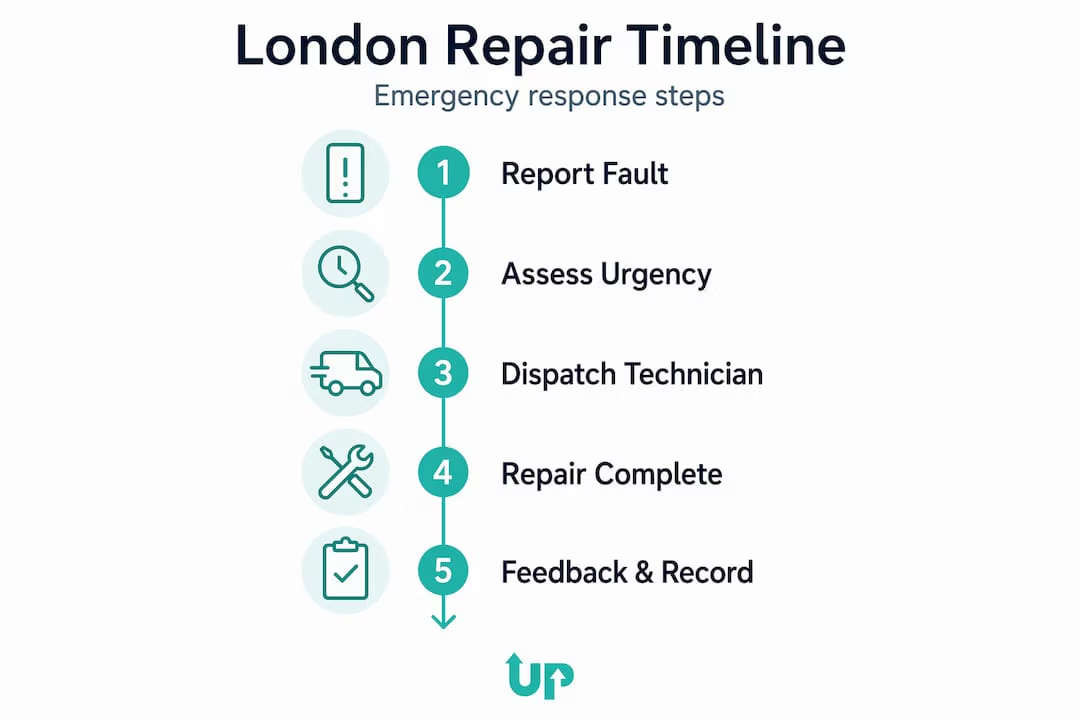
Fast reactive maintenance in London means classifying each repair by urgency, getting a qualified contractor on site within hours for genuine emergencies and agreeing response times in writing. This guide covers how to classify urgency, the response times to expect, how to choose a contractor you can trust at short notice and how to structure a service level agreement that protects your property and tenants. UpKeep UK aims to attend emergencies within 1 to 3 hours.
Key takeaways
| Point | Details |
|---|---|
| Classify urgency correctly | Distinguish life-safety emergencies from routine reactive repairs to deploy resources where they are genuinely needed. |
| Know your legal obligations | Under Section 11 of the Landlord and Tenant Act 1985, delayed repairs can result in compensation claims or prosecution. |
| Benchmark response times | Expect 2 to 4 hours for London emergencies and 24 to 48 hours for non-urgent reactive repairs from a reliable contractor. |
| Build a reactive maintenance SLA | A written SLA with clear response time clauses removes ambiguity and protects both landlord and contractor. |
| Verify contractor accreditations | Gas Safe, NAPIT, and Safe Contractor registration are non-negotiable when vetting any reactive maintenance provider. |
What fast reactive maintenance actually means
Reactive maintenance is any repair carried out in response to a fault or failure, rather than as part of a planned schedule. It sits at the opposite end of the spectrum from preventive maintenance, which aims to service assets before they break down. The term “fast reactive maintenance” refers specifically to the rapid mobilisation of tradespeople following an unplanned failure, particularly where delay would worsen the situation.
Not all reactive repairs are created equal. Understanding that difference is the foundation of good maintenance management. If you’d rather hand the triage to a team that does it every day, our reactive maintenance contractors in London cover every trade with a 1-3 hour emergency response.
Emergency reactive repairs require immediate intervention, typically within two to four hours of notification. Examples include:
- Burst or leaking pipes causing active water ingress
- Total loss of heating or hot water in winter months
- Gas leaks or suspected carbon monoxide presence
- Electrical faults creating a fire or shock hazard
- Structural damage following storm or impact
Non-urgent reactive repairs can be scheduled within 24 to 48 hours without serious consequence. Examples include:
- A single faulty socket or light fitting with alternatives available
- A broken door handle on an internal door
- Minor appliance faults not affecting habitability
- Cosmetic damage such as cracked plaster following a minor incident
Misclassifying repairs carries real risk. Emergency classification must be based on objective criteria like immediate risk to life or major property damage. When landlords treat every request as equally urgent, genuine emergencies get lost in the queue. When everything is labelled an emergency, contractors become desensitised and true rapid response breaks down.
Legally, the stakes are equally clear. Landlords must act promptly after notice of disrepair under Section 11 of the Landlord and Tenant Act 1985, and courts apply strict interpretation to what “prompt” means once notification has been received.
How to assess urgency and prioritise repairs
Accurate urgency assessment is the skill that separates reactive maintenance operations that function well from those that lurch from crisis to crisis. The goal is a simple, repeatable framework your team can apply consistently, even under pressure.
A practical way to score urgency uses three criteria:
- Life and safety risk. Does the fault create immediate danger to occupants or visitors? Gas leaks, exposed wiring, and structural instability always sit at the top of the priority list.
- Property damage potential. Is the fault causing progressive or irreversible damage? A slow roof leak in January will cost significantly more to remedy in March if ignored.
- Tenant impact. Does the fault affect the tenant’s ability to use the property normally? Loss of heating in winter or no access to a working toilet qualifies as serious impact.
Any repair scoring highly on two or more of these criteria should be treated as an emergency and dispatched immediately. Repairs scoring on one criterion warrant a 24-hour response. Those with no immediate score can be scheduled within 48 hours.
Pro Tip: Set up a simple digital triage form for all incoming maintenance requests. Ask three questions: Is there a risk to safety? Is damage getting worse right now? Is the property partially or fully unusable? Answers drive immediate categorisation without relying on anyone’s subjective judgment.
The broader risk of getting this wrong is “emergency fatigue.” Treating all maintenance requests with the same urgency leads to ineffective prioritisation and requires systems that auto-assign priority based on asset criticality and safety risk. When your team stops believing in the classification system, response times for real emergencies slow down. A Computerised Maintenance Management System (CMMS) can automate initial triage, but the underlying criteria must be clearly defined first. You can learn more about establishing those criteria in Upkeep’s reactive maintenance guide for UK property managers.
Response time expectations for London properties
London presents a unique set of challenges for rapid response maintenance. Traffic congestion, the sheer spread of the 33 boroughs, and high demand for skilled tradespeople all affect how quickly a contractor can arrive on site. Knowing what to realistically expect helps you hold contractors accountable without demanding the impossible.
| Repair category | Target response time | Acceptable maximum | Consequence of delay |
|---|---|---|---|
| Life-safety emergency | 2 hours | 4 hours | Legal exposure, serious property damage |
| Urgent reactive repair | 4 hours | 8 hours | Tenant dissatisfaction, damage escalation |
| Non-urgent reactive repair | 24 hours | 48 hours | Tenant complaints, minor damage risk |
| Scheduled reactive repair | 48 hours | 5 working days | Reputational damage if unmanaged |
The law expects landlords to carry out repairs within a reasonable time, and for emergencies that means acting straight away to make the property safe. Good contractors work to a much tighter window than that: UpKeep UK aims to attend emergencies within 1 to 3 hours, because a contractor who arrives days later may be within the law but has still let the damage spread.
Speed of response also affects costs in a way many landlords underestimate. A structured emergency response system can reduce response times dramatically, compressing the gap from fault detection to resolution and preventing costly damage escalation. A slow roof leak ignored for 48 hours can saturate insulation, damage ceilings, and create damp conditions that take weeks to dry out and tens of thousands of pounds to properly restore.
For emergency property repairs across London, the baseline expectation is clear: two to four hours for genuine emergencies, same-day attendance for urgent reactive repairs, and next-day resolution for non-urgent faults.
Choosing a reliable reactive maintenance contractor
Finding a contractor who shows up fast is straightforward. Finding one who shows up fast, does the job correctly, and leaves a clear paper trail is considerably harder. For London property managers with multiple properties across several boroughs, the stakes of getting this choice wrong are significant.
When evaluating any on-demand maintenance provider, check for the following:
- 24/7 availability across all London boroughs. A contractor who covers Zone 1 but not Zone 5 or 6 is not a viable reactive maintenance partner for a portfolio spanning the city.
- Gas Safe Register certification for any contractor attending gas appliance or boiler faults. This is a legal requirement, not a preference.
- NAPIT or NICEIC membership for electrical works. These accreditations verify that electricians work to current standards.
- Safe Contractor or Constructionline approval for broader building and maintenance works, confirming insurance, health and safety compliance, and financial stability.
- Technology-enabled dispatch. The best providers use real-time AI dispatch that accounts for technician skills, certifications, GPS location, and current workload to send the right person first time.
- Clear reporting and communication. After every job, you should receive a written report covering what was found, what was done, materials used, and any follow-on work recommended.
Pro Tip: Before signing with any reactive maintenance provider, ask for their average emergency response time across the past 90 days, verified by job records. Any contractor unwilling to share this data is giving you your answer.
References matter too. Ask specifically for references from managing agents or landlords with similar portfolio sizes in comparable London boroughs. A contractor who performs well for a single residential landlord in Chelsea may not be equipped to cover a commercial portfolio in Lewisham and Croydon simultaneously.
Setting up a reactive maintenance SLA
For managing agents and landlords who handle multiple properties, a verbal agreement with a contractor is not sufficient. A properly drafted reactive maintenance Service Level Agreement (SLA) is the difference between chaos and control when an emergency strikes at 2am on a bank holiday.
A well-constructed reactive maintenance SLA should cover the following components:
Response time commitments defined clearly for each urgency category. The SLA should specify the time from your notification to the contractor’s acknowledgement, and separately the time from acknowledgement to attendance on site.
Scope of works detailing which trades are covered, which properties are included, and any exclusions. Ambiguity about scope causes disputes precisely when you can least afford them.
Reporting requirements specifying what documentation you receive after each job: job sheet, photographs, materials list, and any recommendations for follow-on preventive work.
Escalation procedures defining what happens if the assigned technician cannot attend within the agreed window. Who do you call? What is the fallback?
SLA compliance monitoring through a shared dashboard or monthly reporting. Rising emergency work order rates directly indicate preventive maintenance programme deficiencies, and your SLA reporting should surface these trends so you can act before they worsen.
The most effective SLAs also include an emergency bypass clause. Emergency work orders should bypass approval queues with immediate technician execution authorised, paired with a mandatory post-completion audit within 24 hours. This balances speed with accountability and ensures you retain oversight without adding delay when it matters most.
Upkeep works with managing agents across London to build bespoke SLAs incorporating all of the above, backed by Gas Safe, NAPIT, and Safe Contractor accreditations and genuine 24/7 borough-wide coverage. For landlords who want to understand more about the legal context behind these agreements, Upkeep’s emergency repair response guide covers the key obligations in detail.
My perspective on what most reactive maintenance operations get wrong
I’ve seen reactive maintenance managed well and managed badly across a wide range of property portfolios, and the failure mode is almost always the same. The issue is rarely the contractor. More often, it is the absence of a clear classification system before the phone rings.
When every request arrives with the same level of urgency, the person triaging it defaults to gut instinct. Gut instinct is inconsistent. One team member escalates everything; another downplays issues to avoid conflict with contractors. Neither approach serves the property or the tenant.
What I’ve found actually works is a written urgency matrix, agreed with your contractor before any work begins, with specific examples for each category. When a new request comes in, anyone on your team can match it to the matrix in under two minutes. The decision is made before the anxiety of the situation clouds it.
The technology angle is real but often oversold to landlords who aren’t ready for it. A CMMS is genuinely useful once your classification criteria are solid. Without that foundation, you are simply automating poor decisions faster. Start with the criteria. Add the technology when the human process is working.
The other pattern I’d flag is what happens after the emergency is resolved. Most operations close the job and move on. The smarter approach is a brief post-completion review: Was the response time met? Did the repair hold? Was there a preventive maintenance action that could have prevented this fault? Transitioning from reactive to proactive maintenance can cut unplanned downtime by up to 50%. That statistic becomes real when you start treating your emergency data as a planning resource rather than just a cost record.
: Montgomery
How Upkeep supports London property managers

When you need fast reactive maintenance across London, the contractor you choose must be ready before the phone call, not scrambling after it. Upkeep provides 24/7 emergency maintenance services across all 33 London boroughs, with accreditations including Gas Safe Register, NAPIT, and Safe Contractor that guarantee every trade is qualified, insured, and compliant.
Upkeep’s rapid response maintenance model is built around the response times this guide describes: two to four hours for genuine emergencies, 24 to 48 hours for non-urgent reactive repairs. Managing agents and landlords benefit from tailored SLAs with full reporting, dedicated account support, and transparent pricing that removes guesswork from time-sensitive maintenance decisions.
To understand what good reactive maintenance compliance looks like for your portfolio, read Upkeep’s guide on emergency repairs for UK properties, or explore the maintenance red flags that letting agencies should never overlook. Contact Upkeep today to discuss a reactive maintenance SLA built around your properties.
FAQ
How fast should reactive maintenance be?
For genuine emergencies such as gas leaks, burst pipes, or electrical hazards, the target response time in London is two to four hours from notification. Non-urgent reactive repairs should be attended within 24 to 48 hours.
What counts as an emergency maintenance issue?
An emergency is any fault that creates an immediate risk to life, causes progressive property damage, or renders the property partially or fully uninhabitable. Objective criteria such as safety risk and property damage potential, rather than tenant preference, should define the classification.
Do I need a contract for reactive maintenance?
A written SLA with a reactive maintenance contractor is strongly advisable for any landlord or managing agent with more than one property. It defines response times, scope, reporting requirements, and escalation procedures, removing ambiguity when a fault occurs at an inconvenient time.
What are my legal obligations as a landlord for repairs?
Under Section 11 of the Landlord and Tenant Act 1985, landlords must act promptly upon receiving notification of disrepair. Delays can result in compensation claims or, in serious cases, prosecution, particularly where the fault affects habitability or safety.
How do I verify a reactive maintenance contractor’s accreditations?
Check the Gas Safe Register website for any contractor attending gas works, the NAPIT or NICEIC registers for electrical trades, and Safe Contractor or Constructionline for broader maintenance providers. All legitimate contractors will supply their registration numbers without hesitation.