Every UK landlord who rents out a property with gas appliances must have them checked every year by a Gas Safe registered engineer and hold a valid gas safety certificate, often called a CP12. The duty comes from the Gas Safety (Installation and Use) Regulations 1998, and the certificate confirms that appliances, fittings and flues are safe for tenants to use.
The inspection covers a specific set of items:
- Gas pressure and flow rates at each appliance
- Burner operation and combustion performance
- Flue integrity and safe discharge of combustion gases
- Ventilation adequacy for each appliance
- Safety devices and controls, including flame failure devices
- Visible pipework condition and connections
UpKeep UK is a Gas Safe registered contractor covering London, giving landlords a reliable, accredited route to annual compliance.
What are your legal duties as a landlord for gas safety?
Your obligations under the Gas Safety (Installation and Use) Regulations 1998 go beyond simply booking an annual check. The HSE sets out three core duties for landlords: carry out the annual inspection, keep the records, and communicate the results to tenants.
Annual inspection. Every gas appliance and flue you provide must be checked for safety within 12 months of installation and at intervals of no more than 12 months thereafter. The check must be carried out by a Gas Safe registered engineer, not just any qualified trades person.
Recordkeeping. You must retain the gas safety record for at least two years from the date of each check, as required by law. The record must include the engineer’s name, registration number, and signature, the date and address of the inspection, a description of each appliance checked, any defects found, and any remedial action taken.
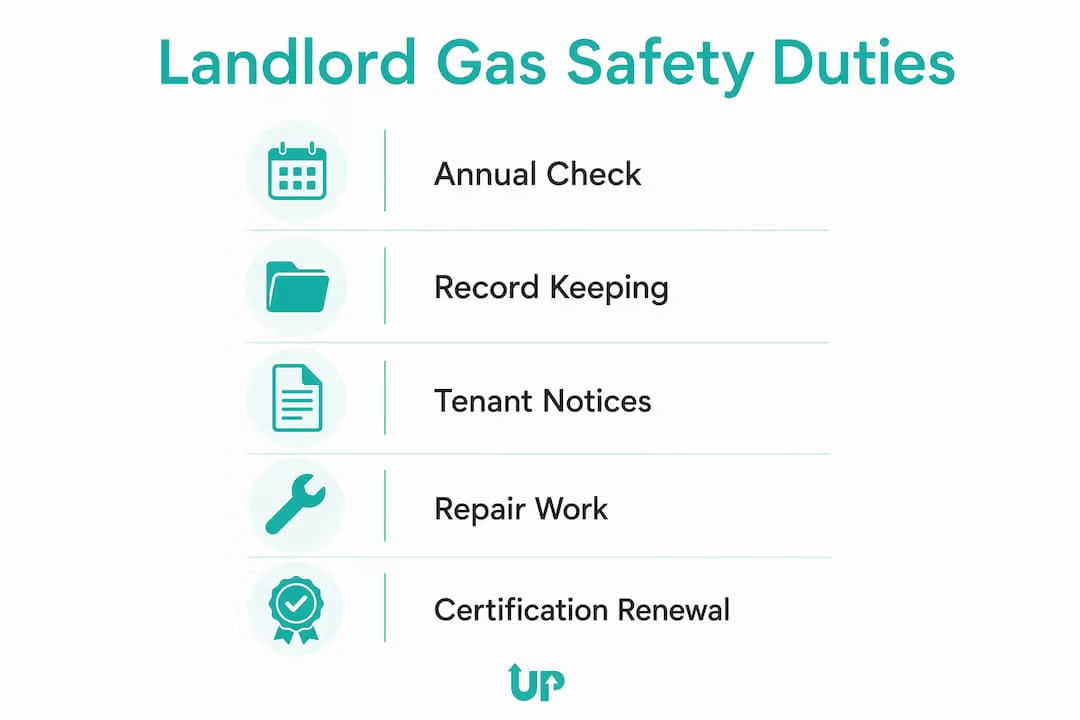
Tenant communication. You must provide a copy of the latest gas safety record to existing tenants within 28 days of the check being completed. New tenants must receive a copy before they move in. Electronic copies are permitted if the tenant agrees, but you must provide a paper copy on request.
Penalties for non-compliance are serious. Breaches of the Gas Safety (Installation and Use) Regulations can result in criminal prosecution, unlimited fines, and imprisonment of up to six months. The Health and Safety Executive takes enforcement action where landlords fail to meet these duties.
A summary of your core obligations:
- Annual gas safety check by a Gas Safe registered engineer
- Gas safety record retained for a minimum of two years
- Copy issued to existing tenants within 28 days of the check
- Copy provided to new tenants before move-in
- Paper copy supplied on request, even if electronic delivery is agreed
- All maintenance and repair work carried out by a Gas Safe registered engineer
Pro Tip: If a tenant refuses access for the annual check, document every attempt in writing. The HSE looks for repeated, evidenced contact before accepting a “reasonable steps” defence. A single phone call will not be sufficient.
One point landlords often overlook: the annual gas safety check is not a substitute for regular servicing. Servicing follows manufacturer instructions and prevents failures; the annual check confirms safety. Both are your responsibility.
How much does a gas safety certificate cost, and when should you book?
The price of a gas safety certificate depends on the number of appliances and the size of the property, so a single-boiler flat costs less than a house with a boiler, gas hob and gas fire. UpKeep UK confirms a fixed price before booking.
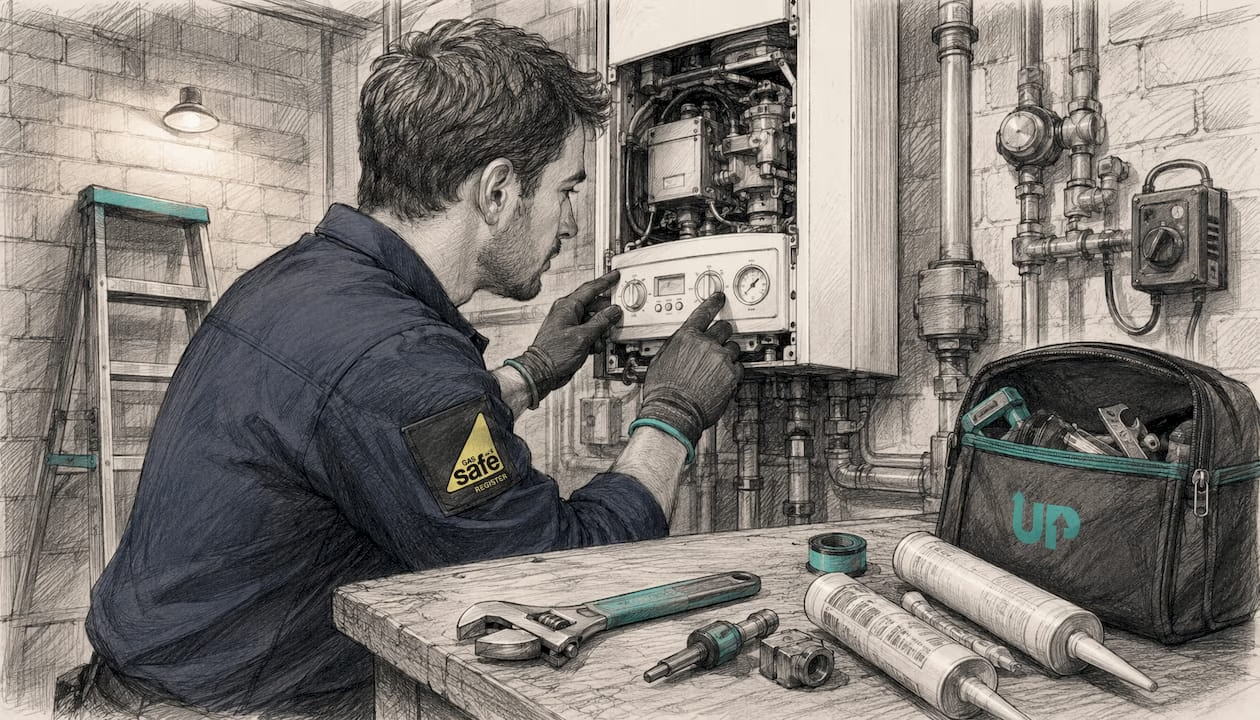
The inspection itself is not particularly disruptive. Most checks take between 30 and 45 minutes, though properties with multiple appliances or restricted access may take longer. Tenants rarely need to be absent for the duration.
Timing matters. The Gas Safety (Installation and Use) (Amendment) Regulations 2018 introduced a useful flexibility: you can book the annual check any time from 10 to 12 calendar months after the previous one, and the original anniversary date is preserved as the new deadline. This means you can schedule slightly early without losing your compliance window, which is particularly useful for landlords managing multiple properties across London.
Booking steps for landlords:
- Confirm the expiry date of your current gas safety record
- Book the inspection 10 to 12 months after the previous check
- Coordinate access with your tenant, giving reasonable written notice
- Confirm the engineer’s Gas Safe registration before the appointment
- Retain the completed record and issue copies to tenants promptly
Upkeep UK covers all 33 London boroughs and can coordinate directly with tenants on access, removing one of the most common scheduling headaches for busy landlords. For broader landlord property maintenance support, Upkeep UK offers a joined-up service that keeps compliance on track year-round.
What should you do if your property fails a gas safety inspection?
A failed inspection does not mean the engineer simply marks a box and leaves. When a defect is identified, the engineer classifies it by severity. An “Immediately Dangerous” (ID) classification means the appliance must be isolated on the spot. An “At Risk” (AR) classification means the appliance is unsafe but not immediately so, and you must arrange repairs before it is used again.
Your legal position is clear. It is an offence to use, or allow the use of, a gas appliance you know to be unsafe. Once a defect is recorded, you cannot reconnect or permit use of that appliance until a Gas Safe registered engineer has carried out and confirmed the remedial work.
Steps to take after a failed inspection:
- Obtain the written gas safety record detailing the defect and its classification
- Arrange remedial work with a Gas Safe registered engineer without delay
- Notify your tenant of the issue, the nature of the fault, and the expected repair timeline
- Provide alternative heating arrangements if a boiler or central heating system is isolated
- Once repairs are complete, arrange a re-inspection to confirm the appliance is now safe
- Update your gas safety record to reflect the remedial action taken
The gas safety record is described by the HSE as a “living document.” Landlords should supplement it with records of all follow-up work, creating a complete audit trail of safety activity at the property. Ignoring a failed inspection does not just risk tenant safety; it exposes you to criminal prosecution and will almost certainly affect your landlord insurance cover, since most policies require compliance with statutory safety obligations.
New tenancy vs existing tenancy: what changes and what stays the same?
The core annual inspection requirement applies regardless of tenancy type, but the timing and communication obligations differ depending on whether you are starting a new tenancy or continuing an existing one.
For a new tenancy, you must ensure that a valid gas safety check has been carried out within the 12 months before the lease commences. If appliances were installed less than 12 months before the tenancy starts, they must be checked within 12 months of installation. Critically, the tenant must receive a copy of the gas safety record before they move in, not on the day of move-in or shortly after.
For an existing tenancy, the 28-day rule applies. Once the annual check is completed, you have 28 days to issue the updated record to all current tenants. There is no grace period beyond that.
Vacant periods between tenancies carry their own risk. Before re-letting a property, you must confirm that all appliances and flues are safe and that the gas safety record is current. If you suspect appliances may have been tampered with during a vacancy, or if there is any doubt about their condition, the HSE recommends arranging a fresh inspection before new tenants move in. Departing tenants sometimes disconnect appliances incorrectly or leave their own equipment behind, which can create hazards that a current record will not capture.
Key distinctions at a glance:
- New tenancy: valid record required before move-in, covering the previous 12 months
- Existing tenancy: updated record issued within 28 days of each annual check
- Vacant property: confirm record is current before any new tenancy begins
- Post-vacancy: fresh inspection recommended if appliance condition is uncertain
- Appliances left by a departing tenant: include in annual checks if the landlord retains them
This is one area where common property maintenance mistakes catch landlords out. Assuming a record from six months ago covers a new tenancy is not a safe position to take.
How do you verify a Gas Safe engineer’s credentials?
Only a Gas Safe registered engineer may carry out a gas safety inspection or any gas maintenance work on appliances you provide for tenants. Using an unregistered engineer does not just invalidate the certificate; it is a criminal offence under the Gas Safety (Installation and Use) Regulations 1998.
Verification is straightforward. Every registered engineer carries a Gas Safe ID card containing a photo, their personal licence number, business registration number, company name, and the card’s start and expiry date. The reverse of the card lists the specific appliance types the engineer is qualified to work on. You should check the engineer’s ID card before any work begins, and confirm that their qualifications cover the specific appliances in your property. A boiler specialist may not be qualified to work on a gas fire, for example.
You can also verify registration online at the Gas Safe Register website (gassaferegister.co.uk) or by calling 0800 408 5500 during office hours. The search function confirms whether an individual engineer is currently registered and what work they are qualified to carry out.
Best practice checklist for selecting an engineer:
- Ask to see the Gas Safe ID card before work starts
- Check the card’s expiry date and confirm it is current
- Verify the engineer’s qualifications for your specific appliance types on the reverse of the card
- Cross-reference registration on the Gas Safe Register website
- Confirm the engineer will provide a completed gas safety record on the day
Upkeep UK’s Gas Safe accreditation covers the full range of domestic gas appliances, and all engineers carry current ID cards. For landlords managing heating system compliance across multiple London properties, working with a single accredited contractor simplifies verification considerably.
What rights do tenants have regarding gas safety certificates?
Tenants have clearly defined rights under the Gas Safety (Installation and Use) Regulations 1998, and landlords who are unaware of them risk complaints, disputes, and enforcement action.
Every tenant has the right to receive a copy of the current gas safety record. For new tenants, this must be provided before they move in. For existing tenants, it must be provided within 28 days of each annual check. If a tenant requests a paper copy after receiving an electronic version, the landlord must supply one. Where a gas appliance is not located in any room used by the tenant, the landlord may display the record in a prominent communal location instead of issuing individual copies, but must inform tenants at the start of the tenancy where the notice is displayed and how to request their own copy.
Tenants also have the right to expect that any gas appliance provided by the landlord is safe to use. If an appliance is classified as unsafe during an inspection, the landlord must arrange repairs before the appliance is used again. Tenants should not be pressured to use an appliance that has been isolated or disconnected on safety grounds.
Where a tenant suspects a gas leak or carbon monoxide risk, they should contact the National Gas Emergency Service on 0800 111 999 immediately. Carbon monoxide poisoning from faulty gas appliances is a genuine risk, and tenants are entitled to expect their landlord has taken all reasonable steps to prevent it.
Tenants are not responsible for the gas safety checks on appliances provided by the landlord. They are, however, responsible for any appliances they own themselves, including the flue if it solely serves their own appliance.
How do you renew and update the gas safety certificate after repairs?
The gas safety record is not a static document. When remedial work is carried out following a failed inspection, the record should be updated to reflect the action taken. The HSE describes the record as a living document, and landlords are advised to supplement the original with written records of all follow-up repairs, creating a complete history of gas safety at the property.
Renewing the certificate after repairs does not automatically reset the annual inspection clock. The 12-month cycle runs from the date of the original annual check, not from the date of any subsequent repair visit. If a boiler is repaired in March but the annual check was due in February, the next annual check is still due the following February.
Where a new appliance is installed mid-tenancy, it must be checked for safety within 12 months of installation and then included in all subsequent annual checks. If the installation date falls outside the existing inspection cycle, you may need to arrange an additional check to bring the new appliance into the annual schedule.
After any significant gas work, including appliance replacement or pipework repairs, ask the engineer to confirm in writing that the appliance is safe to use and that the work meets the requirements of the Gas Safety (Installation and Use) Regulations 1998. This documentation supports your compliance record and provides clear evidence if questions arise later.
For landlords managing multiple properties or HMOs, keeping a centralised log of inspection dates, engineer details, and repair records is the most reliable way to stay ahead of renewal deadlines. The landlord maintenance checklist published by Upkeep UK covers this in practical detail, including how to track gas safety alongside other statutory obligations.
Key takeaways
UK landlords must obtain an annual gas safety certificate under the Gas Safety (Installation and Use) Regulations 1998, provide copies to tenants within the required deadlines, and retain records for at least two years, or face unlimited fines and up to six months’ imprisonment.
| Point | Details |
|---|---|
| Annual legal requirement | Gas safety checks must be carried out every 12 months by a Gas Safe registered engineer. |
| Tenant copy deadlines | New tenants receive the record before move-in; existing tenants within 28 days of the check. |
| Record retention | Gas safety records must be kept for at least two years from the date of each check. |
| Failed inspection action | Unsafe appliances must not be used until a Gas Safe engineer has completed and confirmed repairs. |
| Cost in London | The cost depends on the number of appliances, and UpKeep UK confirms a fixed price before booking. |

Upkeep UK is a Gas Safe registered contractor serving all 33 London boroughs, providing annual gas safety inspections, remedial works, and full compliance support for residential landlords. Whether you manage a single flat or a portfolio of properties, Upkeep UK coordinates directly with tenants on access and delivers completed gas safety records on the day of inspection. To book your annual check or discuss your landlord property maintenance requirements, get in touch with the Upkeep UK team today.