Which commercial fit out contractors in London are worth considering?
The right commercial fit out contractor in London will show current accreditations and insurance, a clear fixed-price contract, a named project manager and proven experience of working in occupied buildings. This guide looks at contractors from across the London market, from full-service design and build firms to Cat A and landlord refurbishment specialists, and sets out what to check before you sign.
A note on this list: UpKeep UK publishes this guide and is one of the companies in it. Check each contractor’s current services, accreditations and prices directly before you shortlist.
-
UpKeep UK covers the full spectrum of commercial fit out and refurbishment work across London, with a team that includes experienced builders, electricians, and project managers. The firm operates with fixed pricing, insured works, and a transparent communication approach that suits landlords, developers, and business operators who need accountability at every stage.
-
JBH Refurbishments specialises in commercial interior refurbishments, with a portfolio spanning office fit outs, retail, and hospitality environments across London. Their work is characterised by close client involvement and a practical approach to programme management.
-
London Fit Out focuses on Cat A and Cat B office fit outs, working with both landlords and tenants. Their service range covers design consultancy through to snagging and handover, making them a viable option for clients seeking a single point of contact.
-
Virtus Contracts brings experience in bespoke design and build projects, with a track record in technically demanding commercial interiors. They hold accreditations that demonstrate compliance with UK health and safety standards.
When evaluating any contractor, accreditations matter. CHAS (Contractors Health and Safety Assessment Scheme), Safe Contractor, and NAPIT are the three most widely recognised in UK commercial construction. They confirm that a contractor has been independently assessed for safety compliance and quality assurance. Any contractor unwilling to disclose their accreditation status at the outset should be treated with caution.
What services do commercial fit out contractors typically offer?
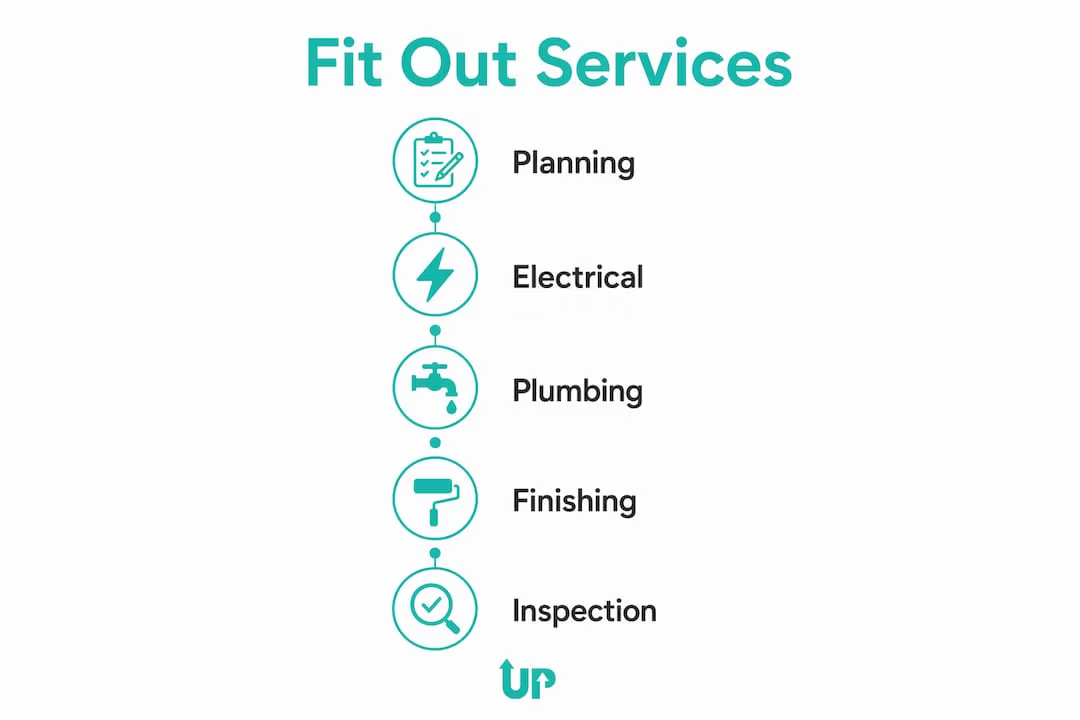
Commercial fit out work in London covers a broader range of project types than many clients initially expect. Understanding the scope helps you brief contractors accurately and compare quotes on a like-for-like basis.
Typical project categories:
- Cat A fit out: The landlord brings a shell-and-core space up to a lettable standard. This includes raised floors, suspended ceilings, basic mechanical and electrical installations, and finished common areas.
- Cat B fit out: The tenant customises the Cat A space for their specific operational needs, adding partitioning, kitchens, branded interiors, AV and IT infrastructure, and furniture.
- Office refurbishment: Upgrading or reconfiguring an existing occupied or recently vacated office, often while the building remains in partial use.
- Landlord refurbishment: Repositioning older commercial stock to attract new tenants, typically involving structural modifications alongside interior upgrades.
- Bespoke design and build: A single contractor takes responsibility for both design and construction, providing cost certainty and a single point of accountability.
Common services within these projects:
- Design consultancy and space planning
- Construction and fit out works
- Mechanical, electrical, and plumbing (MEP) installations
- Fit out project management and programme oversight
- Snagging, defects rectification, and handover
Project scale in London varies from a 500 sq ft office conversion to a multi-floor headquarters refurbishment. A contractor experienced across this range will adapt their approach and resourcing accordingly, rather than applying a one-size approach to every instruction.

How do you choose and vet a reliable fit out contractor?
The most common mistake clients make is prioritising a contractor’s portfolio aesthetics over their financial and operational stability. A beautifully presented brochure does not protect you if the contractor runs into cash flow problems mid-project.
Key vetting steps:
- Run a credit check. Financial instability in a contractor poses a direct risk to your project timeline. Contractors with weak balance sheets or poor payment histories to subcontractors are far more likely to cause delays or abandon works.
- Verify accreditations. Confirm CHAS, Safe Contractor, or NAPIT status directly with the issuing body, not just from a contractor’s own marketing materials.
- Review their portfolio with London case studies. A contractor’s portfolio and client references are among the strongest indicators of sector capability. Ask to visit completed projects where possible.
- Assess their project management approach. How do they communicate progress? Who is your named point of contact on site? What reporting do they provide?
- Interview them properly. Ask about their experience with occupied buildings, their approach to programme delays, and how they handle variations.
Questions worth asking during a contractor interview:
- Can you provide references from clients with similar project types in London?
- How do you manage subcontractor performance and payment?
- What is your process for handling unforeseen site conditions?
- How do you document and resolve snagging items?
Pro Tip: Request a performance bond at tender stage. If a contractor cannot obtain one, or if the bond premium is unusually high, treat it as a signal of financial instability before you commit.
What contract terms must you understand before signing?
The contract is where most fit out disputes originate, and most of those disputes stem from terms that were never properly read or negotiated. JCT contracts remain the UK standard for commercial fit outs in 2026, and selecting the right form for your project is the first decision to make; for an in-depth discussion of contract forms and fit-out suitability within London, see the Google Indexing and Keyword Relevance Case Study: Marylebone.
JCT accounts for around 70% of UK construction contracts. The main forms relevant to commercial fit outs are:
- JCT Minor Works (MW): Suited to smaller, simpler fit outs and refurbishments with limited complexity.
- JCT Intermediate Building Contract (IC): For medium-scale commercial projects with a more detailed scope.
- JCT Design and Build (DB): Transfers design responsibility to the contractor, providing a single point of accountability and earlier cost certainty.
Critical contract terms to understand:
| Term | What it means |
|---|---|
| Programme / schedule | The agreed timeline for works, including key milestones and completion date |
| Payment milestones | Agreed stages at which interim payments are certified and released |
| Defects liability period | The period post-completion during which the contractor must rectify notified defects at no cost |
| Retention | A percentage of the contract sum withheld as security until defects are resolved |
| Collateral warranties | Direct contractual rights allowing landlords, funders, or tenants to pursue contractors or key subcontractors |
| Site possession | The date and terms on which the contractor takes control of the site |
The defects liability period in JCT contracts usually lasts 6 to 12 months after practical completion. During this period, the employer holds retention monies as financial security, and the contractor must return to rectify any notified defects free of charge.
Collateral warranties from contractors and key subcontractors give you a direct right of recourse if the main contractor defaults or becomes insolvent. Insist on these being agreed in principle before the contract is signed, not negotiated under pressure after practical completion.
One clause that catches many clients off guard: standard JCT contracts assume the contractor has exclusive possession of the site. If your building will remain partially occupied, or if other trades will be working alongside the fit out contractor, the contract must include bespoke amendments to address coordination and liability. Without them, you are exposed to claims for additional time and cost.
How do you manage a fit out contractor effectively on site?
Good on-site management is the difference between a project that finishes on programme and one that drifts. The contractor carries the delivery responsibility, but you carry the oversight responsibility.
Practical management steps:
- Establish a single named point of contact on both sides before works begin.
- Agree a weekly progress meeting format and stick to it, with written minutes circulated within 24 hours.
- Monitor progress against the agreed programme at each meeting, not just at key milestones.
- Document all snagging items in writing as they arise, with photographs and a target resolution date.
- Do not release retention or sign off practical completion until all snagging items are resolved to your satisfaction.
Effective site management reduces delays and protects quality delivery. The snagging process in particular deserves attention: a thorough snagging list compiled before practical completion is far easier to enforce than one raised after the contractor has demobilised.
Pro Tip: If your building is occupied during the fit out, include an express coordination clause in the contract requiring the contractor to manage their activities around your occupiers. Without this, any disruption the contractor causes becomes a potential variation claim.
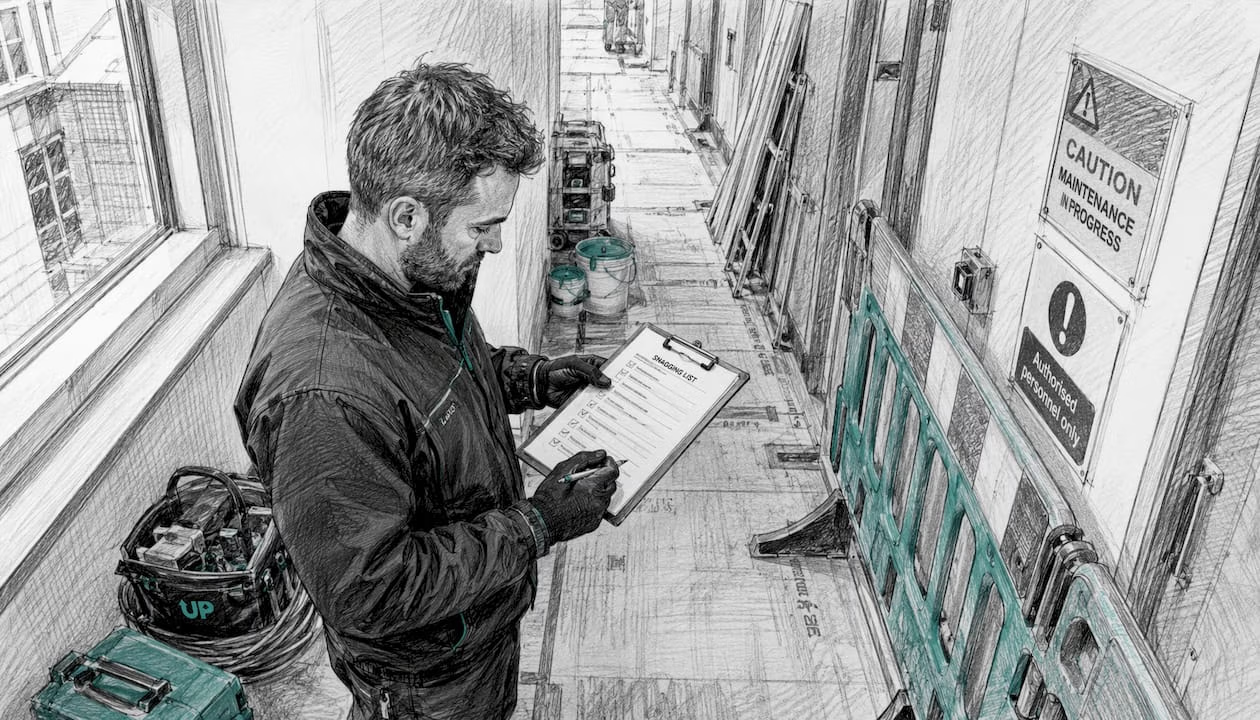
UpKeep UK’s approach to project management reflects this discipline. Their team maintains clear communication channels throughout, provides regular progress updates, and documents issues as they arise rather than allowing them to accumulate.
Red flags that signal an unreliable contractor
Not every contractor presenting a polished proposal is a reliable one. These warning signs are worth taking seriously before you sign anything.
- No verifiable accreditations. A contractor who cannot confirm active CHAS, Safe Contractor, or NAPIT status is operating without independent safety and quality oversight.
- Refusal to undergo a credit check. Financially stable contractors have no reason to resist this. Resistance is itself informative.
- Vague or incomplete scope of works. If the tender documents are thin on detail, the contract will be too, and disputes over scope will follow.
- A history of missed deadlines. Ask references directly about programme adherence, not just finish quality.
- Excessive upfront payment requests. A reasonable deposit is standard; a demand for 40 to 50% before works begin is not.
- No performance bond or inability to obtain one. As noted in the contract section, this is a direct signal of financial risk.
- Poor communication during the tender stage. If a contractor is slow to respond or vague in their answers before they have won the work, their behaviour on site will be worse.
What is a commercial fit out contractor?
A commercial fit out contractor is a specialist construction firm responsible for transforming a commercial space, whether a raw shell or an existing interior, into a fully functional, compliant, and purpose-built environment. The scope typically covers everything from structural modifications and MEP installations through to interior finishes, furniture, and technology infrastructure.
The term covers a wide range of project types. At one end, a Cat A contractor prepares a space for letting. At the other, a full design and build contractor takes a client brief and delivers a finished, branded workplace with no separate design team required. The distinction matters because it determines who holds design liability, how risk is allocated in the contract, and how much involvement you need as the client throughout the project.
In London, the commercial fit out sector serves office occupiers, retail operators, hospitality businesses, landlords repositioning assets, and developers fitting out new commercial stock. The workspace design and fit out process in London is shaped by the city’s density, planning constraints, and the prevalence of occupied or listed buildings, all of which add complexity that contractors must be equipped to handle.
How do you compare and negotiate pricing and payment terms?
Pricing for commercial fit outs in London varies considerably by specification. Basic Cat B fit outs start from lower price bands per square foot, mid-level specifications are at moderate price ranges per square foot, and high-end bespoke fit outs with premium finishes can reach higher price levels per square foot.
When comparing quotes, the headline figure is rarely the whole story. Look at what each tender includes and excludes, particularly around MEP design, furniture, IT infrastructure, and project management fees. A lower quote that excludes these items will often cost more in total than a higher quote that includes them.
On payment terms, the JCT framework provides a useful baseline. Interim payments are typically certified monthly against work completed, with a retention percentage withheld until the defects liability period ends. Negotiate the retention rate and the release mechanism before signing, not after. A common structure includes retention withheld until after practical completion and the end of the defects liability period, with the specific percentage subject to negotiation.
Pro Tip: Ask each contractor to provide a detailed breakdown of their preliminaries (site management, welfare, plant, and insurance costs). This is where pricing differences between contractors often hide, and it tells you a great deal about how they intend to resource the project.
Understanding warranties and guarantees from your contractor
Warranties in commercial fit out projects operate on two levels: contractual and statutory. Understanding both protects you well beyond the defects liability period.
The defects liability period is the contractual window, usually lasting 6 to 12 months post-completion, during which the contractor must rectify notified defects at no cost. JCT contracts call this the rectification period. Once it expires, the contractor’s express obligation to return to site ends, but their liability does not disappear entirely.
Statutory limitation periods mean a contractor can still face claims for defects discovered years after the DLP ends, though enforcement becomes more complex. For contracts executed as a deed, the limitation period is 12 years; for simple contracts, it is 6 years. This is why collateral warranties from key subcontractors matter: if the main contractor is no longer trading when a latent defect surfaces, a collateral warranty gives you a direct route to the subcontractor responsible.
Specific product warranties, such as those covering flooring, glazing systems, or mechanical plant, run independently of the main contract. Collect these at handover and store them with your building records. A contractor who cannot produce these documents at practical completion is leaving you exposed on the assets most likely to require attention in the years ahead.
UpKeep UK: a trusted partner for London commercial fit outs
For London landlords, developers, and business owners who want a single, accountable contractor across the full scope of a commercial fit out or refurbishment, UpKeep UK offers exactly that. Rather than coordinating multiple specialists yourself, you get a team that covers construction, electrical, project management, and ongoing property maintenance under one roof.

What sets UpKeep UK apart for clients coming from this kind of research is the combination of fixed pricing, insured works, and transparent communication that runs from the initial quote through to handover. There is no ambiguity about who is responsible for what, and no surprises in the final account. For landlords managing multiple assets, that predictability is worth as much as the quality of the finish itself.
UpKeep UK’s project portfolio spans commercial and residential work across London, giving you a concrete basis for assessing their capability before you commit. Their construction services cover the full build scope, and their landlord property maintenance offer means the relationship does not have to end at practical completion.
To discuss your project and get a clear, itemised quote, contact UpKeep UK directly through their website.
Key takeaways
The most reliable commercial fit out contractors in London combine verified accreditations, financial stability, clear JCT-based contracts, and disciplined on-site project management to deliver on time and within budget.
| Point | Details |
|---|---|
| Accreditations are non-negotiable | Verify CHAS, Safe Contractor, or NAPIT status directly with the issuing body before appointing any contractor. |
| JCT contracts set the standard | Choose the right JCT form for your project size; Design and Build transfers design risk to the contractor. |
| Defects liability runs 6 to 12 months | Retain a percentage of the contract sum until all notified defects are rectified after practical completion. |
| Credit check every contractor | Financial instability is the leading cause of unfinished works and programme failures in London fit outs. |
| UpKeep UK offers fixed-price fit outs | UpKeep UK covers the full scope of commercial fit out and refurbishment in London with transparent, insured pricing. |