Choose epoxy where floors face heavy static loads, chemical spills and abrasion in a temperature-stable building, such as warehouses, showrooms and dry manufacturing. Choose polyurethane where floors face thermal shock, hot washdowns, organic acids or UV exposure, such as commercial kitchens, breweries and loading bays open to weather. The deciding factors are always substrate condition, duty rating under BS 8204-6, and the chemical environment the floor must survive daily.
As a rough guide for 2027 budgets, thin epoxy coatings typically cost around £15-£35 per m² installed, epoxy self-smoothing systems £35-£70 per m², and heavy-duty polyurethane mortar systems £60-£120 per m² or more, depending on substrate preparation, thickness and access. Getting the binder and thickness right for the duty class matters far more than saving a few pounds per square metre. UpKeep UK surveys and manages resin flooring for warehouses, kitchens, showrooms and commercial units across London as part of our fit-out and planned maintenance work. This guide compares the two binders in detail, with a decision checklist and the questions to ask any contractor.
TL;DR:
- Proper substrate moisture testing and adherence to duty classification are crucial to avoid early cracking or delamination of resin floors.
- Epoxy coatings suit environments with stable conditions and mainly physical wear, whereas polyurethane is better for areas with thermal shocks, UV exposure, or aggressive chemicals.
- Epoxy provides superior hardness and gloss but is vulnerable to UV discoloration and poor thermal shock resistance, while polyurethane offers better flexibility and chemical tolerance.
- Selection should be based on the specific chemical environment, temperature variations, and expected load impact, with a detailed survey ensuring appropriate system thickness.
- Routine maintenance involves regular cleaning and periodic recoating every five to ten years to maintain durability and appearance.
Table of Contents
- Epoxy vs polyurethane floor: quick comparison at a glance
- Main differences: chemistry and performance explained
- Best use cases: when to pick epoxy and when to pick polyurethane
- In-depth comparison: abrasion, impact, chemical and thermal resistance
- System types, thicknesses and expected cure and downtime
- Cost, lifespan and maintenance expectations
- How to choose: decision checklist and contractor questions
- UpKeep UK’s view: why the survey decides the outcome
- Get a resin flooring survey from UpKeep UK
- Sources
Epoxy vs polyurethane floor: quick comparison at a glance
Property managers rarely need a chemistry lesson. They need to know which binder survives their building’s daily abuse. Here is the shorthand version before the detail:
- Hardness: Epoxy is significantly harder and more scratch-resistant; polyurethane flexes rather than resists.
- Flexibility: Polyurethane tolerates movement, vibration and thermal cycling far better than rigid epoxy.
- Chemical resistance: Epoxy handles solvents and oils well; polyurethane copes better with organic acids common in food production.
- UV tolerance: Polyurethane resists yellowing in sunlight; epoxy discolours and chalks under UV within months.
- Typical thickness and cure: Epoxy coatings run 200 microns to 4mm; PU mortars run 4 to 9mm and cure faster, some ready for foot traffic within 12 to 24 hours.
- Cost band: Epoxy self-smoothing systems generally sit below PU mortar systems on installed price per square metre.
Epoxy wins on gloss finish and abrasion resistance. Polyurethane wins where the floor must survive extremes of heat, cold or chemical attack without cracking.
Main differences: chemistry and performance explained
Epoxy is a rigid, cross-linked thermoset resin. Once cured, its molecular structure locks solid, which is exactly why it resists abrasion from forklift traffic and pallet trucks so effectively. That same rigidity is its weakness. A concrete slab that shrinks, expands or develops a hairline crack will transmit that movement straight through an epoxy coating, often as a matching crack on the surface within weeks of substrate movement.
Polyurethane behaves differently at a molecular level. Standard PU coatings and urethane mortar systems retain a degree of elasticity, allowing the floor to absorb minor substrate movement, impact from dropped tools, and the expansion and contraction that comes with repeated heating and cooling. This flexibility is why polyurethane systems dominate specifications for kitchens, cold stores and loading bays that swing between ambient and sub-zero temperatures multiple times a day.
UV behaviour separates the two even more starkly. Standard epoxy contains aromatic components that react with sunlight, producing a yellow or amber discolouration and a chalky surface texture within months of UV exposure. Aliphatic polyurethane, by contrast, holds its colour and gloss for years outdoors or under skylights. This is why showroom floors under fluorescent light can use epoxy freely, while a loading dock with roller shutters open to daylight almost always specifies PU.
Abrasion resistance favours epoxy in dry, controlled environments. Chemical resistance splits by category: epoxy handles solvents, fuels and mineral oils confidently, while polyurethane copes better with the organic acids found in dairies, breweries and food processing, where urethane mortar systems are the near-universal choice.
Best use cases: when to pick epoxy and when to pick polyurethane
Matching the binder to the building’s actual working life matters more than any brochure comparison. A few patterns recur across UK commercial and industrial sites.
Epoxy suits environments where conditions stay stable and the floor mostly faces wear rather than thermal or chemical stress:
- Warehouses and distribution centres: heavy forklift traffic on a temperature-stable slab benefits from epoxy’s abrasion resistance.
- Showrooms and retail units: high-gloss decorative epoxy delivers the polished appearance clients expect without daily chemical exposure.
- Dry manufacturing and assembly: consistent indoor conditions suit epoxy’s rigidity and cost efficiency.
- Domestic and light commercial garages: moderate traffic and minimal thermal swing make epoxy the practical, cost-effective option.
Polyurethane suits environments defined by heat, moisture cycling or chemical aggression:
- Commercial kitchens and food production: hot washdowns and organic acids favour polyurethane’s chemical tolerance, an insight borne out repeatedly in food-sector installations.
- Breweries and dairies: thermal shock from steam cleaning and cold storage demands PU’s flexibility.
- Loading bays and covered outdoor areas: UV exposure and temperature swings rule out standard epoxy.
Many buildings genuinely need both. A distribution warehouse with an attached goods-in wash bay, for instance, commonly runs epoxy through the main storage floor and polyurethane through the wash area, a hybrid approach that respects each zone’s actual demands rather than forcing one binder across the whole footprint.
In-depth comparison: abrasion, impact, chemical and thermal resistance
Rolling loads, such as forklifts and pallet trucks moving at speed, favour epoxy’s hardness. Dropped or impact loads, however, tend to chip or crack a rigid epoxy surface where a flexible polyurethane would simply absorb the shock. Warehouses with frequent pallet drops or tool impact often see epoxy develop stress cracks that a PU mortar system would resist.
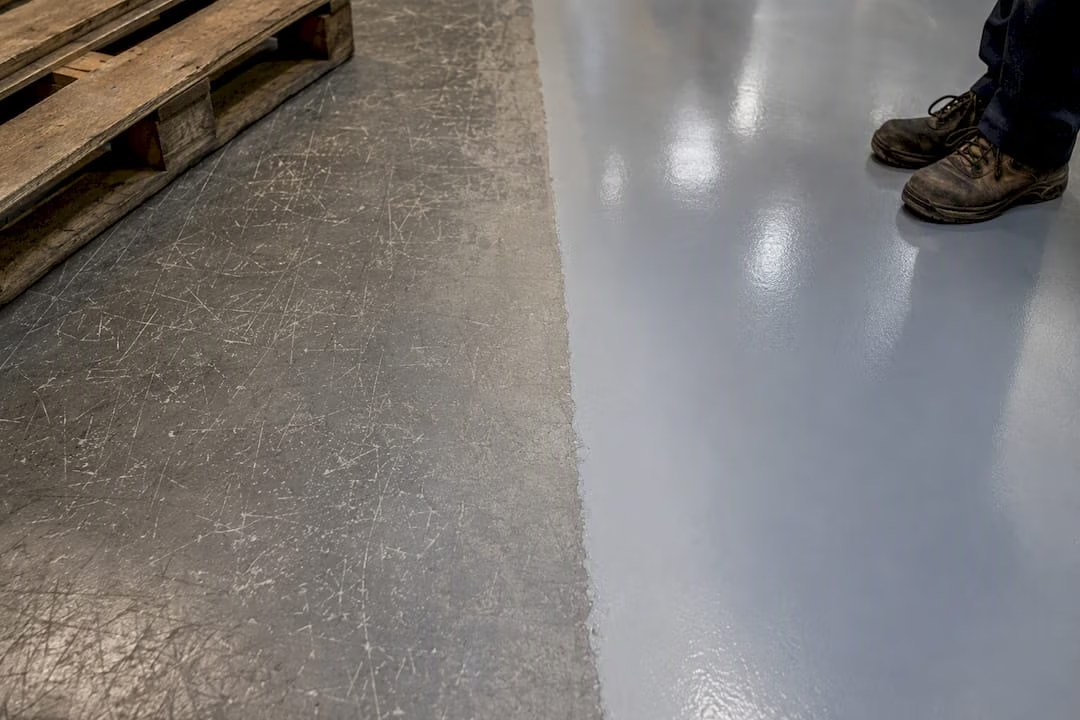
Chemical resistance depends entirely on what actually spills. Epoxy tolerates solvents, hydraulic oils and most industrial cleaning fluids well, which is why vehicle workshops and manufacturing plants favour it. Organic acids are epoxy’s weak point. Lactic acid from dairy processing, or the acidic residue from fruit and vegetable handling, will attack epoxy over time, whereas polyurethane resists this category comfortably.
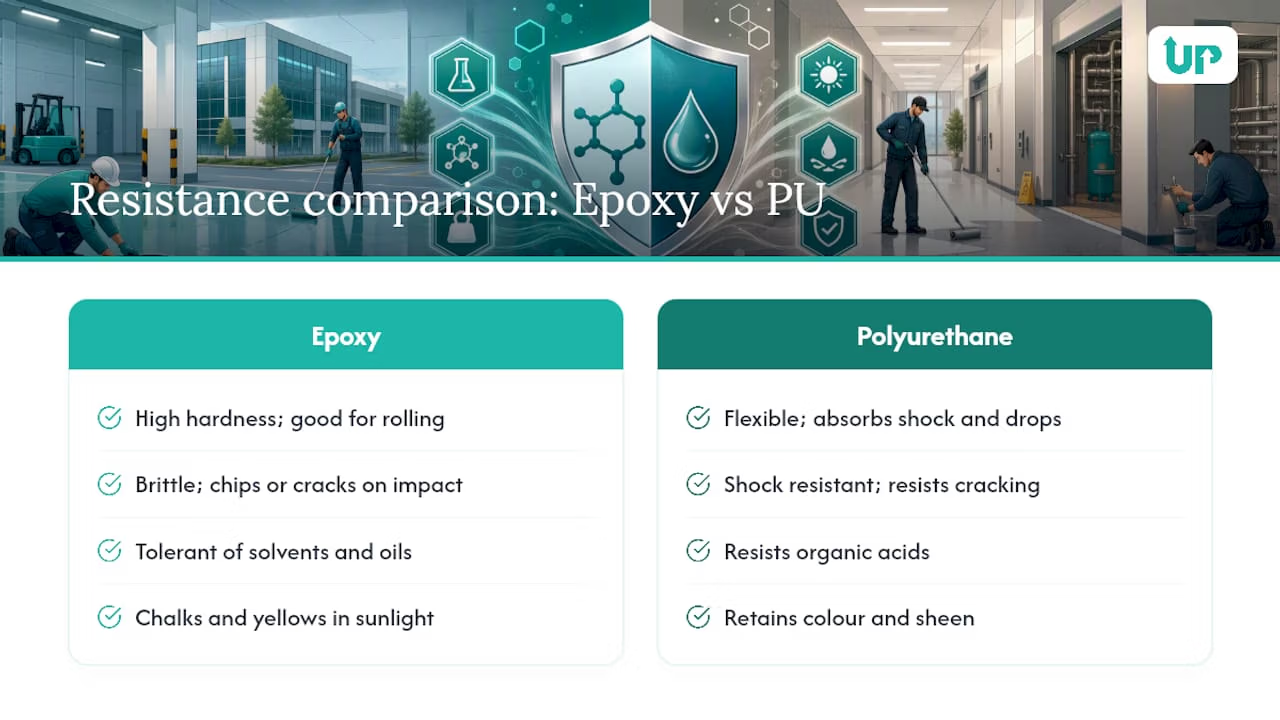
Thermal tolerance is where the two diverge most sharply. Epoxy has a relatively high coefficient of thermal expansion relative to concrete and performs poorly under repeated thermal shock, the kind produced by a hot steam clean followed by cold storage re-entry. Polyurethane mortar systems, particularly heavy-duty urethane concrete builds, tolerate service temperatures up to around 120°C and handle rapid temperature swings without delaminating, which explains their dominance in brewery and dairy specifications.
UV stability rounds out the picture. Standard epoxy chalks and yellows under sustained sunlight within months, a cosmetic issue rather than a structural one, but a visible failure that undermines showroom or reception-area finishes. Aliphatic polyurethane retains colour and sheen for years under the same conditions, making it the sensible default for any floor with meaningful natural light exposure.
System types, thicknesses and expected cure and downtime
Epoxy systems range from thin coatings around 200 to 300 microns, suited to light-duty offices and retail, through to self-smoothing systems of 2 to 4mm for medium and heavy industrial traffic. Polyurethane mortar systems typically run 4 to 9mm, built to withstand the heaviest duty categories and constant washdown.
System thickness must match the duty rating set out in BS 8204-6, which classifies flooring by light, medium, heavy and very heavy traffic intensity. Specifying a thin coating on a very heavy duty warehouse floor is one of the most common causes of premature failure, and it is entirely avoidable with a proper survey.
Cure times vary by system. MMA hybrid systems can take foot traffic within one to two hours, while standard epoxy and polyurethane typically need 12 to 24 hours before foot traffic and up to seven days before full chemical service resumes. Substrate moisture also dictates what happens before any resin goes down: BS 8203 and BS 8204-6 set acceptance criteria around 75% relative humidity or 4.5% moisture by weight for sand and cement screeds. Damp substrates above these limits need a specialist primer or damp-proof membrane before any coating is viable.
Cost, lifespan and maintenance expectations
Epoxy coatings and self-smoothing systems generally carry a lower installed cost than polyurethane mortar systems, largely because PU mortars use more material per square metre and often demand faster, more specialist installation. Anti-slip broadcast, decorative flake finishes and fast-cure MMA hybrids all push the price upward regardless of binder chosen. As an indication, expect roughly £15-£35 per m² for an epoxy coating, £35-£70 per m² for epoxy self-smoothing and £60-£120 per m² for polyurethane mortar, before any substrate repairs.
Lifespan depends less on the binder itself than on how well it was specified. A correctly specified epoxy or PU floor in the right environment can last well over a decade. Poor substrate preparation, incorrect thickness for the duty class, or chemical exposure the system was never designed to handle will shorten that considerably, sometimes to a few years.
Routine maintenance is similar for both: regular cleaning with appropriate chemicals, prompt touch-up of chips or scratches, and recoating cycles typically every five to ten years depending on traffic intensity.
How to choose: decision checklist and contractor questions
Before commissioning any resin floor, work through this checklist:
- What is the traffic and duty rating (light, medium, heavy, very heavy per BS 8204-6)?
- What chemicals, acids or cleaning agents will the floor face regularly?
- Is there a washdown regime, and how hot does the water get?
- Does the area experience thermal cycling or direct UV exposure?
- How much downtime can the business tolerate during installation?
- What is the realistic budget against expected lifespan?
Ask any contractor for their substrate moisture test results, the proposed system build and thickness, expected cure times, and a written warranty with a maintenance plan. Request references from similar installations.
Pro Tip: Treat a single-coat, unspecified quote for a heavy-duty warehouse as a red flag. So is a contractor who skips moisture testing entirely. Both are shortcuts that show up as failures within a year.
UpKeep UK’s view: why the survey decides the outcome
Most floor failures trace back to skipped substrate checks, not bad binder choice. A proper survey, measuring moisture, assessing operational conditions and matching thickness to duty class, is what actually prevents cracking, delamination and early recoating. UpKeep UK has applied this same specification-first discipline across large commercial refurbishments, including the Barbican restoration, where getting the groundwork right mattered as much as the finish.
– Drahim Hasula, UpKeep UK
Get a resin flooring survey from UpKeep UK
UpKeep UK gives London property managers and facilities teams a direct route from uncertainty to a specified, installed floor, without juggling separate surveyors, specifiers and installers. We handle the site survey, system specification and installation management, working with specialist resin installers where a system calls for it, and can add the floor to an ongoing maintenance contract so nothing falls between contractors.

To request a survey or quote, have your floor area in square metres, current substrate type and any operational constraints (washdown regime, chemical exposure, downtime tolerance) ready. That gives us enough to recommend the right binder and thickness rather than guessing from a phone call. See our commercial renovation and fit-out services, get in touch or call 020 3148 8884 to arrange a site visit.
Sources
BS 8204-6 sets the duty class specification rules for resin flooring, and BS 8203 governs substrate moisture limits.