Under CDM 2015, every commercial client must make suitable arrangements to manage health and safety on their construction projects, however small. That means providing pre-construction information, appointing a principal designer and principal contractor in writing when more than one contractor is involved, making sure a construction phase plan and welfare facilities are in place before work starts, keeping a health and safety file, and notifying HSE when a project crosses the notification threshold.
These duties apply just as much to a roof repair on a managed block or a three-day shopfit as to a major refurbishment, which is where many landlords and property managers get caught out. This guide explains who counts as a commercial client, what each duty involves in practice, and gives you a six-step checklist to follow on every project. UpKeep UK supports commercial clients across London with CDM-compliant project management, from pre-construction information packs to the health and safety file at handover.
TL;DR:
- Commercial clients must provide pre-construction information, appoint competent dutyholders, and ensure a construction phase plan before work begins, regardless of project size.
- Notifiable projects require in writing notification to HSE before starting, if they last over a month with many workers or involve extensive person-days of work.
- Failure to appoint a principal designer or contractor before site activity starts results in legal liability and the assumption of those duties by the client.
- Maintaining up-to-date health and safety files, welfare facilities, and reviewing arrangements regularly are essential to stay compliant throughout the project.
- Smaller operators often underestimate their ongoing liability and should establish solid documentation practices, appointing dutyholders early and verifying competence continuously.
Table of Contents
- Who counts as a commercial client, and when do CDM duties apply?
- What the duty to make suitable arrangements actually involves
- Notifiable projects: when you must tell HSE
- Appointing dutyholders and checking they’re competent
- A practical checklist for meeting CDM client duties
- Common pitfalls and how to reduce your exposure
- UpKeep UK’s perspective: turning CDM duties into a working process
- Why clients underestimate their own liability
- Sources
Who counts as a commercial client, and when do CDM duties apply?
A commercial client under the Construction (Design and Management) Regulations 2015 (SI 2015/51) is any organisation or individual for whom a construction project is carried out as part of a business, whether that business is running a shopping centre, managing a block of flats, or operating a hotel. A domestic client, by contrast, is a homeowner having work done on their own house with no connection to trade or business; in that case, most CDM duties transfer to the contractor or principal contractor.
The distinction that trips up property managers most often is scale. Duties apply to all commercial projects, regardless of size and duration, so a landlord replacing guttering on a retail unit carries the same legal obligations, in principle, as a developer building an office block.
That means commercial clients need to think about CDM compliance for:
- A single contractor repairing a roof at a managed property
- A shopfitting job lasting a few days
- Reactive repairs commissioned after storm damage
- Planned maintenance contracts renewed annually
Industry commentators note that clients often assume CDM only applies to large builds. In reality, small maintenance works can create the same legal obligations for a commercial client as a multi-million-pound refurbishment.
What the duty to make suitable arrangements actually involves
Regulation 4 is the backbone of client duty under CDM 2015. It requires you to make suitable arrangements for managing your project, ensuring that health and safety is considered from planning through to completion, not bolted on once work starts. In practice, this means allocating enough time and budget so that competent contractors can plan properly, rather than squeezing a tender timetable so tight that safety planning gets skipped.
Pre-construction information must be pulled together before you appoint anyone and passed to designers and contractors early. It should cover:
- Known site hazards, including previous incident history
- Asbestos surveys and any hazardous materials records
- Records of buried or hidden services (gas, water, electrical)
- Access constraints, working hours restrictions, and neighbouring occupier considerations
Providing this information early materially reduces cost and programme risk later, and it is a legal expectation under CDM 2015, not a courtesy.
Pro Tip: Keep a standing pre-construction information pack for each managed property, updated after every project. It saves you rebuilding the same asbestos and services records from scratch every time a new contractor comes in.
A construction phase plan, prepared by the principal contractor (or contractor, on single-contractor jobs) before work starts, sets out how the site will be managed safely day to day. You should never allow work to begin without sight of this plan.
Where more than one contractor is involved, a health and safety file becomes a legal requirement. It records information future contractors will need for maintenance, alteration, or demolition, and it must stay available and be revised whenever the building changes.
Regulation 4 also requires clients to ensure a construction phase plan and health and safety file are prepared and maintained throughout the project, not just at the outset. Welfare facilities, toilets, washing facilities, drinking water, and rest areas, must be in place before construction starts, and clients should confirm this rather than assume the contractor has sorted it.
Notifiable projects: when you must tell HSE
Some projects cross a legal threshold that triggers a formal notification duty. A project is notifiable if either of the following applies:
- Construction work will last longer than 30 working days and have more than 20 workers working at the same time at any point.
- The project will exceed 500 person days of construction work.
If your project meets either threshold, you (or someone appointed on your behalf, often the principal contractor) must notify HSE in writing using form F10 before construction work begins, and a copy of that notification must be displayed in the site office where workers can see it. Delegating the notification task is fine, but you remain accountable for it happening, so keep a copy on file as evidence.
Appointing dutyholders and checking they’re competent
Where more than one contractor will be on site, you must appoint a principal designer and a principal contractor in writing before the construction phase begins. Both appointments should be confirmed before design work or site activity starts, not retrospectively once someone is already on site.
Skipping this step doesn’t remove the duty. If you fail to appoint a principal designer or principal contractor, you take on those duties yourself, along with the legal liability that comes with them.
Assessing competence doesn’t need to be bureaucratic, but it should be documented:
- Request evidence of relevant experience on comparable projects
- Ask for references from previous clients, not just the contractor’s own case studies
- Check organisational capability: insurance, accreditation, health and safety policy
- Confirm the team proposed for your project, not just the company’s general track record
Pro Tip: Build competence checks into your appointment letter template so they happen automatically, rather than relying on memory each time you procure a new contractor.
Appointing dutyholders doesn’t end your responsibility either. Clients are expected to take reasonable steps to satisfy themselves that appointees keep complying with their duties throughout the project, not just at the point of appointment.
A practical checklist for meeting CDM client duties
- Prepare a client brief and gather pre-construction information, including asbestos surveys and services records, before you approach the market.
- Allocate realistic time and budget, and build procurement expectations around this rather than working backwards from an arbitrary deadline.
- Appoint dutyholders in writing, verifying competence against the checks above before signing anything.
- Require a construction phase plan and confirmed welfare arrangements before work starts on site, no exceptions.
- Insist on a health and safety file where more than one contractor is involved, and agree handover arrangements at the outset, not at completion.
- Maintain records and review arrangements at regular intervals throughout the project, not only at the start and end.
HSE’s guidance for clients emphasises that your greatest influence over safety outcomes comes right at the start of a project, through decisions on procurement, budget, and timescale. Get that sequence right and the rest of the checklist becomes far easier to follow.
Common pitfalls and how to reduce your exposure
Most CDM enforcement problems trace back to decisions made weeks before anyone picked up a tool. Watch for these:
- Vague tender wording that omits pre-construction information, leaving contractors to guess at hazards.
- Compressed procurement timetables that don’t leave room for a proper construction phase plan.
- No written appointment of a principal designer or principal contractor when more than one contractor is on site.
- Missing or outdated health and safety files, discovered only when a future contractor needs them.
HSE typically enforces against clients where these gaps caused, or could have caused, harm, and outcomes range from improvement notices to prosecution in serious cases. Sensible mitigation is unglamorous but effective: keep documentation current, make appointments early, record competence checks in writing, and hold regular review meetings rather than treating CDM as a one-off box to tick.
UpKeep UK’s perspective: turning CDM duties into a working process
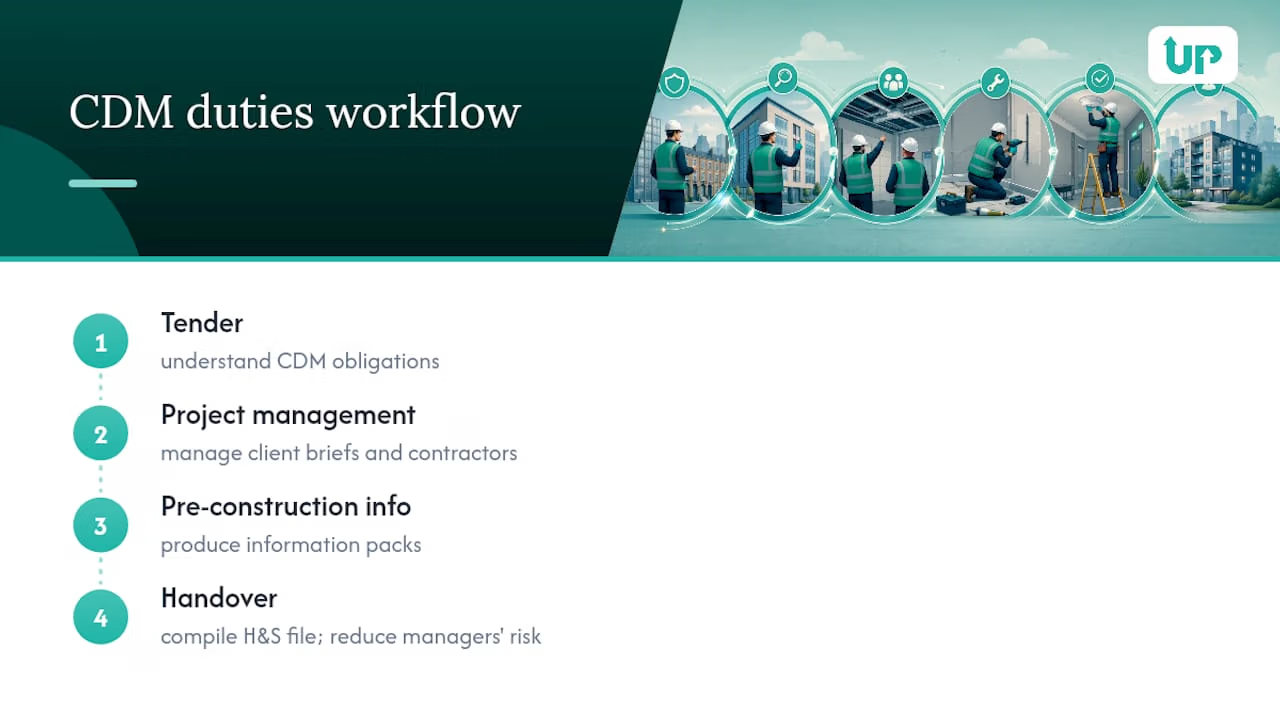
UpKeep UK supports commercial clients with the project management, client briefs and handover documentation that CDM duties demand in practice. As your contractor, we take on much of the administrative load, from pre-construction information requests to compiling the health and safety file, which reduces risk for property managers juggling multiple sites. We are SafeContractor and SSIP accredited. If you need a delivery partner who understands CDM obligations from tender to handover, see our commercial renovation and fit-out services or call 020 3148 8884.
Why clients underestimate their own liability
Most guidance on CDM client duties reads like a compliance checklist, and that’s precisely the problem. Treating regulation 4 as paperwork to file rather than a management discipline is why so many commercial clients get caught out. The regulations don’t ask you to become a safety expert. They ask you to make decisions, on time, budget, and who you appoint, that give competent people the room to do their jobs safely.
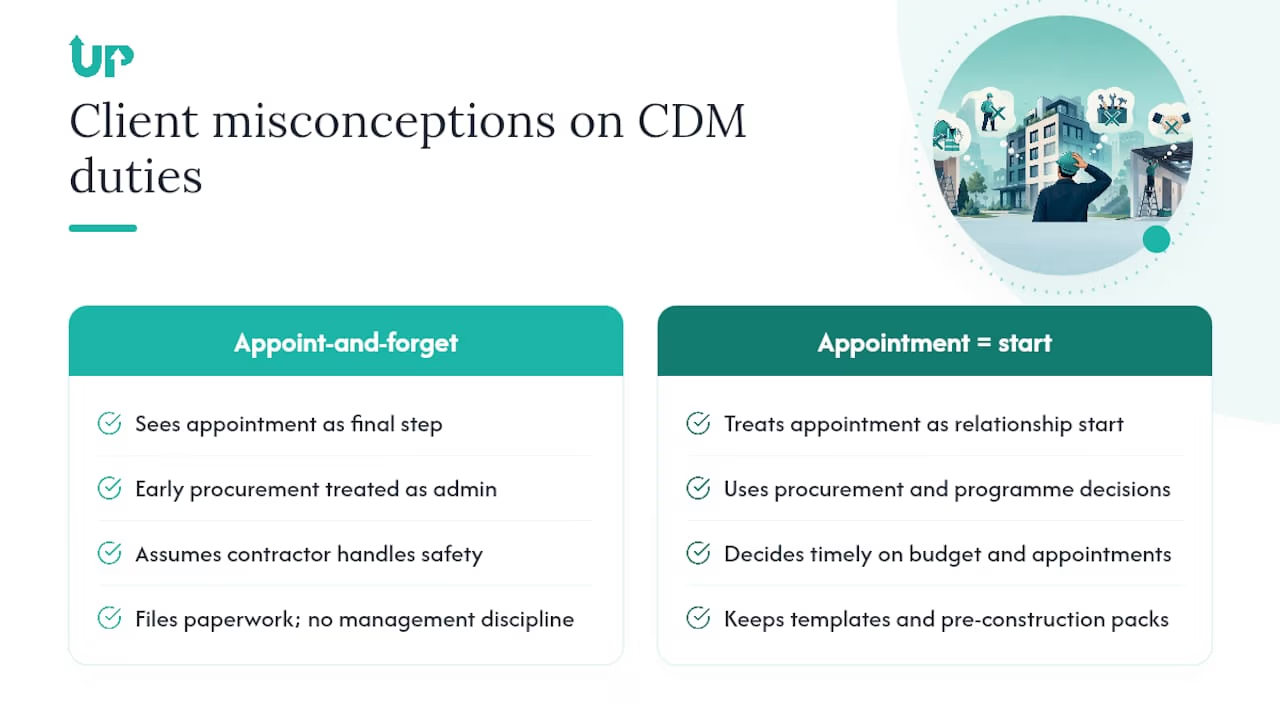
The gap we keep seeing is between clients who appoint a principal contractor and assume the job is done, and clients who understand that appointment is the start of an ongoing relationship, not the end of their obligation. HSE’s own framing backs this up: client influence peaks at the start of a project, through procurement and programme decisions, yet many clients treat those early weeks as administrative throat clearing rather than the point where safety outcomes actually get decided.
Smaller commercial clients are particularly exposed, not because the law treats them differently, but because they often lack the internal resource that a large developer takes for granted. A landlord with one retail unit and a maintenance contract doesn’t have a health and safety team on staff. That is precisely why documentation habits (standing pre-construction information packs and template appointment letters with competence checks built in) matter more for smaller operators than for anyone else. The regulations don’t scale down their expectations just because your portfolio is modest. Building the habit once, and repeating it on every project, is the difference between compliance that holds up under scrutiny and compliance that only looks good on paper.
– Drahim Hasula, UpKeep UK
This article is general information, not a substitute for advice from a qualified lawyer. Consult a qualified legal professional about your own circumstances before acting on anything here.
Sources
- Commercial clients: roles and responsibilities
- The Construction (Design and Management) Regulations 2015