The duty to manage asbestos sits with the dutyholder: whoever owns a non-domestic building, or is responsible for maintaining or repairing it under a contract or tenancy. That can be the landlord, the managing agent, the facilities manager or a tenant with repair obligations, and in many London buildings it is more than one of them. The stakes are real. HSE says asbestos is the single greatest cause of work-related deaths in Great Britain, with over 5,000 deaths a year, from diseases that can take 15 to 60 years to appear.
This guide is for commercial landlords, managing agents and facilities managers of London offices, shops, hotels and block common parts built before 2000. It explains who the dutyholder is, what the law requires, which survey you need and what to check before anyone drills a wall or starts a fit-out. It is general guidance, not legal advice. For your own building, take advice from a competent asbestos surveyor or a health and safety professional.
Key takeaways
- If you have any obligation to maintain or repair a non-domestic building or the common parts of a block, you are likely a dutyholder, and the duty can be shared.
- You must presume materials contain asbestos unless you have strong evidence they do not, then survey, keep a register, assess the risk, and run a written plan that you review at least every 12 months.
- A management survey covers normal occupation. Before drilling, refurbishment or a fit-out you need a refurbishment and demolition survey of the affected area.
- Share the register with anyone who could disturb asbestos, including contractors and emergency services. A survey sitting in a drawer is not compliance.
- You stay responsible for choosing competent contractors, and HSE has prosecuted companies that did not.
Who is the dutyholder?
Regulation 4 of the Control of Asbestos Regulations 2012 defines the dutyholder as every person who, through a contract or tenancy, has an obligation of any extent to maintain or repair non-domestic premises. Where nobody has such an obligation, the duty falls on whoever controls the premises.
In practice that produces several overlapping dutyholders:
- The freeholder or landlord of an office, shop or hotel they let out.
- The managing agent, where the lease or management agreement hands them repair and maintenance responsibilities.
- A tenant with a full repairing lease, for the part they occupy.
- The facilities manager of an owner-occupied building.
The duty is not diluted by being shared. It has to be written down. Your management plan should name who does what, including an appointed person and deputies to cover absences, so that nobody assumes someone else has it in hand.
Which buildings are covered
According to HSE’s guidance on the relevant law, the duty applies to all non-domestic buildings and to the common parts of multi-occupancy domestic premises, such as hallways, stairwells and plant rooms in blocks of flats. It does not apply to an individual private home. That matters if you manage residential blocks: the flats themselves are outside the duty, but the corridors, bin stores, risers and boiler rooms are not.
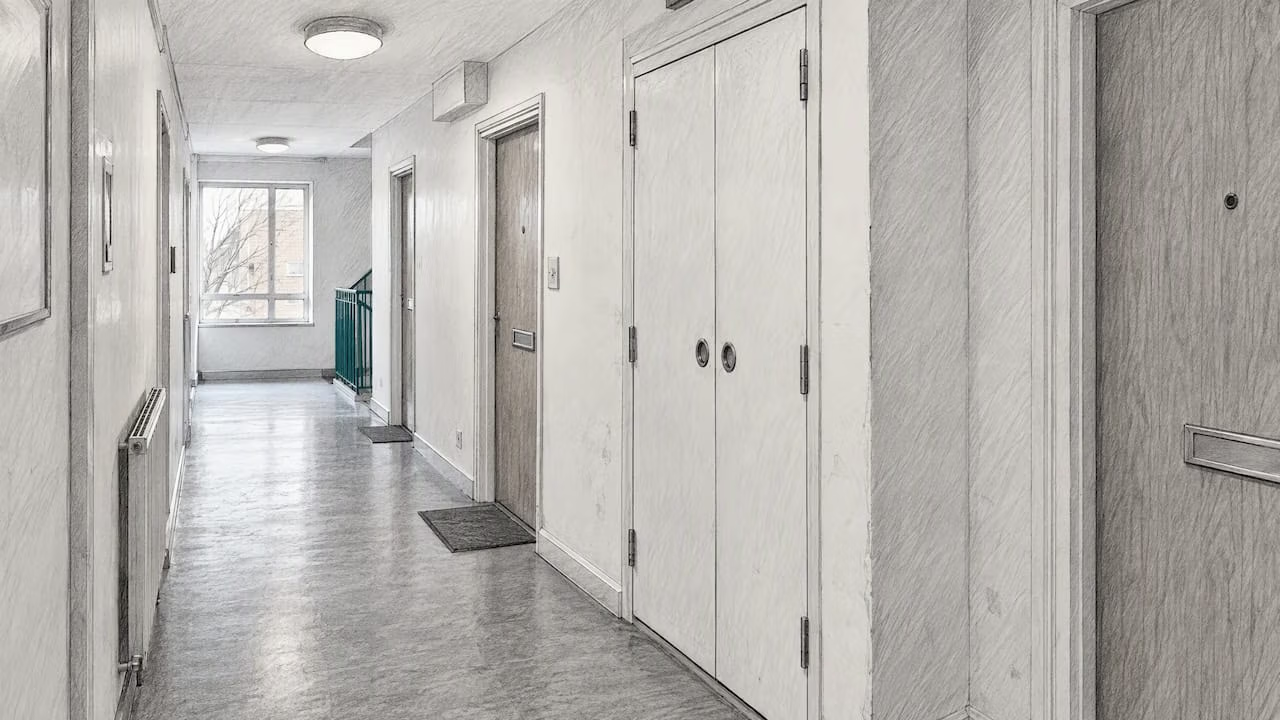
Why the year 2000? Blue and brown asbestos were prohibited in 1985 and white (chrysotile) asbestos was banned in 1999. A building constructed or refurbished before 2000 can therefore contain asbestos-containing materials (ACMs), and in London, with its large stock of Victorian, interwar and 1960s to 1980s commercial buildings, that describes a great deal of what we maintain.
What the duty to manage requires
HSE sets out the duty as a sequence of steps on its dutyholder pages. Treat them as a cycle, not a one-off project.
- Presume. Treat materials as containing asbestos unless you have strong evidence that they do not.
- Find out. Arrange a survey, or presume asbestos throughout and take full precautions for all work. In most multi-room commercial buildings a survey is the more practical route.
- Keep a register. Record the location, amount, type and condition of every known or presumed ACM.
- Assess the risk. Look at how likely each material is to be damaged or disturbed, and how badly it has deteriorated.
- Write a management plan. Set out the procedures to manage those risks, who is responsible and how work is controlled.
- Review it. Review the plan at least every 12 months, or sooner if there is reason to think it is no longer valid, for example after a refurbishment, a change of use or a new finding.
- Share the information. Tell anyone who might disturb the asbestos where it is.
HSE’s overview adds a point that surprises some owners: where ACMs are in good condition and unlikely to be damaged, they should generally be left in place and the risk managed. The duty is about control, not automatic removal. Removal becomes necessary when materials are damaged, cannot be protected, or will be affected by planned work.
What a good register and plan contain
A register that only lists “asbestos present” is not much use to a plumber on a Friday afternoon. Aim for:
- A floor-by-floor plan marking each ACM and any presumed material.
- The material type, product, approximate quantity and condition.
- Any sampling results, and the areas the surveyor could not access.
- A priority or risk score, and the action decided for each item.
- Labelling or marking arrangements where appropriate.
HSE publishes an example asbestos management plan that shows the headings to cover, including the appointed person and deputy. Scale it to the size of your portfolio.
Sharing the register: contractors and emergency services
HSE’s page on providing information to anyone who might disturb asbestos is explicit that the people who could disturb ACMs must be told. That means electricians, plumbers, data cablers, fire alarm installers, ceiling contractors and fit-out teams, and it should be done before they start, not on arrival.
Emergency services are easy to forget. HSE guidance on the management plan covers procedures for emergency services, and a common weakness is a plan that never considers them or is never tested. Try the plan against realistic scenarios: a burst pipe above a suspended ceiling, a fire alarm upgrade, a ceiling collapse after a leak. If your plan cannot tell the person on site what to do in those moments, it needs work.

Management survey or refurbishment and demolition survey?
The single most common mistake is using the wrong survey for the job. HSE’s guidance on arranging a survey distinguishes two types, and the survey guide HSG264 describes them in detail.
| Management survey | Refurbishment and demolition survey | |
|---|---|---|
| Purpose | Locate ACMs that could be disturbed during normal occupation and routine maintenance | Locate all ACMs in the area affected before refurbishment or demolition |
| When | Day-to-day occupation, the basis of your register | Before any structural work, major refurbishment, fit-out or demolition |
| Intrusiveness | Largely non-intrusive, with some sampling and minor disturbance | Fully intrusive, which can mean opening up fabric to find hidden materials |
| Area | The whole building where practicable | The area to be worked on, which may need to be vacated |
| Limitation | Will not find everything hidden behind or within the structure | Must be completed before work starts |
| Output | Feeds the register and management plan | Informs removal and control measures before contractors begin |
A management survey is sufficient for occupation but inadequate before intrusive work, because it is not designed to find asbestos hidden in ducts, risers, floor voids or behind linings. If your fit-out will strip ceilings, open walls or take out partitions, you need the refurbishment and demolition survey first, and the area typically needs to be empty while it is done.
Before any drilling or fit-out: a checklist
Use this before a tenant’s fit-out, a refit of a shop unit, a hotel bedroom refurbishment, or even a cabling job through a riser.
- Pull the register and plan. Check whether the area is covered, when the survey was done and whether it has been updated since.
- Confirm the survey type. If the work is intrusive, commission a refurbishment and demolition survey of the affected area. Do not rely on a management survey.
- Define the scope in writing. Tell the surveyor exactly which walls, ceilings, floors and services will be touched.
- Act on the findings before work starts. Where ACMs will be disturbed, arrange for them to be dealt with first. Some work needs a licensed contractor, so take specialist advice on which, and check the contractor’s credentials.
- Brief every trade. Give each contractor the relevant register extract, and get a signed acknowledgement.
- Stop-work rule. Make clear that anyone who finds suspect material stops, leaves it alone, reports it and waits for instruction.
- Check the construction duties. Larger jobs raise questions under the Construction (Design and Management) Regulations 2015. Our guide to CDM client duties for property managers covers what a client must arrange.
- Update the register afterwards. Record what was found, removed or encapsulated, and review the plan.
None of this is optional extra paperwork. It is the difference between chaos and control on the day a drill hits a hidden board.
Why a survey alone is not compliance
HSE’s March 2026 prosecution makes the point. Two companies and a site manager were prosecuted after a large-scale asbestos disturbance. One company had not appointed a principal contractor as the Construction (Design and Management) Regulations 2015 require, and the case centred on a refurbishment and demolition project where asbestos was disturbed. The lesson for dutyholders is that commissioning a survey is only the beginning. You are also expected to act on it and to choose competent people to do the work.
The human cost is why HSE enforces this. Compensation routes such as Industrial Injuries Disablement Benefit and the Diffuse Mesothelioma Payment Scheme exist, but they are a last resort. They do not reverse a disease that cannot be cured.
Our perspective: where the duty usually breaks down
We maintain and refit pre-2000 commercial and residential buildings across London, so we see the same weak points repeatedly, and they are rarely about the survey itself.
The register is not where the work is ordered. A survey exists, but the person raising a job for a leaking valve has never seen it. We think the register should be attached to every work order for a pre-2000 building, so that the check happens by default rather than by memory.
Reactive jobs bypass the plan. Planned work gets briefed. A burst pipe at 6pm does not. That is why we believe the plan has to cover reactive and emergency repairs from the start, with the register available to whoever attends.
Responsibility is assumed, not assigned. Landlord, agent and tenant each think another party has it. Name an appointed person and a deputy, and write down who commissions surveys and who briefs contractors.
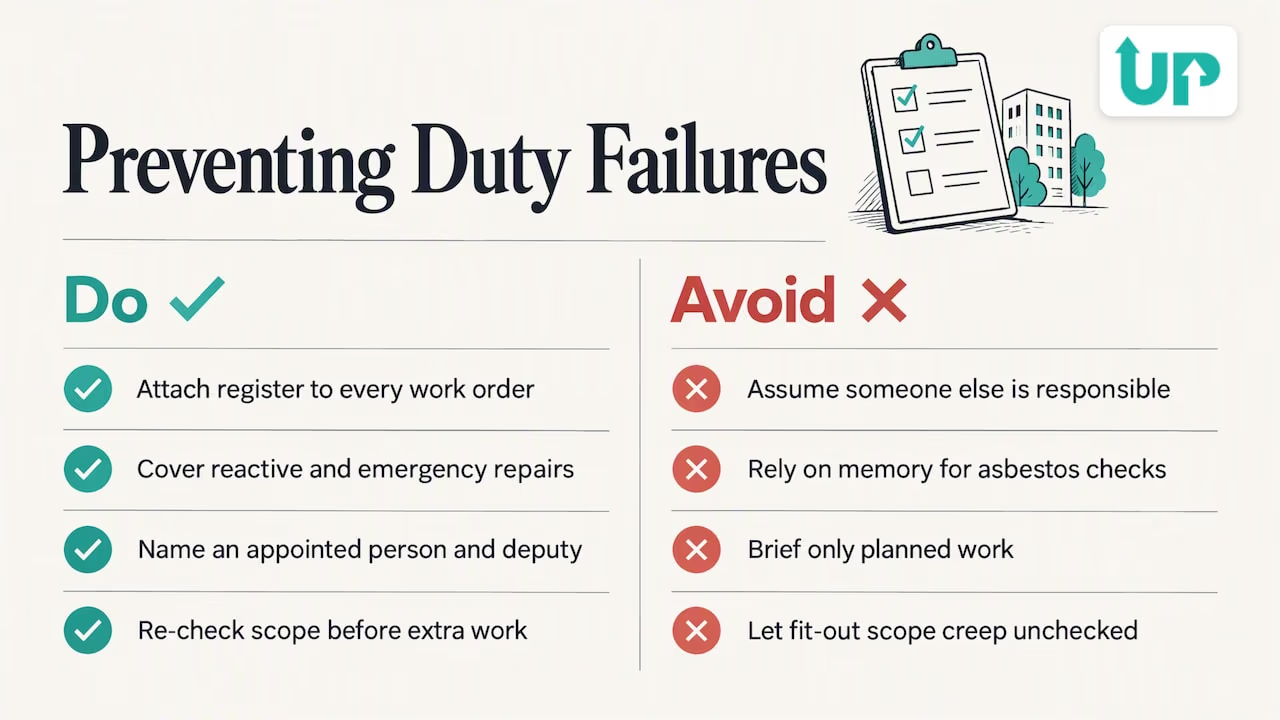
Scope creep in fit-outs. A tenant’s “simple” refit grows to include ceiling removal. If the survey scope was set for the original job, it no longer fits. Re-check before the extra work begins.
Our approach is to keep all trades under one contract with one accountable contact, so the information flow is simple: register in, briefing out, photo progress reports back. We are not a substitute for a competent asbestos surveyor or your own legal advice, but we can make sure the asbestos information reaches the people holding the tools.
— Drahim Hasula
Keeping the duty alive through planned maintenance
The annual review is easiest to keep when it sits inside a maintenance calendar rather than a separate reminder. Our planned maintenance service schedules inspections and servicing across all trades under one agreement, which gives you a natural point to check the register against the work programme, record any damage to known materials and update the plan.
For a block, the same logic applies to common parts. Our block management service covers the communal areas where the duty to manage still applies even though the flats do not. Asbestos sits alongside other statutory obligations, such as fire safety for London landlords and Legionella risk assessments, and handling them in one calendar reduces the chance that one slips.
Planning a fit-out in a pre-2000 building
If you are about to refit offices, a retail unit or hotel areas, build the asbestos checks into the programme before you price the work. Our team delivers commercial renovation and fit-outs for London businesses, and our published guide rate for commercial fit-out is 30 to 80 £ per sq ft as a one-off cost, with the final figure depending on the scope. Allow time and budget for the refurbishment and demolition survey and any follow-up action, because they come first and can change the sequence of the job.
If you would like to talk through a building before work starts, you can reach us through the UpKeep UK website.
FAQ
What is Regulation 4 of the Control of Asbestos Regulations 2012?
It is the duty to manage asbestos in non-domestic premises. It applies to anyone with an obligation, by contract or tenancy, to maintain or repair such premises, and it requires you to find out whether asbestos is present, assess the risk and manage it. The regulation is published on legislation.gov.uk.
Does the duty to manage apply to a block of flats?
It applies to the common parts of multi-occupancy domestic premises, such as hallways and stairwells, but not to the individual flats. The person responsible for maintaining or repairing those common parts is the dutyholder. Anyone planning work in a flat built before 2000 should still make sure asbestos is not disturbed without proper assessment.
How often must an asbestos management plan be reviewed?
HSE says the plan should be reviewed at least every 12 months, and sooner if there is reason to think it is no longer valid. Typical triggers are a refurbishment, a change in condition of a known material or a new survey finding. Record each review.
Is a management survey enough before a fit-out?
No. A management survey is designed for normal occupation, not for work that opens up the structure. Before drilling, stripping out or refurbishing, HSE guidance calls for a refurbishment and demolition survey of the affected area.
Sources
- HSE: Introduction to asbestos safety, overview
- HSE: The duty to manage asbestos in buildings
- HSE: Relevant law
- The Control of Asbestos Regulations 2012, Regulation 4
- GOV.UK: Asbestos general information
- HSE: Arrange an asbestos survey
- HSE: Asbestos, the survey guide HSG264
- HSE: Write your asbestos management plan and monitor it
- HSE: Example asbestos management plan
- HSE: Provide information to anyone who might disturb asbestos
- HSE Media Centre: Two companies and site manager prosecuted following large-scale asbestos disturbance
- GOV.UK: Industrial Injuries Disablement Benefit, other benefits