

The JCT Design and Build Contract 2024 (DB 2024) is the current edition, and it puts design completion and coordination in the contractor’s hands for a lump-sum price. It suits employers who want programme certainty and one point of contact for design and construction, provided the Employer’s Requirements are drafted properly and the Employer’s Agent is treated as a specialist appointment.
This guide is written for employers, landlords and developers commissioning extensions, refurbishments and fit-outs in England. It covers what changed in the 2024 edition, who is responsible for design, the Employer’s Agent role, payment and termination traps, and a drafting checklist to work through before you sign. UpKeep UK delivers design and build refurbishment projects across London, so the practical points come from live projects as well as the contract wording.
TL;DR:
- The good faith clause in DB 2024 shifts the dispute landscape, especially if Employer’s Requirements are vague or poorly drafted.
- The contract’s expanded Relevant Events list increases liabilities for unforeseen discoveries like asbestos or epidemics, requiring careful risk assessment.
- Employers must rigorously review and specify the Employer’s Requirements and appointment scope of the Employer’s Agent before tender to prevent ambiguity.
- Failing to adhere to strict payment notice deadlines can lead to full payment of disputed sums, emphasizing disciplined administration of interim payments.
- Proper termination procedures are critical, with specific notice steps for both employer and contractor to avoid wrongful termination claims.
Table of Contents
- What the JCT design and build contract is and when to use it
- Key changes in the 2024 edition every stakeholder must know
- Who is responsible for design: Employer’s Requirements vs Contractor’s Proposals explained
- The Employer’s Agent: appointment, powers and practical management tasks
- Payment, interim applications and timeline traps to avoid
- Negotiation and drafting checklist: clauses to check or amend before you sign
- Common pitfalls and dispute triggers, including the new good faith obligation
- How UpKeep UK’s practical experience applies to JCT design and build projects
- Termination clauses specific to the Design and Build contract
- Comparison with other procurement routes and standard JCT contracts
- Risk allocation and management under JCT design and build
- Time management and programming obligations
- What the DB 2024 changes mean for employers in 2026
- Delivering your design and build project with UpKeep UK
- Selected primary sources and guidance for further reading
- Sources
- FAQ
What the JCT design and build contract is and when to use it
JCT Design and Build is built around a simple trade: the employer hands over design responsibility, and gets a single point of accountability in return. Once the contractor accepts the brief, they own the risk of turning it into a working building. That is the core difference from the JCT Standard Building Contract, where the employer’s own architect or engineer retains design control and the contractor simply builds to their instructions.
Employers usually choose DB 2024 when they want:
- A fixed lump sum agreed before work starts, rather than open-ended design development costs.
- One party responsible for both design and construction, cutting down finger-pointing between architect and builder.
- Faster procurement, because tender packages can be issued on performance requirements rather than fully worked drawings.
This makes DB 2024 a natural fit for extensions, fit-outs, hotel refurbishments, and speculative commercial developments where the employer knows the outcome they want but is happy to let the contractor’s design team work out the detail. It is less suited to heritage or highly bespoke residential projects where the employer wants tight control over every design decision.
Key changes in the 2024 edition every stakeholder must know
DB 2024 is not a cosmetic update. Walker Morris’s commentary on the JCT Design and Build Contract 2024 sets out several changes that alter how projects are administered and how disputes might unfold.
- A new good faith / collaborative working clause, which asks parties to act reasonably and cooperatively rather than purely by the letter of the contract.
- Building Safety Act 2022 alignment, touching dutyholder roles, building information requirements, and the wider golden thread of information obligations.
- Expanded Relevant Events and Relevant Matters, now covering epidemics and unforeseen discoveries such as asbestos or unexploded ordnance.
- Modernised administration, including electronic notice provisions and sustainability reporting requirements.
Expert view: Legal commentary from Mayer Brown flags the good faith obligation as a potential new vector for disputes, as parties test whether it offers remedies where traditional contractual routes are closed off.
Timing windows for extension-of-time responses have also tightened in places, which means calendar discipline matters more under DB 2024 than under earlier editions.
Who is responsible for design: Employer’s Requirements vs Contractor’s Proposals explained
The Employer’s Requirements (ER) set out what the employer wants: the brief, performance standards, and any fixed design elements. The Contractor’s Proposals (CP) are the contractor’s response, and once the contract is signed, the CP becomes the working benchmark against which the finished building is judged.
Here is the catch many employers miss: clause 2.15 makes clear that the contractor is not responsible for the adequacy of the Employer’s Requirements. If the ERs are vague, contradictory, or simply wrong, that risk sits with the employer, not the contractor. A contractor fulfilling a badly written brief to the letter has still met their contractual obligations, even if the outcome disappoints the employer.
Before tender, both sides should work through a short due-diligence sequence:
- Cross-check the ERs against any existing surveys, planning conditions, or statutory approvals already in place.
- Confirm which design elements are genuinely fixed versus open to contractor innovation.
- Identify any consultants being novated and record their existing scope and liability limits.
- Set out how design queries and clarifications will be logged and resolved during the CP stage.
Pro Tip: Never let “Employer’s Requirements” stay as a wish list. Every performance standard should be measurable, so a dispute about whether the contractor met the brief has an objective answer rather than a subjective argument.
The Employer’s Agent: appointment, powers and practical management tasks
On a Design and Build project, the Employer’s Agent effectively stands in the shoes of the independent contract administrator you would have on a traditional JCT form. That single appointment carries certifying, monitoring, and communication duties that shape how smoothly the whole project runs.
Core duties typically include:
- Issuing instructions and certifying interim payments on the employer’s behalf.
- Monitoring design development against the Employer’s Requirements.
- Managing variations, extension-of-time claims, and practical completion.
- Reporting progress and risk to the employer at agreed intervals.
Practitioners commonly advise treating this appointment as a specialist role rather than handing it to a general project manager with no JCT DB administration experience. Before appointing, confirm the scope of authority, reporting frequency, and professional indemnity cover in writing, so there is no ambiguity about what the Agent can decide alone versus refer back to the employer.
Payment, interim applications and timeline traps to avoid
Payment under DB 2024 runs on the familiar interim application cycle, tied to the Contract Sum Analysis that breaks the lump sum into stage values. The contractor applies, the Employer’s Agent certifies, and the paying party issues a payment notice or pay-less notice within tightly defined windows.
Watch out: Missing the payment notice deadline has direct financial consequences: under the payment notice mechanism inherited from the Construction Act, failing to serve a valid pay-less notice in time can oblige the paying party to pay the contractor’s applied sum in full, even if that figure is disputed.
To protect cashflow and avoid adjudication:
- Build payment notice deadlines into a shared project calendar, not just individual diaries.
- Issue early warnings the moment a certified sum looks likely to be challenged.
- Keep a clear audit trail of instructions and valuations to support any pay-less notice.
Negotiation and drafting checklist: clauses to check or amend before you sign
Signing DB 2024 without reviewing a handful of key clauses is where most avoidable disputes begin. Work through this sequence before anyone puts pen to paper:
- Tighten the ER scope. Ambiguity here becomes the employer’s problem later, not the contractor’s.
- Clarify novation terms. If existing consultants are being novated to the contractor, set out their liability limits and any collateral warranties explicitly.
- Check insurance and professional indemnity limits. Any amendment shifting fitness-for-purpose obligations onto the contractor is meaningless if the PI cover doesn’t match the transferred risk.
- Decide which Relevant Events and Relevant Matters apply. Confirm whether epidemics or change-of-law provisions should be included or narrowed for your project.
- Review retention, bonds, and limitation periods. These are often left at JCT default settings when a shorter or longer period would suit the project better.
Pro Tip: Ask your Employer’s Agent to mark up the standard form against your last two projects’ actual dispute history. Patterns from previous jobs are the best guide to which clauses genuinely need amending.
Remember that DB 2024 often sits alongside ancillary documents such as a Pre-Construction Services Agreement or a Framework Agreement, so check those terms line up with the main contract too.
Common pitfalls and dispute triggers, including the new good faith obligation
Most DB disputes trace back to the same root cause: ambiguous Employer’s Requirements that leave room for competing interpretations once work is underway. That ambiguity then feeds variations, extension-of-time claims, and arguments about whether the contractor properly verified inherited designs.
- Vague or contradictory ERs, leading to disputes over what was actually promised.
- Poor novation practice, where consultant liabilities are not clearly transferred or preserved.
- Reliance on inherited designs without adequate due diligence, a pattern seen in case examples such as WPL v ADI, where disputes turned on whether the contractor had properly checked design completeness.
- The new good faith clause being tested as a lever in negotiations, particularly where a party feels the traditional contractual route offers no remedy.
The fix is largely procedural discipline: sharper ER drafting, documented novation, and a habit of recording decisions as they happen rather than reconstructing them after a dispute starts.
How UpKeep UK’s practical experience applies to JCT design and build projects
Delivering a successful DB project depends on disciplined site management as much as good drafting. On refurbishment and fit-out projects, UpKeep UK’s project teams apply the same habits that keep DB contracts on track: vetting Employer’s Requirements before work starts, maintaining consistent site supervision, and running structured snagging and defects processes at handover.

That experience also shapes a practical judgement call: whether to let the contractor’s own design team run with the brief, or retain key designers directly and novate them later. UpKeep UK helps employers weigh that decision alongside CDM client duties and compliance obligations that sit around any Design and Build project.
Termination clauses specific to the Design and Build contract
DB 2024’s termination provisions give both employer and contractor defined routes out of the contract, but they are not interchangeable, and using the wrong one can undermine an otherwise valid claim.
The employer can generally terminate for contractor default, which includes suspending the works without reasonable cause, failing to proceed regularly and diligently, or becoming insolvent. Each ground has its own notice procedure: a specified default notice, a defined cure period, and a follow-up notice if the default continues. Skipping a step, or terminating before the cure period expires, can turn a valid termination into a wrongful one, exposing the employer to a claim for loss of profit.
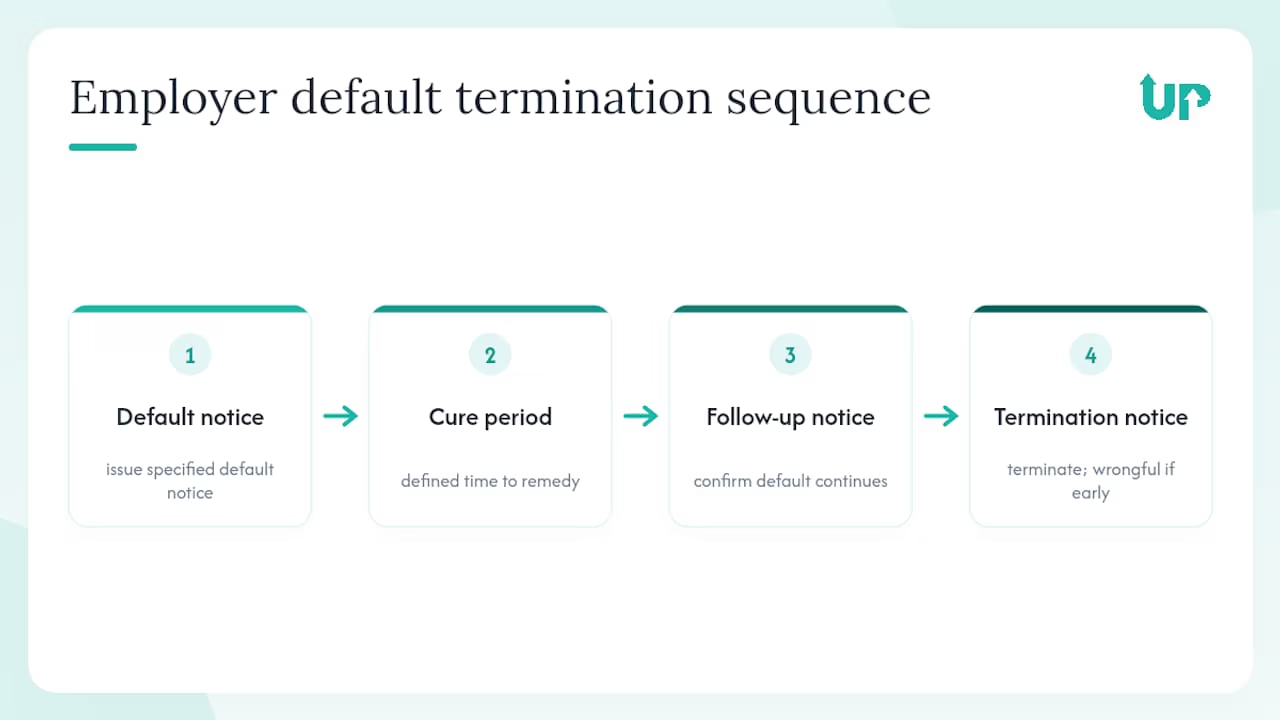
Contractors have a mirrored right to terminate for employer default, most commonly non-payment of a certified sum or prolonged suspension of the whole works by the employer. Either party can also terminate if the whole of the works is suspended for a long continuous period, stated in the contract, for reasons outside both parties’ control, such as force majeure.
Unlike some bespoke contracts, the standard JCT Design and Build form does not give the employer a general right to terminate for convenience. Employers who want that flexibility have to negotiate it as an amendment, usually with an agreed payment for work done plus the contractor’s reasonable demobilisation costs and lost profit, so budget for it rather than treating it as a free exit.
Whichever ground applies, the practical lesson is the same: follow the notice sequence exactly as drafted, because DB 2024’s termination mechanism is unforgiving of procedural shortcuts.
The courts take the same strict view. In Providence Building Services Ltd v Hexagon Housing Association [2026] UKSC 1, the Supreme Court held that a contractor could only rely on the repeated late payment ground in clause 8.9.4 if it had first acquired a right to terminate under clause 8.9.3. Because the employer had cured the earlier late payment in time, that right never arose, and the contractor’s later termination was unlawful. If you are thinking about termination on either side, take legal advice and follow the notice sequence to the letter.
Comparison with other procurement routes and standard JCT contracts
Design and Build sits at one end of a spectrum of JCT forms, and the choice between them comes down to how much design control the employer wants to keep versus how much risk they want to pass on.
Under the JCT Standard Building Contract, the employer’s consultants design the project fully before tender, and the contractor builds to those drawings. The employer keeps design control but also keeps the risk of design errors, since the contractor isn’t responsible for a design they didn’t produce.
JCT Intermediate Building Contract sits closer to mid-sized, less complex projects, without the extensive provisions a major DB scheme needs. It suits refurbishments and fit-outs where the works are well-defined and moderate in scale.
JCT Minor Works is the stripped-back option: short-form, low-value projects with straightforward design and a simple payment structure. It works well for domestic extensions or small commercial refurbishments where a full DB or Intermediate form would be overkill.
Management contracting and construction management routes go the other way from DB, splitting design and construction risk across multiple parties rather than consolidating it. They can suit fast-track or highly complex projects but demand far more employer-side resource to coordinate.
Design and Build’s advantage over all of these is consolidation: one contractor, one price, one point of responsibility. Its trade-off is that the employer gives up granular design control in exchange for that certainty, which is exactly why the quality of the Employer’s Requirements matters so much under DB 2024.
Risk allocation and management under JCT design and build
Design and Build is often sold as a way to transfer risk to the contractor, but the transfer is only as good as the drafting behind it. Design risk moves across largely intact, since the contractor takes on responsibility for turning the Employer’s Requirements into a working building. Site risk, ground conditions, and existing structure risk are more negotiable, and DB 2024’s expanded Relevant Events list now gives some of that risk back to the employer for genuinely unforeseeable events like asbestos discoveries or epidemics.
The practical risk management task for employers is threefold. First, decide deliberately which risks you actually want to transfer, rather than assuming DB automatically transfers everything design-related. Second, match any risk transfer with adequate contractor insurance and professional indemnity cover, because an uninsured risk transfer is a risk that comes straight back to the employer the moment something goes wrong. Third, keep a live risk register through the project, updated at each Employer’s Agent report, rather than treating risk allocation as something settled once at contract signature.
For contractors, the mirror image applies: understand exactly what you are certifying as adequate when you accept the Employer’s Requirements, because clause 2.11 protects you from ER inadequacy, but doesn’t protect you from failing to spot an obvious gap in the brief during tender.
Time management and programming obligations
DB 2024 places clear programming obligations on the contractor, who must produce and maintain a construction programme showing how the works will reach practical completion by the agreed date. That programme becomes the reference point for every extension-of-time discussion that follows.
Extension of time claims under DB 2024 run through the Relevant Events mechanism, and the contractor must give notice of delay within a set period once a cause becomes apparent, not once its full impact is known. This is one of the areas where DB 2024 has tightened timing windows compared with earlier editions, meaning calendar governance needs to be built into project management routines rather than left to individual memory.
Practical programming discipline matters more than the contract wording alone. Employers should expect regular programme updates from the Employer’s Agent, not just at milestone dates, and should flag any slippage the moment it appears rather than waiting for a formal delay notice. Contractors, for their part, should document the cause of any delay as it happens, since a notice submitted weeks late is far harder to substantiate than one raised in real time.
What the DB 2024 changes mean for employers in 2026
The headline change in DB 2024 is not the good faith clause itself, it is what that clause does to the balance of power in a dispute. Conventional advice treats good faith obligations as a soft, aspirational add on. That reading underestimates how a collaborative working clause can be deployed once a project sours, particularly alongside the expanded Relevant Events list.
Where the standard advice falls short is in treating Employer’s Requirements drafting and Employer’s Agent appointment as separate, sequential tasks. They are not. A vague ER combined with a generalist Agent unfamiliar with DB administration is the single most common root cause of the disputes practitioners describe. Fix both together, before tender, not after problems surface.
If there is one priority for employers reading this, it’s this: spend proportionately more time on the ER and the Agent appointment than on the headline contract sum. The price is negotiable throughout the project. The quality of the brief and the competence of the person administering it are largely fixed once you sign.
Drahim Hasula, Founder & CEO, UpKeep UK
Delivering your design and build project with UpKeep UK
A practical way to manage the employer-side tasks that decide whether a JCT Design and Build project runs smoothly is to work with a contractor that has its own experienced project managers. UpKeep UK handles Employer’s Requirements review, design coordination between architects and specialist consultants, compliance with Building Safety Act and CDM obligations, and day-to-day delivery on refurbishment, extension and fit-out projects across London.

On first contact, you can expect a site visit, a scope review against your draft Employer’s Requirements and a fixed-price estimate before any commitment is made. That transparency matters most at the start of a Design and Build project, when the quality of the brief determines everything that follows. Explore our construction and refurbishment services or contact us on 020 3148 8884 to arrange a scope review.
Selected primary sources and guidance for further reading
- JCT Design and Build Contract, 2024 Edition, the primary product page and current standard form.
- Practical Law’s standard document entry on DB 2024, for templates and drafting checklists.
- Walker Morris’s commentary on the 2024 changes, covering good faith and Building Safety Act alignment.
- Mayer Brown’s analysis of key changes, including dispute risk implications.
- Buckles Law on JCT Design and Build disputes, including case examples like WPL v ADI.
This article is general information, not a substitute for advice from a qualified lawyer. Consult a qualified legal professional about your own circumstances before acting on anything here.
Sources
- Design and Build Contract
- The JCT Design and Build Contract 2024
- The JCT Design and Build 2024 has arrived: here are some of the key changes
FAQ
What is the latest JCT design and build contract?
The latest edition is DB 2024, which replaces DB 2016 and introduces a good faith clause, Building Safety Act alignments, and an expanded Relevant Events list.
When should you use a JCT design and build contract?
Use it when you want a fixed lump-sum price, single-point contractor responsibility for design and construction, and faster procurement based on performance requirements rather than full drawings.
What are the downsides of using a JCT design and build contract?
The main downside is reduced employer control over design detail, combined with the risk that poorly drafted Employer’s Requirements leave the employer, not the contractor, carrying the consequences under clause 2.11.
What is a JCT contract in the UK?
A JCT contract is a standard form construction contract published by the Joint Contracts Tribunal, used across England and the wider UK to define the legal relationship, payment terms, and risk allocation between employers and contractors.