TL;DR:
- Reactive maintenance is significantly more expensive than planned maintenance due to emergency labour rates and collateral damage. Most successful property portfolios use a hybrid approach, applying PPM to critical assets and reactive cover elsewhere to control costs and risks. Transitioning requires data-driven strategies, prioritization, and maintaining scheduled work appointments as essential commitments.
Planned maintenance usually costs less than reactive maintenance once you count emergency labour rates, rushed parts, downtime and collateral damage, even though reactive invoices look smaller. This guide compares the true costs and risks of each approach and gives London property managers a practical framework for choosing the right mix.
Key takeaways
| Point | Details |
|---|---|
| Reactive costs far more | Emergency labour and cascading damage make reactive repairs 3 to 5 times pricier than planned equivalents. |
| Not all assets need PPM | Run-to-failure is acceptable for low-criticality items; planned maintenance should focus on high-impact systems. |
| Hybrid models are the norm | Most successful portfolios blend planned preventative maintenance for core systems with reactive cover for sporadic faults. |
| CMMS unlocks the transition | Digital management tools are what separate property managers who break the reactive cycle from those who stay stuck in it. |
| Target 85 to 90% planned | Reducing reactive work below 15% breaks the self-reinforcing cycle where emergencies consume your planned maintenance capacity. |
Planned vs reactive maintenance: what each term really means
The industry’s formal terms for these two approaches are planned maintenance (also known as planned preventative maintenance, or PPM) and reactive maintenance (often called corrective or breakdown maintenance). Understanding the distinction between maintenance types goes further than simply “scheduled” versus “unscheduled.”
Planned maintenance covers any work carried out at pre-agreed intervals before a failure occurs. This includes inspecting boilers on a quarterly schedule, servicing lift mechanisms annually, and replacing HVAC filters at fixed intervals regardless of visible condition. The defining feature is that the work is arranged in advance, priced at standard rates, and completed by technicians who are expected and prepared.
Reactive maintenance, by contrast, is triggered by failure. A tenant reports no heating on a January morning, a water pipe bursts over a weekend, or an electrical fault trips a breaker in an office block. The work happens because something has already gone wrong. Within reactive maintenance, there is a nuance worth understanding: corrective work can be planned if it is identified through inspection and scheduled for a future date at a controlled cost. That is categorically different from true emergency reactive maintenance, where nothing was anticipated and everything happens at speed and premium cost.
Common reactive maintenance examples in London commercial properties include:
- Emergency boiler repairs outside office hours due to sudden failure
- Burst pipe response in multi-tenanted office buildings
- Lift breakdowns requiring same-day engineer call-outs
- Electrical faults causing partial building outages
- Roof leak response following storm damage
Pro Tip: When categorising your maintenance spend, separate emergency reactive work from scheduled corrective work. Many portfolios overstate their planned maintenance percentage because they count post-inspection corrective jobs as “reactive.” Getting this right gives you an honest baseline.
The true cost comparison
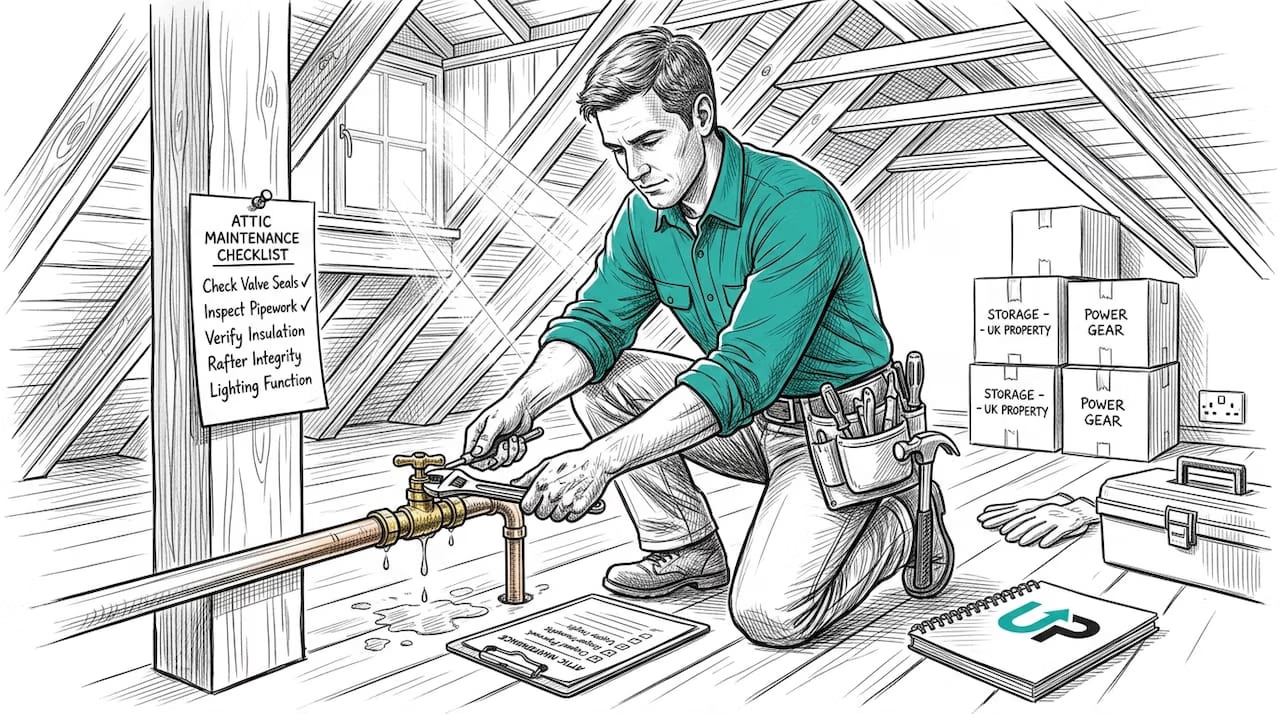
The cost case for preventive maintenance strategies is stronger than most invoicing systems reveal. Direct cost analyses underestimate true reactive maintenance expenses because they ignore unplanned downtime and cascading damage. A boiler replacement triggered by emergency call-out involves not just the part and the engineer, but overtime charges at 1.5 to 2 times standard rates, expedited delivery costs that can run 5 to 10 times higher than scheduled procurement, and secondary damage to adjacent plant or building fabric.
The table below compares the two approaches across the cost factors that matter most to a London commercial property manager in 2026.
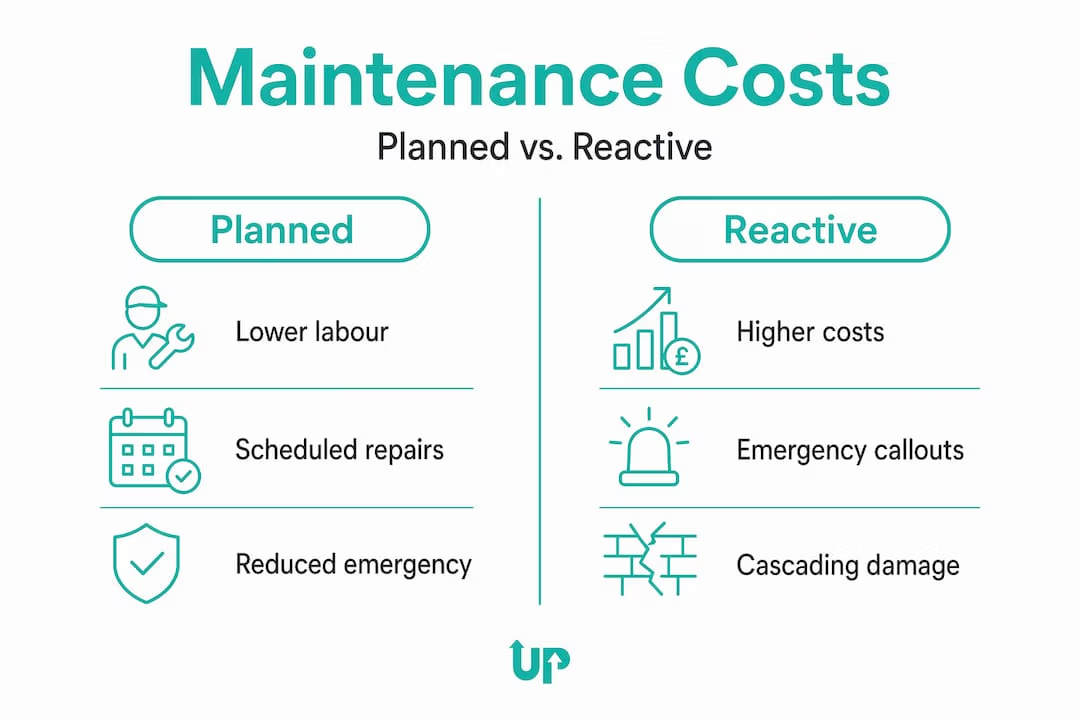
| Cost factor | Planned maintenance | Reactive maintenance |
|---|---|---|
| Labour rate | Standard agreed rate | Emergency rate: 1.5 to 2× standard |
| Parts procurement | Scheduled supply at trade price | Expedited delivery: 5 to 10× standard |
| Collateral damage risk | Low (intervenes before failure) | High (cascading failures common) |
| Unplanned downtime | Minimal (work scheduled off-peak) | Significant (unpredictable timing) |
| Asset lifespan impact | Extended through proactive care | Shortened by operating to failure |
| Compliance risk | Managed through audit trails | High (gaps in servicing records) |
Preventive maintenance programmes usually save money over reactive approaches once all direct and indirect costs are captured, and on a large commercial building that saving becomes a material budget line.
“The true cost of reactive maintenance is not what appears on the invoice. It is the tenant who leaves at lease renewal because of persistent disruption, the compliance gap that surfaces during a building audit, and the asset that fails years ahead of its expected service life.”: Facilities management industry perspective
Pro Tip: Ask your maintenance contractor to provide a spend analysis split by planned work and reactive call-outs. If reactive spend exceeds 30 to 40% of your total maintenance budget, you have a structural problem, not just bad luck.
Matching maintenance strategy to asset type
Knowing the difference between maintenance types is only half the picture. The other half is knowing which approach fits which asset. Not every item in a commercial building justifies a PPM schedule. The goal is to allocate your planned maintenance budget where failure would cause the most operational, financial, or compliance harm.
Consider a typical multi-tenanted office building in central London. The HVAC system serves dozens of occupants and its failure in summer will generate complaints and potential SLA breaches within hours. That asset belongs firmly in the planned maintenance column. The same building’s internal door handles, general lighting tubes, and toilet cistern components are low-criticality items where a run-to-failure approach is entirely sensible and cost-effective.
Here is a practical breakdown by asset category for London commercial properties:
- Critical systems requiring PPM: HVAC plant, commercial boilers, passenger lifts, fire suppression systems, emergency lighting, electrical distribution boards
- Medium-criticality assets (PPM plus reactive cover): Plumbing distribution lines, roof drainage systems, access control equipment, security systems
- Low-criticality assets suitable for reactive approach: Internal finishes, general lighting fittings, minor joinery, non-essential appliances
- Statutory compliance assets (PPM non-negotiable): Gas safety systems, legionella control, fixed wiring inspections, fire alarms
Tenant expectations add a layer of complexity for London property managers. Occupiers of Grade A offices expect zero-disruption servicing, which means planned access windows must be built into PPM contracts. Retail tenants in high-footfall locations are acutely sensitive to any shutdown that affects trading hours. Factoring tenant obligations into your asset criticality ranking is not optional; it directly affects your Service Level Agreement (SLA) commitments and your liability exposure.
The hybrid maintenance model
Hybrid maintenance approaches are the accepted standard in well-managed commercial portfolios. The idea is straightforward: apply planned preventative maintenance to your highest-criticality assets, and maintain a reactive capability for everything else. The benefit is cost control on your most expensive systems combined with the flexibility to handle unpredictable faults without being financially ambushed.
A practical model for London commercial portfolios is to put core systems such as HVAC, lifts, boilers and fire systems on planned maintenance contracts, and handle everything else reactively through one maintenance partner with agreed response times and fixed call-out rates.
Implementing a hybrid model successfully requires the following steps:
- Conduct an asset register audit. List every maintainable asset in your portfolio and assign a criticality rating based on operational impact, safety risk, and compliance obligation.
- Define your PPM scope. Identify which assets will be covered by scheduled maintenance contracts and set service frequencies aligned with manufacturer recommendations and statutory requirements.
- Negotiate reactive SLAs. For assets outside the PPM scope, agree response time tiers with your contractor. A category one fault (total failure affecting tenant operations) should carry a two to four hour response commitment.
- Establish record-keeping protocols. Every job, planned or reactive, should generate a digital record. This audit trail is your defence in disputes and your data source for future planning.
- Review quarterly. Use reactive call-out data to spot recurring faults on assets currently outside your PPM schedule. Three reactive calls on the same asset in twelve months is a signal to bring it into the planned programme.
Pro Tip: The most common reason hybrid models fail is that reactive call-outs consume the time and budget meant for scheduled PPM visits. Set a firm rule: planned maintenance appointments are not cancelled to accommodate reactive work unless there is a genuine safety emergency.
Transitioning from a reactive-led approach
Reactive maintenance still accounts for 49% of maintenance activities globally as of 2026, which tells you that most property managers are managing this challenge rather than having solved it. The transition to a predominantly planned approach is achievable, but it requires a structured plan rather than good intentions.
Start by calculating your Planned Maintenance Percentage (PMP). Divide the number of planned work orders completed in the last twelve months by the total number of work orders (planned plus reactive), then multiply by 100. If your PMP sits below 60%, you are in reactive-dominant territory. The target for a well-managed commercial portfolio is 85 to 90%.
Key steps for making the transition:
- Baseline your current spend. Separate planned and reactive costs for the past twelve months to understand the true scale of your reactive exposure.
- Prioritise by criticality. Bring your three to five highest-risk assets onto PPM schedules first. Early wins build organisational confidence and generate the data you need to justify further investment.
- Invest in a CMMS. Shifting maintenance culture requires digital record-keeping and planning systems. A Computerised Maintenance Management System (CMMS) gives you work order tracking, asset history, compliance documentation, and KPI reporting in one place.
- Set measurable KPIs. Track PMP percentage, mean time to repair (MTTR), reactive call-out frequency per asset, and PM compliance rate monthly. An automotive sector case study showed PM compliance rising from 29% to 94% and reactive work orders falling from 83% to 31% after CMMS implementation, principles directly applicable to property management.
- Budget for the transition period. During the first six to twelve months, you will likely carry both reactive costs and new PPM contract costs simultaneously. This is a short-term investment, not a sign the strategy is not working.
Pro Tip: A phased transition from reactive to planned delivers measurable cost savings at every stage. You do not need to wait until the entire portfolio is on a PPM schedule before you start seeing the financial benefit.
My perspective: why the reactive cycle is so hard to break
I have worked with enough London property managers to say with confidence that the reactive maintenance cycle is not primarily a knowledge problem. Most people in this industry understand that planned maintenance is more cost-effective. The problem is structural and cultural.
When your day is filled with emergency call-outs, tenant complaints, and contractor coordination, scheduled maintenance visits feel like a luxury you cannot afford. The PPM appointment gets pushed, the asset runs a little longer, and then it fails at the worst possible moment. That failure generates three days of reactive chaos, which pushes the next PPM visit, and the cycle repeats.
What I have seen work is a commitment to protecting planned maintenance appointments as if they were tenant meetings. The moment you allow reactive pressure to displace scheduled work, you are choosing to pay more later. Data transparency is the other critical ingredient. When property managers can see exactly how much their reactive spend costs in real terms compared to a planned equivalent, the investment in PPM contracts becomes an easy decision rather than a debated one.
The portfolios that make the transition successfully are the ones that treat the first twelve months as a data-gathering exercise, not an instant cost-saving exercise. The savings come. But only after the data is good enough to make the right decisions.
Eugen, Operations Manager, UpKeep UK
How UpKeep UK can help you take control
Managing the balance between planned and reactive maintenance across a London commercial portfolio is not simple, and the stakes are high. Tenants have expectations, compliance deadlines do not move, and budgets are under constant scrutiny.

Upkeep UK works with property managers, landlords, and estate agents across London to design maintenance programmes that actually fit their portfolios. Their planned maintenance programmes cover all critical building systems with documented service records and compliance sign-off. Alongside that, Upkeep UK provides 24/7 reactive maintenance cover with agreed response times for when the unexpected happens. For letting agencies managing multiple properties, understanding the red flags in property maintenance before they become emergencies is exactly the kind of support Upkeep UK is built to provide. Get in touch to discuss a package tailored to your portfolio.
FAQ
Is planned or reactive maintenance cheaper?
Planned maintenance is significantly cheaper when all costs are accounted for. Reactive repairs typically cost 3 to 5 times more per incident due to emergency labour rates, expedited parts, and secondary damage.
Can you have both planned and reactive maintenance?
Yes, and most well-managed portfolios do. A hybrid model applies planned preventative maintenance to high-criticality systems and uses reactive cover for lower-priority assets and genuinely unpredictable faults.
What is a PPM contract in property management?
A PPM (Planned Preventative Maintenance) contract is a formal agreement with a maintenance contractor to carry out scheduled servicing of specified building systems at agreed intervals, typically covering statutory compliance requirements alongside general upkeep.
How do I know if I rely too heavily on reactive maintenance?
Calculate your Planned Maintenance Percentage by dividing planned work orders by total work orders. A figure below 60% indicates a reactive-dominant approach. The industry target for commercial property is 85 to 90% planned work.
What assets in a commercial building most need planned maintenance?
Boilers, HVAC plant, passenger lifts, fire alarm systems, emergency lighting, and electrical distribution boards all carry high operational or compliance risk and should always be covered by a PPM schedule.