TL;DR:
- Property repairs in London include urgent and routine tasks to keep homes safe and compliant. Landlords must meet legal obligations under the Housing Act and Renters’ Rights Act, with penalties for non-compliance reaching up to £40,000. Proper documentation and verified contractors are vital for effective repair management and legal protection.
Property repairs in London range from urgent jobs such as a burst pipe at 2am to routine work such as clearing gutters before winter, and landlords must keep the structure, exterior and essential services in repair under Section 11 of the Landlord and Tenant Act 1985. Tenants have responsibilities too. This guide explains who fixes what, how to find a reliable contractor and how to stay compliant.
What legal responsibilities exist for property repairs in London?
Landlord repair obligations in England are defined primarily by Section 11 of the Landlord and Tenant Act 1985. This section applies to all tenancies under seven years and cannot be excluded from a tenancy agreement, regardless of what the contract says. It requires landlords to maintain the structure and exterior of the property, along with all installations for water, gas, electricity, sanitation, and heating.
The Renters’ Rights Act 2025 adds a further layer of accountability. Civil penalties under this legislation can reach £40,000 per offence for landlords who fail to meet mandatory standards, including the requirement to provide tenants with a formal Information Sheet. That figure represents a significant financial risk for any landlord who treats compliance as optional.
Local councils in London hold enforcement powers through the Housing Health and Safety Rating System (HHSRS). Where a property presents a serious hazard, councils can issue improvement notices or take emergency action directly. Tenants who feel their landlord is ignoring repair obligations can report the issue to their local authority and trigger a formal inspection.
Tenants also carry duties. You must report defects promptly and grant reasonable access for repair work to be carried out. Critically, Section 11 duties only activate once the landlord has received formal written notice. A phone call or verbal complaint does not meet the legal threshold. This distinction matters enormously if a dispute ever reaches a tribunal.
Key landlord obligations under Section 11 include:
- Maintaining the roof, walls, windows, and external doors
- Keeping heating and hot water systems in working order
- Ensuring gas, electrical, and sanitation installations are safe
- Repairing any damage caused by carrying out the above works
Pro Tip: Always send repair notifications by email or recorded post. This creates a timestamped record that satisfies the written notice requirement under Section 11 and protects you if the matter escalates.
How can you find and verify trustworthy contractors in London?
Selecting the right tradesperson is where many homeowners and tenants make costly mistakes. The most common error is choosing based on price alone. Industry guidance is clear: trading history, accreditations, insurance, and willingness to communicate openly are the factors that separate reliable professionals from those who disappear after taking a deposit.
Public liability insurance is non-negotiable. Reputable tradespeople carry a minimum of £2 million in public liability cover. This protects you from financial liability if a contractor causes damage to your property or injures someone during the work. Always ask to see the certificate before work begins.
Certification bodies provide an additional layer of assurance. Gas engineers must be registered with Gas Safe. Electricians should hold NICEIC or NAPIT membership. These are not optional extras. They are the baseline standard for safe, compliant work on London properties.
Follow these steps when vetting any contractor:
- Ask for proof of public liability insurance with at least £2 million cover before any work is agreed.
- Verify trade certifications directly with the relevant body. Gas Safe registrations can be checked online at gassaferegister.co.uk.
- Request at least three written quotes for any job above a minor repair. Written estimates create accountability and allow fair comparison.
- Check trading history and reviews through recognised directories or accredited trade bodies rather than relying solely on a contractor’s own testimonials.
- Confirm the scope of work in writing before signing anything, including timescales, materials, and what happens if additional problems are found.
Choosing certified contractors also reduces the risk of poor workmanship that leads to repeat repairs and further expense. A contractor who resists putting things in writing is a contractor worth avoiding.
Pro Tip: Search for contractors through government-backed schemes such as TrustMark or the Which? Trusted Traders directory. These programmes require members to pass independent assessments, giving you a baseline of confidence before you even make contact.
What are the most common urgent and routine repairs London properties need?
London’s housing stock presents specific challenges. Victorian and Edwardian terraces, purpose-built flats, and converted properties each carry their own maintenance demands. Understanding the difference between urgent and routine repairs helps you prioritise correctly and avoid the compounding costs that come from delayed action.
Urgent repairs include gas leaks, boiler breakdowns, severe roof leaks, and total loss of heating or hot water. These require a response within 24 hours. Leaving them unaddressed creates immediate safety risks and, for tenants, triggers the landlord’s legal duty to act without delay.
Routine maintenance covers tasks that are less dramatic but equally important over time:
- Gutter clearing, typically needed twice a year in London due to leaf fall and urban debris
- External repainting to protect brickwork and timber from moisture ingress
- Minor plumbing fixes such as dripping taps, slow drains, and toilet cistern repairs
- Checking and testing smoke and carbon monoxide alarms
- Inspecting roof tiles and flashings after periods of high wind
| Repair type | Urgency level | Typical response time |
|---|---|---|
| Gas leak | Emergency | Within 24 hours |
| Boiler breakdown (winter) | Emergency | Within 24 hours |
| Severe roof leak | Urgent | Within 2 to 3 days |
| Electrical fault | Urgent | Within 2 to 3 days |
| Broken window (ground floor) | Serious | Within a week |
| Gutter clearing | Routine | Within a few weeks |
| External repainting | Routine | Planned schedule |
Reasonable repair timescales depend on severity. Emergencies require a response within 24 hours, serious hazards within days, and routine work within a few weeks. These timescales are not arbitrary. They reflect the legal standard of what a court would consider reasonable if a dispute arose.
Delaying urgent repairs compounds the damage. A slow roof leak ignored for a month can saturate insulation, rot joists, and trigger a mould problem that costs ten times more to fix than the original leak. Proactive maintenance is always cheaper than reactive repair.
What practical steps should you take to manage repairs effectively?
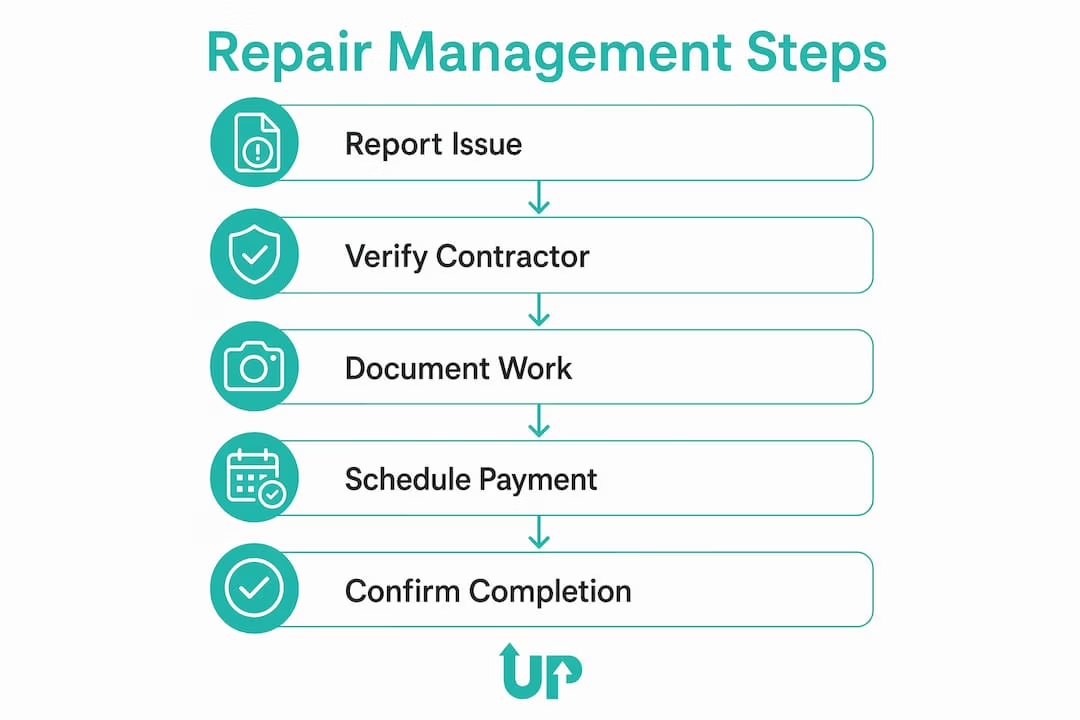
Effective repair management starts before a problem becomes serious. The difference between a resolved repair and a protracted dispute often comes down to how well you documented the issue from the start.
- Report in writing immediately. Send an email or letter the moment you identify a defect. Include the date, a description of the problem, and any photographs. This satisfies the written notice requirement and starts the legal clock.
- Photograph everything. Take dated photographs of the defect when you first notice it and at regular intervals if it worsens. Detailed records of repair requests and photographic evidence form the audit trail that holds landlords accountable.
- Set clear expectations on timescales. Reference the urgency level when reporting. If your boiler has failed in january, state clearly that this is an emergency requiring a 24-hour response.
- Keep copies of all quotes and contracts. Store written estimates, signed agreements, and completion confirmations in a single folder. Digital copies backed up to cloud storage are the most reliable method.
- Escalate formally if repairs stall. If a landlord fails to act within a reasonable period, contact your local council’s housing team and request an HHSRS inspection. Councils hold enforcement powers and can compel action.
- Consider mediation before litigation. If a dispute arises over the quality or scope of completed work, a mediation service can resolve the matter faster and at lower cost than a tribunal.
Maintaining thorough documentation is the single most effective protection available to tenants. It removes ambiguity, establishes timelines, and gives you a clear basis for any formal complaint or legal action.
For homeowners managing their own contractors, the same principles apply. Written contracts, staged payments tied to completion milestones, and independent sign-off on finished work all reduce the risk of disputes. Common landlord mistakes in London often stem from informal arrangements that leave no paper trail when things go wrong.
Key takeaways
Effective property repair management in London requires written communication, verified contractors, and a clear understanding of legal obligations under the Landlord and Tenant Act 1985 and the Renters’ Rights Act 2025.
| Point | Details |
|---|---|
| Written notice is legally required | Section 11 duties only activate once the landlord receives formal written notice of a defect. |
| Insurance and credentials are non-negotiable | Always verify public liability insurance (minimum £2 million) and trade certifications before work begins. |
| Urgency determines response time | Emergencies require a 24-hour response; routine repairs are reasonable within a few weeks. |
| Documentation protects you | Photographs, written reports, and signed contracts form the audit trail for any dispute. |
| Non-compliance carries serious penalties | Civil penalties under the Renters’ Rights Act 2025 can reach £40,000 per offence for landlords. |
What I’ve learned from years of watching London property repairs go wrong
After working closely with London property owners and tradespeople for many years, the pattern I see most often is not negligence. It is a lack of structure. Landlords who genuinely intend to fix things still end up in tribunal because they responded verbally, used an uninsured contractor, or failed to keep a record of what was agreed.
The legal framework around home repair services London is more demanding than most people realise. The Renters’ Rights Act 2025 has raised the stakes considerably. A £40,000 penalty is not a theoretical risk. It is a real outcome for landlords who treat compliance as an afterthought.
What I find most underestimated is the value of using accredited professionals. Tenants often assume any tradesperson will do for a minor repair. Homeowners sometimes use a neighbour’s recommendation without checking credentials. Both approaches carry risk that a single insurance claim or failed inspection makes very expensive.
The proactive approach to property maintenance London consistently outperforms the reactive one. Spending a modest amount on annual inspections and planned maintenance prevents the kind of emergency that disrupts tenants, triggers enforcement action, and costs multiples of what prevention would have cost. The best contractors I have seen work in London are those who communicate clearly, document everything, and treat each job as if their reputation depends on it. Because it does.
Eugen, Operations Manager, UpKeep UK
Upkeep UK: professional property repairs across London

Upkeep UK provides professional property maintenance services across London for residential and commercial clients, with a team of certified tradespeople covering electrical, plumbing, roofing, and structural repairs. Every contractor is fully insured and accredited, meeting the standards outlined throughout this article. For landlords managing compliance under the Renters’ Rights Act 2025, Upkeep UK offers structured maintenance programmes that reduce the risk of enforcement action. For homeowners and tenants facing urgent situations, emergency repair services are available with fast response times across all London boroughs. Contact Upkeep UK for a clear, written quote with no obligation.
FAQ
What does Section 11 of the Landlord and Tenant Act 1985 cover?
Section 11 requires landlords to repair the structure, exterior, and all gas, electrical, water, sanitation, and heating installations in properties let on tenancies under seven years. It cannot be excluded from any tenancy agreement.
How quickly must a landlord respond to an emergency repair in London?
Emergency repairs such as gas leaks and boiler failures require a response within 24 hours. Serious hazards should be addressed within days, and routine repairs within a few weeks, in line with the legal standard of reasonableness.
What insurance should a contractor have before starting repair work?
Any reputable contractor should carry public liability insurance with a minimum of £2 million cover. This protects you from financial liability if the contractor causes damage or injury during the work.
What can a tenant do if a landlord refuses to carry out repairs?
Tenants should first report the defect in writing to establish formal notice. If the landlord fails to act within a reasonable time, the tenant can contact the local council to request an HHSRS inspection, which can result in enforcement action against the landlord.
Are affordable home repairs possible without compromising on quality?
Affordable home repairs are achievable by obtaining at least three written quotes, checking contractor credentials, and using accredited trade directories. Price should never be the sole deciding factor. Verified credentials and clear contracts protect against costly rework.