Block management maintenance is the upkeep, safety compliance and financial administration of a block’s shared parts. For landlords and freeholders it means meeting the lease repair covenants, running statutory checks on fire safety, lifts, gas, electrics and water, consulting leaseholders under Section 20 before major works, demanding service charges correctly and building a reserve fund for big repairs.
This guide focuses on the legal and financial side: the duties that apply, how service charges and reserve funds should work, lift and security system upkeep, and the practical habits that keep a block compliant. For the day-to-day maintenance calendar, see our block maintenance London guide, or our block management maintenance service if you need a contractor.
Property managers and landlords running residential blocks face a more demanding regulatory environment than ever. The Building Safety Act 2022, the Fire Safety (England) Regulations 2022, the Landlord and Tenant Act 1985 and the leasehold reforms now being phased in all carry real consequences when ignored. Getting this right is the difference between a well-run block and a liability.
What are the key legal requirements for block management maintenance?
Legal compliance is the foundation of every well-managed residential block. Property managers who treat regulation as a checklist rather than a framework tend to find themselves exposed when things go wrong.
The Building Safety Act 2022 reshaped accountability across the sector. Since 1 October 2023, every Responsible Person must record their fire risk assessment in full and share fire safety information with residents. In higher-risk buildings (at least 18 metres or seven storeys with two or more homes), the Accountable Person must register the building, manage building safety risks and keep the “golden thread” of building safety information up to date. In any block over 11 metres, communal fire doors must be checked at least every three months and flat entrance doors annually.
Repair duties depend on the type of occupation. For long leaseholders, the landlord’s repairing obligations come from the lease covenants, which usually cover the structure, exterior, roof and common parts. For tenancies of under seven years (such as flats in the block let on assured shorthold tenancies), section 11 of the Landlord and Tenant Act 1985 also implies a duty to keep the structure, exterior and installations for water, gas, electricity, heating and sanitation in repair, which can’t be contracted out of. Disrepair claims most often involve leaks, drainage, gutters and heating failures.
The Fire Safety (Residential Evacuation Plans) (England) Regulations 2025 add a further layer for taller buildings. Since 6 April 2026, in blocks at least 18 metres or seven storeys tall, and in blocks over 11 metres with a simultaneous evacuation strategy, the Responsible Person must offer residents who may need help to evacuate a person-centred assessment and an evacuation plan, and share minimal information with the fire service with consent.
Key compliance obligations for block managers in 2026:
- Fire risk assessment recorded in full and reviewed regularly
- Quarterly communal fire door checks and annual flat entrance door checks in blocks over 11 metres
- Lift thorough examinations at least every six months (LOLER) and regular servicing
- Gas safety checks for communal plant and an EICR for the landlord’s supply at least every five years
- Legionella risk assessment where there are communal water systems
- Asbestos management survey and register for common parts built before 2000
- Section 20 consultation before qualifying works or long-term agreements
- Building registration and golden thread records for higher-risk buildings
Pro Tip: Keep a single compliance calendar that maps every statutory deadline, from fire door checks to service charge demands, against the date costs are incurred rather than the invoice date. This one habit prevents the most common legal breaches.
How should service charges and reserve funds be managed?
Service charges fund the day-to-day running of a residential block. They cover routine maintenance, communal cleaning, building insurance, and statutory safety checks. Managing them poorly is the fastest route to leaseholder disputes and tribunal proceedings.
Budgets should be itemised, reasonable and transparent, in line with the RICS Service Charge Residential Management Code, and capable of withstanding scrutiny at the First-tier Tribunal. The Leasehold and Freehold Reform Act 2024 will bring in further service charge transparency rules, such as standardised demands and annual reports, as it is brought into force. Service charge disputes are the leading cause of leaseholder dissatisfaction, and clear billing is the best defence.
One rule that catches many managing agents out is the 18-month rule in section 20B of the Landlord and Tenant Act 1985. Costs must be demanded within 18 months of being incurred, unless leaseholders were notified in writing within that period that the costs had been incurred and they would be asked to contribute. Late demands can make costs unrecoverable, so track every cost from the date it was incurred, not the date it was paid.
Reserve funds, sometimes called sinking funds, serve a different but equally critical purpose. Reserve funds allow better scheduling and budgeting for major capital works such as roof replacements, lift overhauls, and external redecoration. Without a properly funded reserve, leaseholders face sudden, large demands that damage trust and can trigger legal challenges.
A structured approach to financial management involves four steps:
- Set an annual service charge budget itemised by cost category, following the RICS Code.
- Maintain a separate reserve fund account, with contributions calculated against a long-term maintenance plan.
- Issue demands on time, tracking every cost from the date it was incurred to stay within the 18-month rule.
- Publish annual accounts with clear disclosure of insurance commissions and any agent fees.
Pro Tip: Disclose any insurance commission or fees earned by the managing agent in writing. Transparency here is one of the easiest ways to avoid disputes, and new leasehold rules are tightening it further.
What are best practices for proactive and reactive maintenance?
Planned maintenance and reactive maintenance serve different functions, and the best-run blocks use both deliberately. Planned, or preventive, maintenance follows a schedule: annual boiler services, gutter clears in autumn, lift inspections, and external condition surveys. Reactive maintenance responds to failures as they occur, from a burst pipe to a broken entry system. The goal is to make reactive work the exception, not the rule.
Condition surveys are the starting point for any credible maintenance plan. A survey carried out every three to five years gives property managers a clear picture of the building’s condition and helps prioritise capital expenditure. Maintenance logs, updated after every visit, create the audit trail that protects managers in the event of a dispute or insurance claim. You can find a practical starting point in a landlord maintenance checklist that covers the most common inspection points for residential blocks.
Contractor management is where many property managers lose control of costs and quality. Approved contractor lists, with agreed rates and response time commitments, remove the guesswork from reactive situations. A written scope of works for every job, however small, creates accountability and prevents scope creep. Resident communication matters equally. Keeping residents informed about planned works, expected timescales, and any disruption reduces complaints and builds trust.
Best practices for managing block maintenance effectively:
- Carry out condition surveys every three to five years and act on findings within a defined timeframe.
- Maintain a maintenance log updated after every contractor visit, inspection, or repair.
- Use an approved contractor list with agreed rates and response time commitments.
- Communicate planned works to residents at least two weeks in advance wherever possible.
- Review planned versus reactive maintenance ratios quarterly to identify recurring failures.
- Track all repair requests from receipt to completion to demonstrate responsiveness.
Pro Tip: The ratio of planned to reactive maintenance is a reliable indicator of block management quality. A block where reactive jobs consistently outnumber planned ones is a block where costs are rising and resident satisfaction is falling.
Lift and security system maintenance in blocks
Lift maintenance
Passenger lifts in blocks must have a thorough examination by a competent person at least every six months under the Lifting Operations and Lifting Equipment Regulations 1998 (LOLER), separate from routine servicing under the maintenance contract. Keep the reports, act on defects within the timescales given, and agree response times for breakdowns and trapped-person call-outs. Lift failures hit elderly and disabled residents hardest, so they should be treated as urgent.
Security systems and door entry
Door entry systems, access control, communal lighting and CCTV all need regular checks and quick repairs, because a failed entrance door or entry panel leaves the whole building insecure. Include them in the planned maintenance calendar, keep spare fobs and parts, and make sure CCTV use complies with UK GDPR, with signage and a clear policy on who can view footage. Our reactive maintenance team can attend lock, door and entry failures the same day.
How is technology transforming block management maintenance?
Digital tools are changing how property managers plan, record, and communicate maintenance activity. Cloud-based property management platforms give managers real-time access to maintenance schedules, contractor records, and compliance documents from any device. This matters particularly for managers overseeing multiple blocks across different locations.
Predictive maintenance uses data from equipment, such as lift monitoring, boiler controls and water sensors, to flag problems before they cause a breakdown. It is most useful for larger blocks with complex plant, but even simple steps, like tracking repeat faults by location, help managers spot recurring failures early. You can read more about how maintenance practices are changing.
Digital communication tools improve resident engagement and reduce the volume of informal complaints. Automated notifications for planned works, urgent safety alerts, and document sharing through resident portals all reduce the administrative burden on managing agents. Cybersecurity and staff training are the two considerations most often overlooked when adopting new platforms. Any system holding resident data or financial records must meet UK GDPR requirements, and staff must be trained to use it correctly.
Key technology applications in block management:
- Cloud-based platforms for real-time scheduling, compliance tracking, and document storage
- Predictive maintenance to reduce emergency repairs and optimise budgets
- Resident portals for maintenance requests, planned works notifications, and document access
- Digital inspection tools that feed into compliance records, including the golden thread for higher-risk buildings
Key takeaways
Effective block management maintenance requires legal compliance, transparent financial administration, and a planned approach to upkeep that treats reactive work as the exception rather than the standard.
| Point | Details |
|---|---|
| Legal compliance is non-negotiable | Lease repair covenants, the Building Safety Act 2022 and fire safety rules all carry direct legal exposure. |
| The 18-month rule protects revenue | Costs must be demanded within 18 months of being incurred, unless leaseholders were notified in time. |
| Reserve funds prevent leaseholder disputes | A funded sinking fund allows major works to be scheduled and budgeted without sudden large demands. |
| Planned maintenance reduces costs | Condition surveys and scheduled works consistently lower reactive call-out rates and overall expenditure. |
| Technology reduces risk and improves communication | Digital records, resident portals and equipment monitoring reduce emergency repairs and complaints. |
What I have learned from years of block management
The most persistent mistake I see in block management is treating compliance and maintenance as separate disciplines. They are not. A fire door that fails its quarterly inspection is both a safety failure and a legal record failure. The Golden Thread exists precisely because these two things must be managed together.
Financial transparency is where trust is won or lost with leaseholders. I have seen well-maintained blocks lose the confidence of their residents entirely because service charge demands arrived late, were poorly itemised or included undisclosed commissions. Clear, early, itemised demands avoid most of that.
Technology helps, but it isn’t a substitute for professional judgement. The best block managers I know use digital tools to free up time for the site visits and resident conversations that no platform can replace.
Building safety responsibilities will only grow more demanding. The Accountable Person framework under the Building Safety Act 2022 places individual accountability at the centre of block management in a way that was not true five years ago. That is the right direction. It means the days of managing a block at arm’s length, through a chain of subcontractors with no clear ownership, are over.
Drahim Hasula, Founder & CEO, UpKeep UK
How UpKeep UK supports landlords with block maintenance
UpKeep UK provides block management maintenance across London for freeholders, managing agents, RMCs and RTM companies. We run planned maintenance calendars for communal areas and building services, carry out responsive repairs on agreed response times, and offer 24/7 emergency repairs with a 1-3 hour response.
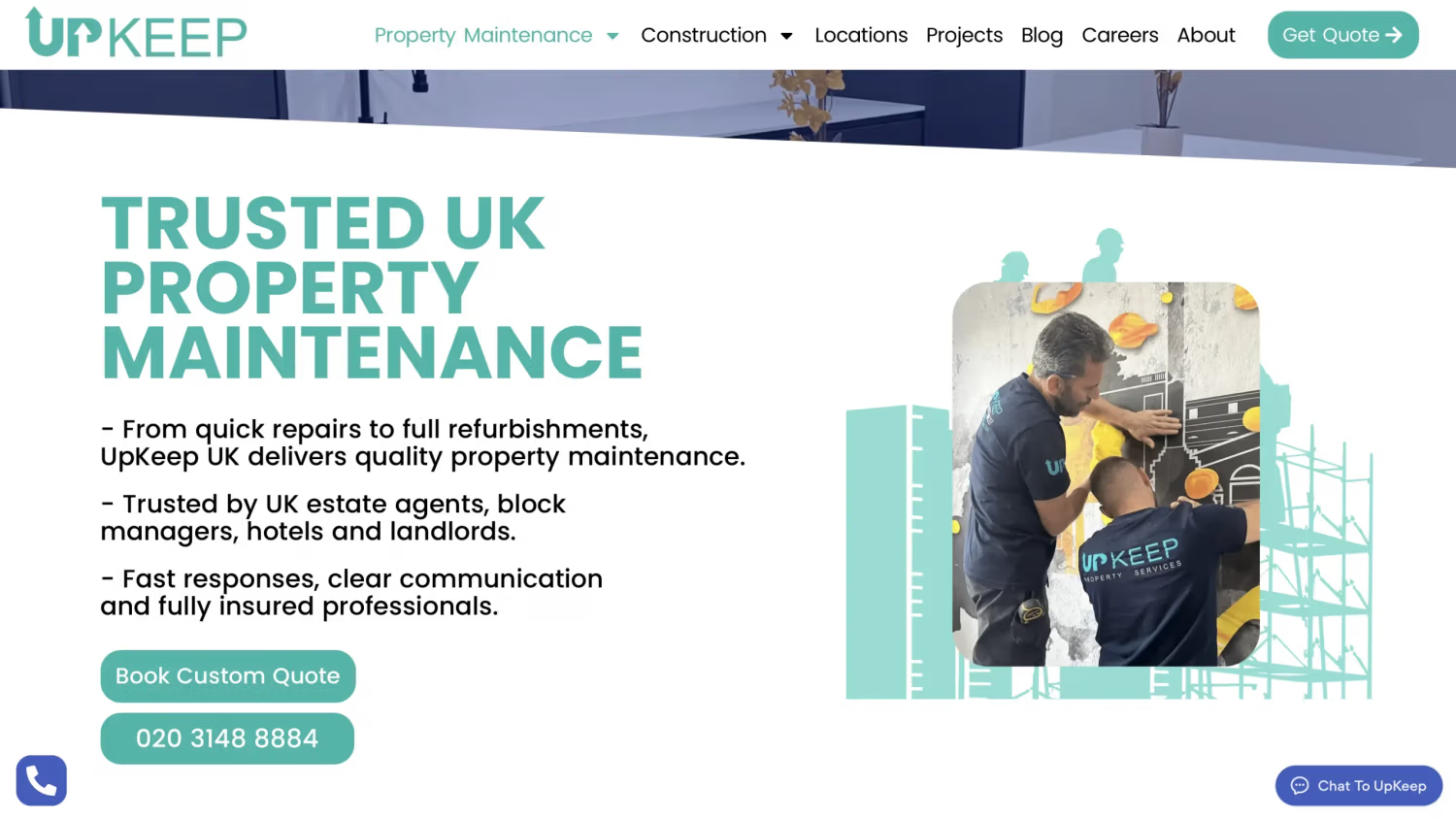
Every job comes with photo-evidenced reporting to support your compliance records and service charge accounts. We are Gas Safe registered, NAPIT approved, TrustMark endorsed and members of the Federation of Master Builders, with SafeContractor and SSIP accreditation, and we work to fixed-price quotes. Call 020 3148 8884 or request a quote to discuss your block.
Frequently asked questions
What does block management maintenance include?
Block management maintenance covers the upkeep of all communal areas and shared systems in a residential block, including structure, roofing, lifts, fire safety equipment, heating, and external spaces. It also includes compliance with statutory obligations such as fire risk assessments and, in higher-risk buildings, the golden thread record under the Building Safety Act 2022.
What are a landlord’s repair obligations under Section 11?
Section 11 requires landlords to keep the structure, exterior and installations for water, gas, electricity, heating and sanitation in repair, but it only applies to tenancies of under seven years. Long leaseholders in a block rely on the repair covenants in their lease instead.
How does the 18-month service charge rule work?
Under section 20B of the Landlord and Tenant Act 1985, service charge costs must be demanded within 18 months of being incurred. If that isn’t possible, the landlord must notify leaseholders in writing within the 18 months that the costs have been incurred and will be charged later; otherwise the costs may be unrecoverable.
What is a reserve fund in block management?
A reserve fund, also called a sinking fund, is a separate account into which leaseholders contribute regularly to fund future major capital works such as roof replacements or lift refurbishments. It prevents the need for sudden large demands and supports long-term financial planning.
When do the Fire Safety (Residential Evacuation Plans) Regulations 2025 apply?
They came into force on 6 April 2026 and apply to residential buildings at least 18 metres or seven storeys tall, and to buildings over 11 metres with a simultaneous evacuation strategy. Residents who may need help to evacuate must be offered an assessment and an evacuation plan.
How often do lifts in a block of flats need inspecting?
Passenger lifts need a thorough examination by a competent person at least every six months under LOLER, in addition to regular servicing under the maintenance contract.